
News

Who are the Iranian Sanctions Violators Pardoned on Implementation Day?

On January 17, 2016 – the day after implementation of the nuclear deal with Iran – President Barack Obama announced the details of another agreement with Iran: four Americans who had been detained in Iran were released, and, in exchange, clemency was granted to six Iranian-Americans and one Iranian serving sentences or awaiting trial in the United States.

President Obama said that the Americans, including Washington Post journalist Jason Rezaian, had been “unjustly detained by Iran,” and called the exchange “a one-time gesture to Iran given the unique opportunity offered by this moment and the larger circumstances at play.”[1] Federal prosecutors, in a subsequent court filing in one of the cases, echoed the President’s language, stating that the deal was “a one-time, unique agreement based on extraordinary circumstances.”[2]

In his statement, the President emphasized that the individuals granted clemency in the United States “were not charged with terrorism or violent offenses.” Indeed, all but one case related to violations of U.S. export control laws and sanctions on Iran. As part of the exchange, the United States also agreed to drop charges and remove Interpol arrest notices (“red notices”) against fourteen Iranians who had been fugitives from prosecution in the United States and whom the U.S. government had not been able to locate or extradite. These fourteen Iranians were all facing charges related to sanctions violations.

In their February 1 court filing, prosecutors explained that the President’s actions would not “in any way impact how the Department of Justice prosecutes future cases involving citizens of Iran or any other country who violate the domestic laws of the United States. This includes individuals who violate the United States trade embargo on Iran, which remains in place with the exception of a few activities that will be licensed by the United States Department of Treasury.”[3]

The U.S. government’s statements notwithstanding, observers have raised concerns about the potential precedent set by the exchange. David Locke Hall, a former federal prosecutor who worked on cases involving illicit Iranian procurement, argued in the Wall Street Journal that the deal “diminishes any deterrent effect [the pardoned men’s] arrests and convictions may have had. It also erases years of hard work by investigators and prosecutors.”[4] Mr. Hall also wrote that “the administration’s actions send a clear signal to federal agents and prosecutors that their labors produce nothing more than political capital, to be traded away when it is politically expedient.” As a result, he warned, future prosecutions of export-enforcement cases—which “are always difficult and labor intensive”–may be less likely.

The export violations committed, or allegedly committed, by the individuals granted clemency as part of this exchange are described below.

Bahram Mechanic: A dual U.S. and Iranian citizen who allegedly was involved in a procurement network that supplied U.S.-origin microelectronics, including items with applications in surface-to-air and cruise missiles, to end users in Iran. Mechanic was the majority owner and Chairman of the Board of Faratel Co., located in Iran, and the majority owner of its sister company, Smart Power Systems Inc., located in Houston, Texas. According to the indictment, Mechanic placed order requests for the sensitive electronics with Arthur Shyu and his company, Hosoda Taiwan, who then procured the items and shipped them either directly to Iran or through Turkey via Golsad Istanbul Trading. The end user in this network was allegedly Faratel, which designs and produces uninterruptible power supplies, including for the Ministry of Defense, Atomic Energy Organization of Iran, and Iranian Centrifuge Technology Company. Mechanic was indicted on 22 counts related to sanctions violations and money laundering in 2015. He had pleaded not guilty and had been held in a Houston jail awaiting trial.

Tooraj “Roger” Faridi: A dual U.S. and Iranian citizen who was a co-defendant in the Mechanic case. He was a vice president of operations at Smart Power Systems and an engineer at Faratel. Prosecutors alleged that Faridi assisted Mechanic by processing orders from Faratel, organizing the procurement network, and procuring and shipping export-controlled items to Faratel in Iran. Faridi also allegedly directly shipped controlled items from Smart Power Systems in the United States to Faratel in Iran. He was indicted in 2015 on three charges related to sanctions violations. Faridi had pleaded not guilty and was free on bail awaiting trial.

Khosrow Afghahi: A dual U.S. and Iranian citizen who was also a co-defendant in the Mechanic case. He was the managing director and part owner of Faratel and the minority owner of its sister company, Smart Power Systems. Afghahi also assisted Mechanic in operating the procurement network. In 2015, Afghahi was indicted on four criminal charges related to sanctions violations and money laundering. He had pleaded not guilty and had been held in a Houston jail awaiting trial.

Nader Modanlo: A dual U.S. and Iranian citizen who was convicted in 2013 of conspiracy to defraud the United States, violating the Iran Trade Embargo, and money laundering. Between January 2000 and November 2007, he conspired to supply Iran with satellite technology and hardware. He facilitated contact with POLYOT, a Russian government-owned aerospace enterprise, which led to the launch of an Iranian satellite from Russia on October 27, 2005. He had served as chairman and managing member of New York Satellite Industries, LLC, which received $10 million from a front company, Prospect Telecom, as consideration for facilitating the agreement between Iran and POLYOT, as well as for providing telecommunications services as part of that agreement. Modanlo was released from a federal prison in Virginia on January 17, 2016, where he had been serving an eight-year prison sentence.

Ali Saboonchi: An Iranian-American who was convicted in 2014 of attempting to export industrial parts to end-users in Iran via transshipment through the United Arab Emirates or China. He was the founder and operator of Ace Electric Company in Maryland and was charged with being part of a procurement network that sought industrial parts and components for Iranian customers. He was convicted on eight criminal counts related to sanctions violations in 2014 and was serving a two-year sentence in a federal prison in Virginia. He was released on January 17, 2016.

Arah Ghahreman: An Iranian-American who was convicted in 2015 of trying to acquire U.S.-made navigation equipment for end-users in Iran. Prosecutors argued that Ghahreman acted as the procurement network’s agent in the United States and sought to acquire the U.S.-origin goods for illegal export. He had been serving a 78-month sentence before his release in January 2016.

Nima Golestaneh: An Iranian national who pleaded guilty in 2015 to charges related to his involvement in the October 2012 hacking of a Vermont-based defense contractor. He was arrested in Turkey in 2013 and extradited to the United States in 2015. According to his plea agreement, Golestaneh was part of a conspiracy to hack the computer network of Arrow Tech Associates Inc. in Vermont in order to steal information. Golestaneh admitted that he acquired servers in other countries in order for his co-conspirators to launch the attacks while masking their identity and location. He had been held in a New York jail awaiting sentencing before he was freed.

The export violations allegedly committed by the individuals located outside the United States against whom charges were dismissed are described below.

Alireza Moazami Goudarzi: An Iranian citizen who allegedly attempted to export military and civilian aircraft parts from the United States to Iran. According to prosecutors, these included parts for an attack helicopter and for military aircraft. In 2012, Goudarzi was charged with six criminal counts in the United States related to sanctions violations and money laundering. He was arrested in Kuala Lumpur, Malaysia by Malaysian authorities, pursuant to a provisional arrest warrant, but was subsequently released from custody. The United States has since not been able to locate Goudarzi. On January 19, 2016, prosecutors filed a request to dismiss all charges against Goudarzi. The judge in the case asked that prosecutors explain the “significant foreign policy interests” that justify dropping charges. Prosecutors submitted this explanation on February 1, 2016, and the case is still pending.

Matin Sadeghi: A Turkish national who was a co-defendant in the Mechanic case. He operated Golsad Istanbul Trading Ltd., a shipping company located in Istanbul, Turkey that allegedly served as the transshipment point for dual-use U.S.-origin electronics exported illegally to Iran. Sadeghi allegedly acted as a “cut out” for Mechanic’s procurement network, allegedly received shipments from Arthur Shyu in Taiwan and sending them to Faratel in Iran. In 2015, Sadeghi was charged with six criminal counts related to sanctions violations. The charges against him were dropped on January 19, 2016.

Seyed Abolfazi Shahab Jamili: An Iranian citizen who allegedly operated an import-export business in Iran that procured nuclear-related equipment via China. Jamili was the operator of Nicaro Eng. Co., Ltd., a Tehran-based company used to ship parts into Iran. U.S. prosecutors alleged that between 2005 and 2012, Jamili purchased thousands of Chinese manufactured parts with nuclear applications from Sihai Cheng, a Chinese national. The end-user of these parts was allegedly Eyvaz Technic Manufacturing Company, an Iranian company that remains blacklisted by the United States and the European Union. Jamili also allegedly conspired with Cheng to obtain U.S.-made pressure transducers—equipment that can be used in gas centrifuges for uranium enrichment. Jamili was charged with ten criminal counts in 2013. All charges were dropped on February 3, 2016.

Koorush Taherkhani: An Iranian citizen who allegedly used his Dubai-based firm, Tig Marine Engineering Services, as a front company to acquire U.S.-made navigation equipment for end-users in Iran. In 2013, Taherkhani, along with his company and two other employees of Tig Marine, were charged with nine criminal counts related to Iran sanctions violations and money laundering. The charges against Taherkhani and Tig Marine were dropped on January 21, 2016. This was the same case involving Arah Ghahreman, whose sentence was commuted by President Obama.

Jalal Salami: A dual U.S. and Iranian citizen and owner of Pastek Solutions, a company located in San Marcos, California. He is alleged to have been involved in a conspiracy to procure electronic components from the United States for end-users in Iran through transshipment in Malaysia. In 2011, Salami was charged with 29 criminal counts related to the alleged conspiracy. The charges against Salami were dropped on January 15, 2016.

Sajad Farhadi and SeyedAhmad Abtahi: Farhadi and Abtahi are both Iranian citizens who were allegedly involved in the same conspiracy as Salami. They both worked for SunSem Sdn, Bhd., a company located in Kuala Lumpur, Malaysia, which allegedly served as the transshipment point for U.S.-origin electronic components en route for Iran. Farhadi oversaw the daily operations of SunSem in Malaysia, while Abtahi helped managed SunSem operations from Iran and allegedly identified the specific electronic components to be purchased from U.S. companies. They both faced 13 criminal counts. The charges against Farhadi and Abtahi were dropped on January 15, 2016.

Amin Ravan: An Iranian citizen alleged to have smuggled military antennas from the United States to Hong Kong and Singapore. In 2011, Ravan and his Iran-based company IC Market Iran were charged with three criminal counts. According to the indictment, Ravan worked with Singapore-based Corezing International in order to acquire the antennas and disguise their intended destination in Iran. Ravan was arrested in Malaysia in 2012 and U.S. authorities had sought his extradition. The charges against Ravan were dropped on January 26, 2016.

Behrouz Dolatzadeh: An Iranian citizen who allegedly conspired to purchase U.S.-made assault rifles and import them into Iran. Dolatzadeh was charged with two criminal counts in 2012. According to the indictment, Dolatzadeh, who was working for Tehran Fanavar International Group, agreed to purchase thousands of assault rifles, via transshipment through Syria, from a federal agent posing as a sales representative in January 2011. Between October 2011 and January 2012, he also sought to purchase additional assault rifles via the Czech Republic. According to Reuters, Dolatzadeh was appointed to the boards of three technology companies linked to a conglomerate, Setad Ejaiye Farmane Hazrate Emam, which is controlled by Iran’s Supreme Leader. Dolatzadeh was reportedly indicted in 1995, in a separate case involving the attempted export of U.S.-made radio equipment to Iran.[5] He was initially convicted in a Czech court on local charges of arms smuggling and sanctions violations but was freed after a Czech appeals court overturned the conviction, ruling that the case had been entrapment. The U.S. charges against him were dropped on February 1, 2016.

Hamid Arabnejad, Gholamreza Mahmoudi, and Ali Moattar: Three Iranian citizens who held positions at Mahan Air and were alleged to have conspired to import U.S.-made Boeing aircraft into Iran on behalf of their company. Arabnejad (managing director), Mahmoudi (vice president of business development), and Moattar (consultant to the managing director) were charged along with Mahan Air with two criminal counts in 2014. According to the indictment, the three Mahan Air officials used a front company to obtain three Boeing airplanes on behalf of Mahan Air through a leasing arrangement. Mahan Air also sought to obtain three additional Boeing planes using a similar arrangement with an airline in Iceland. The charges against the three were dropped on January 20, 2016.

Mohammed A. Sharbaf (aka Mohammad Ali She’rbaf): An Iranian citizen alleged to have conspired to procure U.S.-origin forklift parts in violation of U.S. sanctions. Sharbaf was charged with six criminal counts in 2005. According to the indictment, Sharbaf, president and managing director of Sepahan Lifter Company—a forklift company based in Esfahan, Iran—sought to import forklift parts from the United States via Dubai-based Sharp Line Trading, owned by Khalid Mahmood. The charges were against Sharbaf were dropped on February 4, 2016.

Mohammad Abbas Mohammadi: An Iranian citizen who allegedly conspired to procure U.S.-origin aircraft parts for use in civilian and military aircraft and export those parts from the United States to Iran. Mohammadi was charged with eleven criminal counts in 2013, including violations of the International Emergency Economic Powers Act, Iranian Transactions Regulations, and the Arms Export Control Act. According to the indictment, between March 2011 and December 2012, Mohammadi conspired to procure American-made aircraft parts and engines for Iranian Aircraft Industries—an entity controlled by the Government of Iran—for use in the Iranian government’s military and civilian aircraft fleet. The conspiracy involved an unnamed Turkish company used for transshipment and two procurement front companies for Iranian Aircraft Industries in Iran: TEM Co and ERI. The charges against Mohammadi were dropped on January 19, 2016.


Footnotes: 

[1] Statement by President Barack Obama on Implementation Day, January 17, 2016, available at http://www.iranwatch.org/library/governments/united-states/executive-branch/white-house/statement-president-obama-implementation-day

[2] Declaration of John P. Cronan, U.S. v. Alireza Moazami Goudarzi, S.D.N.Y., 12 Cr. 830 (PKC), February 1, 2016. http://www.iranwatch.org/sites/default/files/goudarzi_declaration_of_support.pdf

[3] Declaration of John P. Cronan, U.S. v. Alireza Moazami Goudarzi, S.D.N.Y., 12 Cr. 830 (PKC), February 1, 2016. http://www.iranwatch.org/sites/default/files/goudarzi_declaration_of_support.pdf

[4] David Locke Hall, “Meet the Friends of Iran’s Military Pardoned by Iran,” Wall Street Journal, January 20, 2016, https://www.wsj.com/articles/meet-the-friends-of-irans-military-pardoned-by-obama-1453335742

[5] Steve Stecklow, “Exclusive: Iranian linked to Setad wanted by U.S. for attempted arms smuggling,” Reuters, December 18, 2013, http://www.reuters.com/article/us-setad-fugitive-idUSBRE9BH0D020131218
Chinese Man Convicted on Charges of Exporting U.S.-Origin Pressure Transducers to Iran

On January 27, 2016, Chinese national Sihai Cheng pleaded guilty to six counts related to the export of American-made pressure transducers to Iran in violation of U.S. export laws.  He had been extradited from the United Kingdom to the United States to face the charges on December 5, 2014.

Also indicted in the case were Iranian national Seyed Abolfazl Shahab Jamili, who allegedly bought the transducers from Cheng, Jamili’s Iran-based company, Nicaro Engineering, and Eyvaz Technic, the Iranian end-user. Eyvaz Technic has been sanctioned by both the United States and the European Union for its involvement in Iran’s nuclear program. According to the European Union, Eyvaz has supplied vacuum equipment to Iran’s Natanz and Fordow uranium enrichment facilities, and has provided pressure transducers to Kalaye Electric Company, a centrifuge testing facility located in Tehran.

In 2005 Cheng allegedly began selling Jamili thousands of Chinese-manufactured parts with nuclear applications, such as vacuum pressure valves, electronic switches, and stainless steel bellows. Jamili in turn sold these goods to Eyvaz, which apparently supplied them to the Iranian government. On Jamili’s instructions, Cheng often shipped the parts directly to Eyvaz in Tehran using commercial air freight delivery services. Jamili informed Cheng in a 2007 e-mail that the parts he needed were for a “very big” and “secret” project. Beginning in February 2009, Jamili worked with Cheng to obtain higher quality pressure transducers for Eyvaz: those manufactured either by Edwards Limited, a British firm, or by the American company MKS. Eyvaz even specified the model number of the export-controlled MKS pressure transducers it sought — the “722a model.” Pressure transducers have a variety of commercial applications but are also used to regulate gas pressure in centrifuges during uranium enrichment.

After receiving Jamili’s request, Cheng contacted an unnamed employee at MKS Instruments Shanghai, a wholly-owned subsidiary of MKS Instruments in Andover, Massachusetts. This employee then set up two shell companies in China and used these companies as false end-users for the pressure transducers obtained from the United States. Other employees at MKS Shanghai listed legitimate Chinese companies as customers on the intra-office purchase orders they submitted to MKS headquarters in the United States. MKS-Andover, in turn, unwittingly used this information to apply for the requisite export licenses from the U.S. Department of Commerce. Once the parts arrived at MKS-Shanghai, they were diverted, and then sold to Cheng.

Between April 2009 and January 2011, Cheng ordered more than 1,000 pressure transducers worth over $1.8 million through employees at MKS-Shanghai. On Jamili’s instruction, the transducers were then shipped from China to Tehran in small batches so as to avoid attracting attention from the manufacturer. In his e-mails with MKS-Shanghai employees, Cheng claimed he represented the Shanghai office of Hong Kong Sohi Technology Co. Ltd., a trading firm he used to conduct his transactions.

Although the indictment is unclear as to the exact number of transducers that reached Iran, a publicly-available photograph shows former Iranian President Mahmoud Ahmadinejad standing next to MKS transducers mounted on centrifuges in Iran’s Natanz uranium enrichment plant.

This is not the first time MKS’s Shanghai office has been implicated in illicit diversion of dual-use pressure transducers. In May 2012, Chinese citizen Qiang Hu was arrested in North Andover, Massachusetts and charged with illegally supplying pressure transducers to end-users in China in violation of U.S. export laws. Hu, the sales manager at MKS-Shanghai, later pled guilty to using fraudulent end-user information to deliver over $6.5 million worth of MKS export-controlled pressure transducers to unauthorized customers. In both cases, MKS employees created shell companies to pose as end-users for their illegal transactions.

Cheng was held in custody in the United Kingdom following his arrest in February 2014.  He was extradited to the United States on December 5, 2014, made an initial appearance at the U.S. District court in Boston on December 8, and was arraigned on December 12.  Cheng pleased guilty to six counts of conspiracy to commit export violations, conspiracy to smuggle goods, and illegal exports of U.S. goods to Iran and was sentenced to 9 years in federal prison on January 27, 2016.  On February 8, 2016, Cheng filed a motion to appeal his case.


Sources:

[1] “Indicted Chinese National Lands at Boston’s Logan International Airport to Face Federal Prosecution for Supplying Iran with Nuclear Production Parts”, Press Release, U.S. Attorney’s Office for the District of Massachusetts, December 5, 2014.

[2] Assented-to Motion for Order of Excludable Delay from December 12, 2014 through January 22, 2015, Case No. 1:13-cr-10332-PBS, U.S. District Court, District of Massachusetts, December 12, 2014.

[3] “Chinese National Detained in United Kingdom for Illegally Exporting U.S. Manufactured Parts with Nuclear Applications,” Press Release, U.S. Department of Justice, April 4, 2014.

[4] Indictment, United States of America v. Sihai Cheng, aka Chun Hai Cheng, aka Alex Cheng; Seyed Abolfazl Shahab Jamili, Nicaro Eng. Co., Ltd., and Eyvaz Technic Manufacturing Company, Case No. 13cr10332, U.S. District Court, District of Massachusetts, November 21, 2013.

[5] “Additional Treasury and State Designations Targeting Networks Linked to Iranian WMD Proliferation and Sanctions Evasion,” Media Note, U.S. Department of State, December 12, 2013.

[6] “Council Regulation (EU) No 267/2012 of 23 March 2012 concerning restrictive measures against Iran and repealing Regulation (EU) No 961/2010,” Official Journal of the European Union, L 88/76, March 24, 2012.

[7] “Chinese National Charged with Illegal Export of Sensitive Technology to China,” Press Release, U.S. Attorney’s Office for the District of Massachusetts, May 23, 2012.

[8] Affidavit of Special Agent Catherine L. Donovan, United States of America v. Qiang Hu, aka Johnson Hu, Case No. 12cr10188, U.S. District Court, District of Massachusetts, May 18, 2012.

[9] Rule 11 Hearing (Redacted), United States of America v. Qiang Hu, aka Johnson Hu, Case No. 12cr10188, U.S. District Court, District of Massachusetts, November 12, 2013.

[10] Indictment, United States of America v. Qiang Hu, aka Johnson Hu, Case No. 12cr10188, U.S. District Court, District of Massachusetts, June 13, 2012.

[11] “Suspect in Iran Export Case Held Without Bail”, WBSM, December 8, 2014.

[12] Assented-to Motion for Order of Excludable Delay from December 12, 2014 through January 22, 2015, Case No. 1:13-cr-10332-PBS, U.S. District Court, District of Massachusetts, December 12, 2014.

[13] Judgment in a Criminal Case, United States of America v. Sihai Cheng, Case Number 1:13cr10332-PBS, United States District Court, District of Massachusetts, February 1, 2016.

[14] Notice of Appeal, United States of America v. Sihai Cheng, Case Number 1:13cr10332-PBS, United States District Court, District of Massachusetts, February 8, 2016

Related Library Documents: 

Pakistan Prioritizes Short-Range, Nuclear-Capable Missiles

Introduction

Pakistan is currently prioritizing the development and deployment of short-range missile systems armed with low-yield nuclear warheads. This risky plan, which is part of an effort to deter conventional attacks from India, could lower the threshold for nuclear weapons use in South Asia. At the same time, Islamabad continues to develop and deploy longer-range ballistic missiles. The Shaheen-III, which at a range of 2,750 km is Pakistan’s longest-range missile to date, was tested for the first time in 2015. The Shaheen-III can reach Indian-controlled islands in the Bay of Bengal, in addition to all of mainland India. Pakistan continues to test other land-based missiles, such as the Shaheen-II, Ghaznavi, and Babur.

Besides land-based systems, Pakistan is also developing a nuclear-capable air launched cruise missile, the Ra’ad, and is in the early stages of developing a sea-based deterrent.

The National Development Complex is the main organization overseeing work on missiles, with a number of other entities involved as well. Pakistan appears to have made great strides in its ability to develop and produce missiles domestically. However, it remains reliant to a considerable extent on foreign sources for related equipment and materials.

Major Developments on Nuclear-Capable Missiles

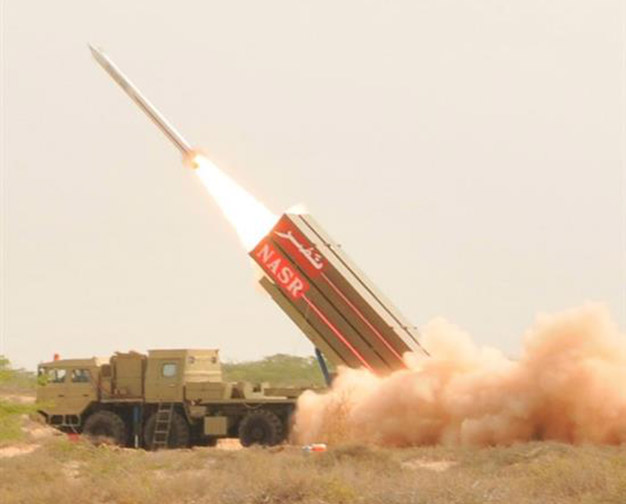
Test launch of the nuclear-capable Nasr (Hatf-IX) short-range surface-to-surface missile, May 2012 (Courtesy: Inter Services Public Relations, Government of Pakistan)

Land-based Ballistic Missiles

Nasr: In an effort to guard against India’s overwhelming advantage in conventional forces, Pakistan is developing tactical, nuclear-capable systems, such as the Nasr (Hatf-IX) short-range ballistic missile (SRBM). It was first tested in April 2011. Its most recent test, in September 2014, was done in salvo mode using a multi-tube launch vehicle (MLV). The road-mobile, solid-fueled Nasr has a range of 60 km and is equipped with “fire and forget” capabilities. Its main mission is understood to be to deter against a conventional attack by India. If it is deployed in the battlefield or along the Indo-Pakistani border during a crisis, it could increase the risk of a nuclear exchange between the two countries.

Shaheen: Pakistan continues to enhance its series of Shaheen solid-fueled ballistic missiles. By April 2013, Pakistan had extended the range of the Shaheen-1 (Hatf-IV) from 750 km to 900 km. In April 2012 and December 2015, a test of the Shaheen-1A was conducted, an improved version of the Shaheen-1 with a range of 900 km and a reported payload capacity of 700-1,000 kg.

The Shaheen-II (Hatf-VI), which was reportedly first tested in 2004, was first used by the Army in a training exercise in 2008. It was last tested in November 2014. This two-stage solid-fueled missile has a 2,000 km range and reportedly has a payload capacity of 1,000-1,100 kg.

In March 2015, Pakistan conducted the first known test launch of the Shaheen-III ballistic missile. It was tested again in December 2015. This nuclear-capable missile has a range of 2,750 km. According to Lieutenant General (Retired) Khalid Kidwai, the former head of Pakistan’s Strategic Plans Division, the Shaheen-III is able to bring the Indian-controlled Nicobar and Andaman Islands in the Bay of Bengal, where Pakistan fears India may build “strategic bases,” within range of Pakistan’s nuclear arsenal.

Ghaznavi: The first batch of Ghaznavi (Hatf III) ballistic missiles were reportedly inducted into the Strategic Forces Command in 2004. The nuclear-capable Ghaznavi is a solid-fueled missile with a range of 290 km and a reported payload capacity of 800 kg.

Ghauri: The Pakistan military continues to conduct training launches of the liquid-fueled Ghauri (Hatf V) ballistic missile, which has already entered service. The nuclear-capable missile, which has a range of 1,300 km and a reported payload capacity of 700 kg, was tested again in April 2015.

Cruise missiles

Babur: In October 2011 and September 2012, Pakistan conducted tests of the Babur cruise missile (Hatf-VII), which Islamabad describes as a nuclear-capable missile with a 700 km range. It is fired from a multi-tube launch vehicle (MLV), and has a reported payload capacity of 300 kg.

Ra’ad: The Ra’ad Air-Launched Cruise Missile (Hatf-VIII) was last tested in January 2016. The Pakistani government claims that the missile can carry nuclear warheads to a range of over 350 km. It has a reported payload capacity of 450 kg.

Sea-based Missiles

Pakistan hopes to develop a sea-based nuclear arsenal. In May 2012, Islamabad inaugurated the headquarters of the Naval Strategic Force Command, which was tasked with ensuring Pakistan’s “second strike capability” and “strengthen[ing] Pakistan’s policy of Credible Minimum Deterrence.” Such capability may include sea-launched versions of the Babur and Ra’ad cruise missiles, which might be carried on its diesel-powered submarines or even on surface warships.

Command and Control Improvements

The National Command Authority (NCA), established in 2000 with the Strategic Plans Division (SPD) as its secretariat, has broad power over “all issues relating to nuclear and space technologies” in Pakistan, bringing all national strategic organizations under its authority. The NCA was created to increase institutional accountability within the nuclear establishment, develop a strong command and control system for Pakistan’s nuclear arsenal, and to increase its security. These initiatives have improved Pakistan’s command and control system, as well as the security of its nuclear arsenal.

Pakistan has also been developing a Strategic Command and Control Support System (SCCSS) to improve command and control and allow for real-time monitoring of missile flights. The SCCSS was first used in a test of the Ra’ad ALCM in May 2012.

MTCR and U.S. Export Restrictions

The Missile Technology Control Regime (MTCR), a group of thirty-four countries (not including Pakistan) with common export control policies aimed at stemming the proliferation of WMD-delivery vehicles, is the world’s primary anti-missile proliferation tool. The MTCR guidelines forbid or restrict the transfer of most ballistic-missile related equipment and technology from participating states, a group that includes France, Russia, the United Kingdom, and the United States. China is not a member, although it claims to abide by MTCR guidelines.

Member states have agreed on a “strong presumption” to deny transfers of MTCR “Category I” items, which are deemed the most sensitive. Included in this category are ballistic missile, cruise missile, and space launch vehicle systems capable of traveling beyond 300 km with a 500 kg payload, as well as sub-systems, facilities, and technology that support these systems. “Category II” contains less sensitive and dual-use missile related components, as well as missile systems with a range of at least 300 km, regardless of payload; participating states have greater flexibility regarding transfers of these items. The MTCR therefore remains an important obstacle to direct cooperation in ballistic missile development between Pakistan and the majority of the states which have advanced ballistic missile programs. The regime’s provisions create a set of “best practices” that work against the proliferation of WMD delivery vehicles.

Many of Pakistan’s major missile developers and producers are on the “Entity List” maintained by the U.S. Department of Commerce, subjecting them to heightened export license requirements. This list includes the Advanced Engineering Research Organization (AERO), Khan Research Laboratories (KRL), Pakistan Atomic Energy Commission (PAEC), National Development Complex (NDC), and Space and Upper Atmosphere Research Commission (SUPARCO).

Major Pakistani Developers and Producers

Pakistan has revealed little officially about which organizations within its defense establishment develop and produce specific missile systems. However, reliable outside sources, including publically available intelligence assessments, have provided useful insight into the work of this secretive community.

Major participants in Pakistan’s missile effort include the following:

National Engineering and Scientific Commission (NESCOM): NESCOM oversees a number of entities involved in Pakistan’s missile program. It is also reportedly involved in the development of the Ra’ad, the sea-launched version of the Babur, and the Ghauri.

National Development Complex (NDC): NDC is subsidiary of NESCOM. In 2001, it reportedly assumed primary responsibility from the PAEC and KRL for Pakistan’s missile development program. It reportedly oversees development of the Shaheen missiles and is involved in the development of the Ghauri

Air Weapons Complex (AWC): A subsidiary of NESCOM, AWC reportedly developed the guidance systems for many of Pakistan’s major missile systems, and is reported to be involved in the development of the Ra’ad. It is also responsible for the development of cruise missiles and UAVs.

Pakistan Atomic Energy Commission (PAEC): PAEC is reportedly involved in the development of a sea-launched version of the Babur.

Space and Upper Atmosphere Research Commission (SUPARCO): SUPARCO, which oversees Pakistan’s space program, is reported to have assisted NDC in the development of the Shaheen-I and Shaheen-II missiles.

Foreign Assistance and Procurement

Pakistan has made steady progress in developing its indigenous missile production capabilities over the decades. However, these capabilities were developed with extensive help from abroad, and Islamabad continues to rely on foreign entities for equipment and materials.

China

The U.S. Central Intelligence Agency has reported that Chinese entities assisted Pakistan in the development of solid-fueled ballistic missiles, particularly the Shaheen series, and that through this assistance Pakistan became capable of serial production of solid-fueled ballistic missiles.

In 2011, press reports described several sales or attempted sales by Chinese firms of equipment that could be used in Pakistan’s missile program. These transactions included: an illegal sale by the Chinese firm Polytechnologies of a coil-winding device and specialized optical chips to Pakistan’s Advanced Engineering Research Organization (AERO), an entity involved in the development of bombs and UAVs; a planned sale of machinery by the Chinese company Jinan Metal Forming Machinery Engineering Co. to Pakistani defense organizations; and an attempted sale of of specialty steel by a Chinese company to Pakistan’s Aginel Enterprises. This type of steel had previously been used for components of the Ghaznavi SRBM. In 2012, the U.S. Director of National Intelligence reported to Congress that Pakistan continued to receive “a variety of missile-related items” from Chinese entities, primarily private companies and individuals.

North Korea

U.S. intelligence has also reported that the Ghauri missile is derived from North Korea’s No Dong missile. In 2003, the United States applied sanctions to North Korea’s Changgwang Sinyong Corporation (aka Korea Mining Development Trading Bureau – KOMID) for exporting missile-related technology to KRL.

United States

Pakistani entities are also engaged in the procurement of missile-related equipment and technology illegally exported from the United States.

In 2007, SUPARCO received 90 fixed coaxial attenuators from Nadeem Akhtar, a Pakistani national living in Maryland, which were shipped without the required authorization from the Commerce Department. That same year, SUPARCO received an unauthorized shipment of an atmospheric testing device and related equipment from the University of Massachusetts at Lowell. In recent years, SUPARCO also received unauthorized shipments of carbon fiber and microwave laminates from Bilal Ahmed, a businessman in Illinois.

In addition, according to the Commerce Department, since 2010 AERO has been using a network of front companies and intermediaries to procure illicit items of U.S. origin for the development of missiles and UAVs. Some of these items were procured for AWC. This network is spread across several countries, including Pakistan, China, Singapore, and Australia. In 2014, Commerce identified eight companies as part of AERO’s network: Vortex Electronics (Australia), Beijing Lion Heart International Trading Company (China and Hong Kong), Future Systems Pvt. Ltd. (Pakistan), IKAN Engineering Services (Pakistan), LT Engineering and Trade Services (Pvt) Ltd. (LTE) (Pakistan), Nazir and Sons International (Pakistan), Orion Eleven Pvt. Ltd. (Pakistan), and Izix Group Pte Ltd. (Singapore).

Gone but not Forgotten: Entities Removed from Official Blacklists on Implementation Day

Spreadsheet of Entities Removed from the E.U., U.N., and U.S. Lists

Iran and the P5+1 announced on January 16, 2016 that Iran had met its initial obligations under the terms of the nuclear agreement. “Implementation Day” brought a first round of sanctions relief for Iran, including the removal of some 600 individuals and firms from the European Union, United States, and United Nations blacklists.

These removals were included in three separate lists attached to the Joint Comprehensive Plan of Action and U.N. resolution 2231, sometimes with the same entity included under a different name across the various lists. In many cases, entities removed from the E.U. list on Implementation Day had never been designated by the United States, and vice versa. In a few instances, entities were removed from one list on Implementation Day but will remain on another blacklist until Transition Day (estimated to take place in October 2023).

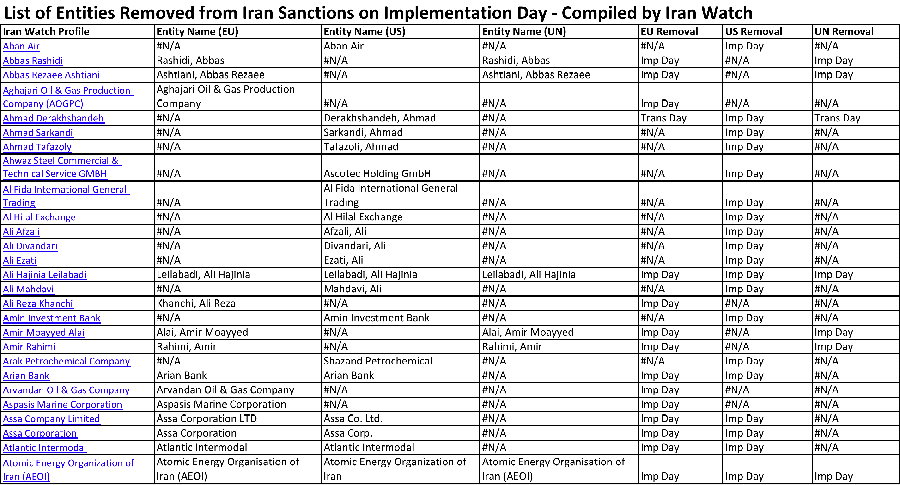
To clarify the changes to these blacklists and support sanctions compliance, Iran Watch has created an Implementation Day spreadsheet that includes every entity that was removed from the E.U., U.S., and U.N. lists (with the exception of the individual vessels and aircraft). This spreadsheet will help support continued vigilance with regard to Iran, in particular toward Iranian entities that until this month had been under strict financial sanctions because of their support for proliferation. Compliance officers at companies preparing to resume dealings with Iran should continue to avoid many of these entities because of the support they have provided to Iran’s nuclear, missile, and military programs.  And officials charged with enforcing the nuclear agreement should work to ensure that, for example, the companies previously targeted for facilitating illicit procurement have not resumed this activity now that they have been officially cleared.

The spreadsheet matches entity names from each of the lists into unified entries; shows when each entity was or will be removed from individual blacklists; and links to a profile on Iran Watch that describes an entity’s connection with proliferation. The spreadsheet also notes those entities that were removed from the U.S. Treasury Department’s Specially Designated Nationals (SDN) list on Implementation Day but were identified as “Government of Iran” or an “Iranian financial institution” and therefore remain off-limits for U.S. parties. These entities have been added to the oddly-named “Non-SDN List,” pursuant to Executive Order 13599.

In general, the timing of removals across the different blacklists was consistent. However, there were a few anomalies worth noting. For example, Bank Sepah, Bank Sepah International, and Ahmad Derakhshandeh (a former Bank Sepah chairman) were removed from the U.S. blacklist on Implementation Day but will remain on the E.U. and U.N. blacklists for now. Bank Sepah was moved to the Executive Order 13599 List, but not Bank Sepah International or Mr. Derakhshandeh. Bank Sepah International would seem to qualify for at least this lesser list, as it describes itself as “a wholly owned subsidiary of Bank Sepah.”  Update: U.N. sanctions against Bank Sepah and Bank Sepah International were lifted on the heels of Implementation Day, following a delisting request.  This change was confirmed on the U.N. website in February.

The Implementation Day spreadsheet is available for download as an Excel file below: 

Attachment: 

 List of Entities Removed from Iran Sanctions on Implementation Day

Iranian Government Procurement Agent Sent Military Electronics to Iran

Criminal indictments were unsealed in Delaware and Massachusetts relating to the prosecution of Iranian arms procurement agent Amir Hossein Ardebili. In May 2008, Ardebili pled guilty to multiple violations of the Arms Export Control Act, the International Emergency Economic Powers Act, smuggling, conspiracy and money laundering. He was sentenced to five years in prison in December 2009 and was reportedly deported back to Iran after serving his sentence.

Ardebili was living in Iran and working as an arms acquisitions agent for the government of Iran. He was arrested on October 2, 2007 in the country of Georgia in an undercover sting operation conducted by U.S. Immigration and Customs Enforcement agents following a three year investigation; he was secretly extradited to the U.S. in January 2008. During the investigation, Ardebili negotiated the purchase and illegal export of a number of military components, including: QRS-11 Gyro Chip Sensors, which are used in advanced aircraft, missile, space and commercial applications; MAPCGM0003 Phase Shifters, which can be used in missile guidance systems; and a Digital Air Data Computer, which is a replacement for the computer that calculates flight parameters on U.S. F-4 fighter aircraft used by Iran.


Sources:

[1] “Iranian Arms Procurement Agent Sentenced to 60 Months Imprisonment,” Press Release, Immigration and Customs Enforcement (ICE), Department of Homeland Security, December 14, 2009.

[2] John Shiffman, “Iranian Arms Dealer, Extradited in ’07, Secretly Jailed in Phila,” Philadelphia Inquirer, December 2, 2009.

[3] David Locke Hall, “Meet the Friends of Iran’s Military Pardoned by Obama,” Wall Street Journal, January 20, 2016.

Implementation Day Brings Sanctions Relief to Past Proliferators

Iran and the P5+1 announced on January 16 that Iran had met its obligations under the terms of the nuclear agreement and would immediately receive a first round of sanctions relief.  “Implementation Day” of the agreement arrived sooner than expected, as Iran rushed to limit the scope of its nuclear work and stockpiles, including by diluting or exporting enriched uranium, removing the core of its heavy water reactor at Arak and selling off excess heavy water, and dismantling about 13,000 centrifuges.  The International Atomic Energy Agency (IAEA) confirmed Iran’s actions, along with the implementation of transparency measures required by the agreement, thus triggering sanctions relief.

Sanctions Relief by Sector

In the first round of sanctions relief, the European Union, United States, and United Nations lifted the bulk of its nuclear-related sanctions against Iran, including most of the restrictions that had been imposed against Iran’s financial, transport, and energy sectors.  (U.S. parties will still be prohibited from doing business with Iranian entities because of the embargo.)


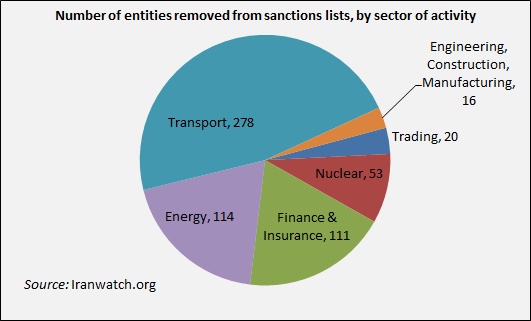
In addition, some 600 individuals and firms were removed from the E.U., U.S., and U.N. blacklists.  Nearly half of these removals represent entities associated with Iran’s transport sector, in particular the national container shipping company, Islamic Republic of Iran Shipping Lines (IRISL), the National Iranian Tanker Company (NITC), and their many branch offices and front companies.  Twenty percent of the entities receiving sanctions relief are from Iran’s energy sector; 20 percent from its finance and insurance sector; and 9 percent from the nuclear sector.  The remainder includes engineering, construction, or manufacturing firms, or import-export firms that facilitate trade.

Many of these entities may seem far removed from Iran’s missile program or past nuclear weapon effort, which first triggered sanctions; they are not.  For example, the Atomic Energy Organization of Iran and several AEOI departments and divisions have been removed from U.N., E.U. and U.S. blacklists.  One such department, Jabber Ibn Hayan, was the location of undeclared uranium metal production and irradiated reactor fuel experiments, and the storage location for separated plutonium.  Other AEOI subordinates, like Mesbah Energy and Kavoshyar, have been involved in illicit nuclear procurement.

Banks and other financial institutions that helped Iran evade sanctions, or actively financed proliferation-related transactions, have also received sanctions relief.  One example is the German-based Europaisch-Iranische Handelsbank (EIH Bank), which has been removed from both U.S. and E.U. blacklists.  This bank has facilitated billions of dollars in transactions on behalf of sanctioned Iranian banks and Iranian proliferators, reportedly including the Iran Electronics Industries, the Defense Industries Organization, Aerospace Industries Organization, and the Iranian Revolutionary Guard Corps – none of which are being removed from sanctions lists.  EIH Bank is poised to resume “its full range of services at the disposal of old and new customers,” according to its website.[1]

Iran has a history of using entities in its energy sector as fronts for illicit dual-use procurement.  Some of the energy companies implicated in this trade have been removed from blacklists.  Kala Naft and Jam Petrochemical are two examples.  The former, which has been struck from U.S. and E.U. blacklists, calls itself the procurement arm for the National Iranian Oil Company.  Its attempt to procure bellows seals was denied by a member state of the Nuclear Suppliers Group (NSG).  Jam Petrochemical has made similar procurement attempts, also denied by NSG member states.

Iranian vessels will once again be welcome in ports around the world, and dozens of domestic and overseas branches of Iran’s national shipping firms will be able to resume operation.  Many of these firms were originally added to blacklists because of their status as affiliates or front companies used by IRISL or NITC.  Treasury designated a number of IRISL affiliates “for providing logistical services to Iran’s Ministry of Defense and Armed Forces Logistics (MODAFL)” – an entity that remains blacklisted.[2]  IRISL branches located in destinations of concern for transshipment, and that helped Iran evade sanctions have also been removed from blacklists.  For instance Good Luck Shipping in the United Arab Emirates “issued false transport documents for IRISL and entities owned or controlled by IRISL,” according to the European Union.[3]

A Summary of European Union Sanctions Relief

The EU terminated all nuclear-related economic and financial sanctions, including restrictions on:

  • Transfers of funds between EU entities, including financial and credit institutions, and Iran
  • Banking activities, including the opening of new branches of Iranian banks in the EU and the opening by EU entities of new offices, subsidiaries, joint ventures, or bank accounts in Iran.
  • Insurance and reinsurance for Iranian entities.
  • The import of Iranian oil, gas, and petrochemical products.
  • Investment in and the export of equipment for Iran’s oil, gas, and petrochemical sectors​
  • The shipping, shipbuilding, and transport sectors.
  • The export of gold, precious metals, and diamonds and the delivery of Iranian banknotes and coinage.

Iran will also regain access to financial messaging services, including SWIFT, on Implementation Day, but banks that remain designated by the EU will remain cut off from those services until Transition Day.

The EU will also lift sanctions that impose asset freezes and travel bans on a set of 337 companies and individuals (mostly in the financial, energy, shipping, and transport sectors).

A Summary of United States Sanctions Relief

The United States ceased the application of the bulk of its secondary sanctions on non-U.S. persons engaged in Iran’s financial and energy sectors.  This was be done by executive waiver.  However, the agreement noted, “U.S. persons and U.S.-owned or -controlled foreign entities will continue to be generally prohibited from conducting transactions of the type permitted pursuant to the JCPOA.”

The secondary sanctions suspended in this first round include restrictions on:

  • Financial and banking transactions with Iranian financial institutions.
  • Transactions in Iranian Rial.
  • The provision of U.S. banknotes to the Government of Iran.
  • The purchase or facilitation of issuance of Iranian sovereign debt.
  • Financial messaging services.
  • Insurance and re-insurance.
  • Sales, investment, and transport of Iranian oil, gas, and petrochemicals.
  • Shipping, shipbuilding, and port sectors
  • Trade in gold and other precious metals.
  • The automotive sector.

The United States also removed a set of 446 entities from various restricted party lists (mostly Iranian financial institutions, individuals and entities designated for being part of the Government of Iran, as well as entities in the energy, transport, and shipping sectors), plus an additional set of individual vessels and aircraft owned by delisted entities.

An Update on United Nations Sanctions

On Implementation Day, U. N. Security Council resolution 2231 officially terminated the provisions of previous Iran-related resolutions: resolutions 1696 (2006), 1737 (2006), 1747 (2007), 1803 (2008), 1929 (2010), and 2224 (2015).  As a result, 36 entities were removed from the U.N. sanctions list, of the 121 entities that had been blacklisted since 2006.  Sanctions will remain in place on the remaining 85 entities for eight years, or until the IAEA reaches its Broader Conclusion that “all nuclear material in Iran remains in peaceful activities.”

The previous six Iran-related resolutions had targeted Iran’s nuclear, ballistic missile, and conventional arms programs, while imposing limited penalties on the country’s financial and transportation sectors.  Resolution 2231 leaves in place the following U.N. sanctions:

  • A conventional arms embargo (five years).
  • A ban on ballistic missile technology imports and ballistic-missile related activity (eight years).  The language of the new U.N. resolution on the restrictions on ballistic-missile related activity appears to be more permissive than the ban under previous resolutions.​
  • Restrictions on nuclear-related procurement, overseen by the procurement channel that is not yet operational (ten years).

Footnotes: 

Bait and Switch on New Iran Missile Sanctions

Last week, the White House backtracked on plans to impose new financial sanctions on Iran’s ballistic missile program.  The Wall Street Journal reported on December 30 that the Treasury Department was preparing to sanction 11 companies and individuals that helped Iran’s missile developers illicitly procure key items from foreign suppliers. Iran’s missile work has surged in recent months, with two tests of nuclear-capable missiles last fall.  These new sanctions would have imposed asset freezes and prohibited U.S. parties from conducting transactions with the blacklisted entities.[1]

The White House sent notification to Congress that these new designations would be announced on December 30.  The Journal reported on December 31, however, that the White House subsequently notified Congress that it was indefinitely delaying the new sanctions.  State Department spokesman John Kirby said the delay was not related to either President Hassan Rouhani’s threats to accelerate Iran’s missile program in the face of the pending sanctions or to the implementation of the nuclear agreement reached in July.[2]

Since the nuclear deal was finalized, Iran has test-fired two different medium-range ballistic missiles: the Emad missile on October 10 and the Ghadr-110 on November 21.  A report by the U.N. Panel of Experts on Iran concluded that the October 10 test violated Security Council resolution 1929, which bans Iranian launches of ballistic missiles capable of delivering a nuclear warhead.  There are now growing bipartisan calls in Congress for the Obama administration to impose fresh missile sanctions on Iran in response to these tests.[3]  Yesterday, the House Foreign Affairs Committee approved a bill that would prohibit the lifting of U.S. sanctions on over 50 individuals and entities that are set to receive sanctions relief under the nuclear deal until the President certifies to Congress that they are not involved in missile or terrorism-related activity.[4]

The planned sanctions would have targeted two networks involved in missile-related procurement: 1) a group of five officials working for Iran’s Ministry of Defense Armed Forces Logistics and its subsidiaries, including three officials who have worked directly with North Korea on missile development; 2) a network based in the United Arab Emirates and Hong Kong that procured carbon fiber for an Iranian state-owned company involved in ballistic missile work.

The following information comes from a copy of the Treasury Department’s draft statement, reviewed by Iran Watch, which was intended to accompany the sanctions announcement.

The Iran-North Korea Nexus

Treasury was preparing to blacklist five Iranian officials affiliated with the Ministry of Defense of Armed Forces Logistics (MODAFL), which coordinates Iran’s ballistic missile program, and two subsidiaries: the Aerospace Industries Organization (AIO), which oversees missile production; and the Shahid Hemmat Industrial Group (SHIG), an AIO subsidiary responsible for liquid-fueled missiles.

According to Treasury, SHIG missile technicians and MODAFL officials have traveled to North Korea over the past several years to work on an 80-ton rocket booster being developed by the North Korean government.  This technology would help both countries extend the range of their missiles.[5]

SHIG also coordinates shipments of missile-related goods to Iran from the Korea Mining Development Trading Corporation (KOMID), North Korea’s primary exporter of ballistic missile-related equipment that has been sanctioned by the United Nations, United States, and European Union.  These goods include valves, electronics, and measuring equipment that can be used in tests of liquid-fueled ballistic missiles and space launch vehicles.

The five individuals that were set to be blacklisted include:

1. Sayyed Javad Musavi: Commercial director of SHIG who has worked directly with KOMID officials in Iran.

2. Seyed Mirhmad Nooshin: Director of SHIG who has been critical to the development of the 80-ton rocket booster and travelled to Pyongyang during contract negotiations.

3. Sayyed Medhi Farahi: Current Deputy of MODAFL.  Farahi, like Nooshin, has been critical to the development of the 80-ton rocket booster and also travelled to Pyongyang.

4. Seyed Mohammad Hashemi: A MODAFL official.

5. Mehrdada Akhlaghi Ketabachi: Director of AIO.  Ketabachi was sanctioned by the United States in 2008 when he headed the Shahid Bagheri Industrial Group (SBIG), an entity subordinate to AIO involved in Iran’s solid-fueled missile work.


UAE and Hong Kong-Based Procurement Network

The second network includes six companies and individuals based in the United Arab Emirates and Hong Kong that since early 2015 sought to procure carbon fiber and related equipment for Iran’s ballistic missile program.  This network allegedly used front companies in third countries to deceive foreign suppliers about the identity of the intended end-user: Navid Composite Material Company.

Navid Composite, which was sanctioned by the United States in 2013, has contracted with Asia-based companies for equipment and material to build a carbon fiber production line capable of producing 150 tons per year of carbon fiber that is “probably suitable for use in ballistic missile components,” according to a 2013 Treasury statement.

The entities supporting Navid Composite that were set to be blacklisted include:

1. Mabrooka Trading Co L.L.C. (Mabrooka Trading)A trading company based in Dubai, United Arab Emirates.

2. Hossein PournaghshbandFounder and owner of Mabrooka Trading.  Pournaghshband used his company to procure material and equipment for Navid Composite’s carbon fiber production line.

3. Chen Mingfu: A resident of Hong Kong and owner of Anhui Land Group Co., Limited.  Chen brokered deals using Anhui Land Group in support of Pournaghshband and Mabrooka Trading’s procurement efforts on behalf of Navid Composite.

4. Anhui Land Group Co., Limited: A private Hong Kong-based company.  Chen is listed as Anhui Lang Group’s company director and sole owner in the company’s 2015 annual return submitted to the Hong Kong Companies Registry.  Chen submitted an application to the Companies Registry to deregister Anhui Land Group in July 2015.  Anhui Land Group was previously named “China Mabrooka Trading Co., Limited,” and the Wall Street Journal identified Anhui Land Group as a subsidiary of Mabrooka Trading.

5. Candid General Trading: A Dubai, United Arab Emirates-based company that conducted financial transactions on behalf of Mabrooka and Pournaghshband, for goods intended for Navid Composite.

6. Rahim Reza Farghadani: Managing director of Candid General Trading.


Footnotes:

[1] Jay Solomon, “Obama Administration Preparing Fresh Iran Sanctions,” Wall Street Journal, December 30, 2015, http://www.wsj.com/articles/obama-administration-preparing-fresh-iran-sanctions-1451507921

[2] Jay Solomon, “White House Delays Imposing New Sanctions on Iran for Missile Program,” Wall Street Journal, December 31, 2015, http://www.wsj.com/articles/white-house-delays-imposing-new-sanctions-on-iran-for-missile-program-1451604822

[3] Carol Morello, “Iran’s Missile Tests are Spurring Calls from Congress for More Sanctions,” Washington Post, January 7, 2016, https://www.washingtonpost.com/world/national-security/irans-missile-tests-are-spurring-calls-from-congress-for-more-sanctions/2016/01/07/ce8582d8-b54a-11e5-a76a-0b5145e8679a_story.html

[4] Richard Lardner, “GOP-lead Panel Passes Bill for Oversight of Iran Nuclear Deal,” Associated Press, January 7, 2016, Carol Morello, “Iran’s Missile Tests are Spurring Calls from Congress for More Sanctions,” Washington Post, January 7, 2016, https://www.washingtonpost.com/world/national-security/irans-missile-tests-are-spurring-calls-from-congress-for-more-sanctions/2016/01/07/ce8582d8-b54a-11e5-a76a-0b5145e8679a_story.html

[5] Ilan Berman, “The Iran-North Korea Strategic Alliance,” Testimony Before the House Committee on Foreign Affairs, Subcommittee on Terrorism, Nonproliferation, and Trade, Subcommittee on Asia and the Pacific, Subcommittee on the Middle East and North Africa,” July 28, 2015, http://docs.house.gov/meetings/FA/FA18/20150728/103824/HHRG-114-FA18-Wstate-BermanI-20150728.pdf

Questions Remain in “Final” Report on Iran’s Alleged Weapons Work

The International Atomic Energy Agency (IAEA) released its long-awaited final report on Iran’s alleged past nuclear weapons work on December 2.  This report is likely to be the Agency’s last word on its investigation into what it calls “the possible military dimensions [PMD] to Iran’s nuclear program.”  The Agency found that Iran had a “coordinated” program to develop a nuclear weapon through the end of 2003 and that some of the work on nuclear weapons continued into 2009.  Specifically, the IAEA found that Iran developed several components of a nuclear weapon and undertook related research and testing.

This report is part of a side agreement between the IAEA and Iran.  The IAEA’s conclusions are not directly linked to the implementation of the larger nuclear deal with Iran, which may explain the limited nature of Iran’s cooperation.  To many of the Agency’s questions, Iran offered no new information, or made denials without explanation, or gave explanations contradicted by other information available to the Agency.  The report sheds little new light on the allegations originally compiled by the Agency in 2011 and leaves unanswered many questions about the extent of both Iran’s nuclear capability and its intentions.

Nevertheless, the countries of the P5+1 appear willing to accept the IAEA’s incomplete report and close the book on the PMD issue.  According to U.S. State Department spokesperson Mark Toner, the P5+1 will introduce a resolution at the next IAEA Board of Governors meeting on December 15 to bring the PMD investigation to an end.  Iran, for its part, has stated that it will not implement the nuclear agreement, known as the Joint Comprehensive Plan of Action (JCPOA), until the IAEA investigation is concluded.  In a November 29 interview, Iran’s former defense minister and current secretary of the Supreme National Security Council warned that “without the closure of the file regarding past issues, there is no possibility of implementing the JCPOA.”

The allegations about a nuclear weapons program in Iran began surfacing in 2002, and the IAEA consolidated the “outstanding issues related to possible military dimensions to Iran’s nuclear program” in a report issued in November 2011.  The analysis in the report was based on information that the Agency received from IAEA member states, from the Agency’s own investigative efforts, and from information provided by Iran.  The IAEA judged the allegations of work on nuclear weapons “to be, overall, credible” and “consistent in terms of technical content, individuals and organizations involved, and time frames.”  In a 2012 resolution, the IAEA Board of Governors decided that “the resolution of all outstanding issues was essential and urgent in order to restore international confidence in the exclusively peaceful nature of Iran’s nuclear program.”

The 2011 IAEA report described detailed information about Iran’s efforts to develop a nuclear weapon, including:

  • computer modeling of implosion, compression, and nuclear yield, as recently as 2009;
  • high explosive tests simulating a nuclear explosion but using non-nuclear material in order to see whether an implosion device would work;
  • the construction of at least one containment vessel at a military site, in which to conduct such high explosive tests;
  • studies on detonation of high explosive charges, in order to ensure uniform compression in an implosion device, including at least one large scale experiment in 2003, and experimental research after 2003;
  • support from a foreign expert, reportedly a former Soviet weapon scientist named Vyacheslav Danilenko, in developing a detonation system suitable for nuclear weapons and a diagnostic system needed to monitor the detonation experiments;
  • manufacture of a neutron initiator, which is placed in the core of an implosion device and, when compressed, generates neutrons to start a nuclear chain reaction, along with validation studies on the initiator design from 2006 onward;
  • the development of exploding bridgewire detonators (EBWs) used in simultaneous detonation, which are needed to initiate an implosive shock wave in fission bombs;
  • the development of high voltage firing equipment that would enable detonation in the air, above a target, in a fashion only making sense for a nuclear payload;
  • testing of high voltage firing equipment to ensure that it could fire EBWs over the long distance needed for nuclear weapon testing, when a device might be located down a deep shaft;
  • a program to integrate a new spherical payload onto Iran’s Shahab-3 missile, enabling the missile to accommodate the detonation package described above.

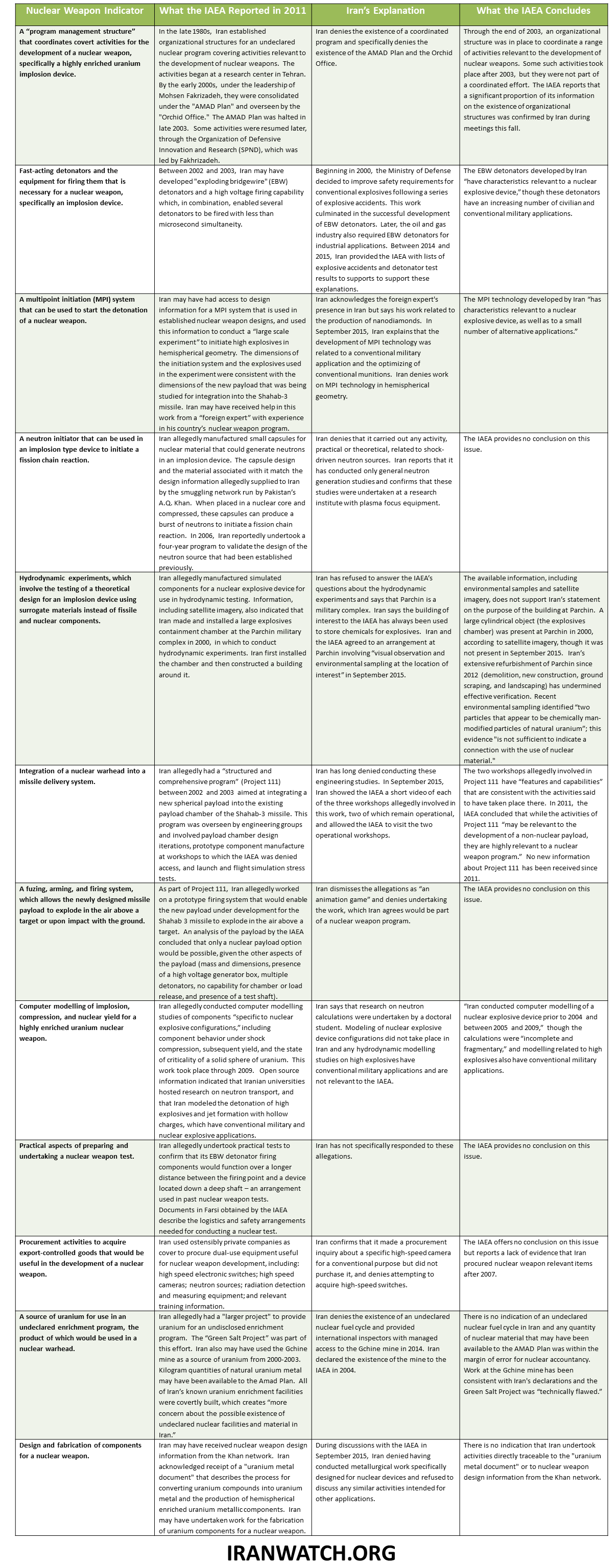
The chart below details each of the 12 “outstanding issues” identified by the IAEA, and it explains their significance for nuclear weapons.  It also lists the original evidence or basis for concern described by the IAEA in 2011, as well as any explanation offered by Iran since then.  It ends with the IAEA’s conclusion.  For most of the 12 issues, the IAEA, in the absence of new information or meaningful disclosures from Iran, has merely reiterated the evidence contained in its 2011 report.   This “final” report fails to present a complete picture of Iran’s past work on nuclear weapons.

[Click here for a larger version of the chart.]

Iran Moves to Implement Nuclear Deal by January

Iran is taking steps to expedite the implementation of the nuclear deal, which Iranian deputy foreign minister Abbas Araqchi expects in “early January.”[1]  An early January implementation date now looks possible because Iran has taken two key steps needed to fulfill the nuclear restrictions required by the Joint Comprehensive Plan of Action: 1) it has agreed to sell the bulk of its low-enriched uranium gas stockpile to Russia; and 2) it has started decommissioning centrifuges at a rapid pace.  Limitations on both enriched uranium and centrifuges – critical to Iran’s current nuclear capability – must be in place for Iran to receive a first round of sanctions relief from the United Nations, European Union, and the United States.

The head of the Atomic Energy Organization of Iran, Ali Akbar Salehi, announced on November 24 that Iran “will sell about nine tons of enriched uranium to Russia and in return will import 140 tons of natural uranium.”[2]  Such an exchange would allow Iran to quickly reduce its stockpile of low-enriched uranium (LEU) gas from its current level to the 300-kg level required by the nuclear deal.  The deal allows Iran to either downblend its enriched uranium or to sell it “on the international market” in exchange for natural uranium.   However, many analysts had questioned Iran’s ability to efficiently convert its LEU stockpile to natural uranium—which Iran can hold in unlimited quantities—based on its current technical capacity.

Iran has also started to decommission centrifuges at the Natanz and Fordow uranium enrichment facilities, according to the latest International Atomic Energy Agency (IAEA) report.  The JCPOA requires Iran to reduce its enrichment capacity at the larger Natanz facility to 5,060 IR-1 centrifuges, which Iran will be permitted to continue operating.   The IAEA reported that as of November 15, Iran had removed 4,112 IR-1 centrifuges, bringing the number of IR-1s at the facility down to 11,308.  Iran has also removed 160 of the 1,008 more advanced IR-2m centrifuges installed at Natanz—all of which must be dismantled before the first round of sanctions relief.

The JCPOA also requires Iran to reduce by about half the number of centrifuges at Fordow, none of which can be used for uranium enrichment for the first 15 years of the deal.  The IAEA reported that as of November 15, Iran had dismantled 258 IR-1 centrifuges of the 2,710 installed. In an interview with Iranian state television on November 15, Mr. Salehi estimated that the process of decommissioning centrifuges at Natanz would take about a month, while the smaller number of centrifuges at Fordow could be dismantled “at the last moment.”[3]

Mr. Salehi confirmed that Iran had started removing centrifuges at Natanz, saying in the same November 15 interview that thus far only inactive centrifuges at the facility had been removed and that the “decommissioning” process would damage between 10 and 20 percent of the centrifuges.[4]  In its report, the IAEA confirmed that just over 9,000 IR-1 centrifuges remain operational.

Contrary to the IAEA report, Mr. Salehi said that Iran had not yet begun dismantling centrifuges at Fordow, which he expected to start on December 15.  Iran may be trying to link dismantlement at Fordow with the conclusion of the IAEA’s investigation into possible military dimensions of Iran’s nuclear work – which is expected on December 2.  In a November 29 interview, Iran’s former defense minister and current secretary of the Supreme National Security Council warned that “without the closure of the file regarding past issues, there is no possibility of implementing the JCPOA.”[5]

In the interview, Mr. Salehi emphasized that Iran’s motivation for quickly meeting its obligations under the nuclear deal is the promise of sanctions relief: “If we delay decommissioning the centrifuges, the opportunity will be lost and the time for implementing the JCPOA will be delayed.  Correspondingly, the sanctions will be lifted later.  At the moment, we have suffered a $150 million in damages due to the fact that the sanctions have not been lifted.”[6]


Footnotes: 

[1] “Iran Nuclear Deal to Enter Into Force Early January,” Agence France-Presse, November 24, 2015, available at http://news.yahoo.com/iran-nuclear-deal-enter-force-early-january-deputy-164548785.html

[2] “Iran Joins Uranium Enrichment Service Providers,” Mehr News Agency, November 24, 2015, http://en.mehrnews.com/news/112233/Iran-joins-uranium-enrichment-service-providers

[3] “Nuclear Chief Says Iran Has Started Decommissioning Centrifuges,” Iranian Student News Agency, November 15, 2015.

[4] “Nuclear Chief Says Iran Has Started Decommissioning Centrifuges,” Iranian Student News Agency, November 15, 2015.

[5] “Iran Demands Closure of UN Nuclear Watchdog Probe,” Agence France-Presse, November 29, 2015, available at http://www.france24.com/en/20151129-iran-demands-closure-un-nuclear-watchdog-probe

[6] “Nuclear Chief Says Iran Has Started Decommissioning Centrifuges,” Iranian Student News Agency, November 15, 2015.

Taiwanese National Conspires with Known Procurement Network to Send U.S.-Origin Dual-Use Electronics to Iran

Kunlin Hsieh, a Taiwanese national and sales manager for Junbon Enterprises Co. Ltd. in Taiwan, pleaded guilty in June 2015 to conspiring to ship U.S.-origin dual-use electronic parts from the United States to Iran, via Taiwan.  He was sentenced to 14 months in federal prison.

Hsieh admitted to one count of conspiracy to violate the International Emergency Economic Powers Act (IEEPA) and the Iranian Transactions Regulations (ITR).  Between October 2007 and August 2014, Hsieh participated in a conspiracy to obtain controlled items from U.S. companies without disclosing the intended end-users in Iran.  The goods included U.S.-origin laminates, microwave pyramidal absorbers, and multi-line pass filter networks.  The potential applications for these items include missile guidance systems, secure tactical radio communications, and military radar networks.

As part of the conspiracy, Hsieh procured items on behalf of Mehrdad Foomanie, whose companies in Iran included Sazgan Ertebat Co. Ltd. and Moravid Sanant Co. Ltd.  Foomanie and one of Hsieh’s other co-conspirators, Susan Yip, were previously indicted in June 2011 for their involvement in a conspiracy to ship thousands of U.S.-origin military and dual-use parts from the United States to Iran, via Dubai and Taiwan.

Hsieh was indicted along with another Junbon employee, Agris Indricevs, who was also charged with conspiracy to violate the International Emergency Economic Powers Act (IEEPA) and the Iranian Transactions Regulations (ITR).  Court documents related to Indricevs, a Latvian citizen, remain sealed, so it is unknown whether a plea agreement with him was also reached.  A third Junbon employee, Ryan Surrena, was separately indicted in September 2013.  Surrena is a U.S. citizen who worked in international sales at the company.  In November 2015, he pleaded guilty to one count of conspiracy to violate the International Emergency Economic Powers Act (IEEPA) and the Iranian Transactions Regulations (ITR).  Surrena was sentenced to 5 years probation.


Sources: 

[1] Indictment, United States of America v. Kunlin Hsieh, Case No. SA-14-CR-641(1)FB, U.S. District Court, Western District of Texas, filed on August 13, 2014, available via PACER, accessed on February 25, 2016.

[2] “Taiwanese National Pleads Guilty to Violating U.S. Sanctions on Exportation of Goods to Iran,” Department of Justice, U.S. Attorney’s Office, Western District of Texas, June 25, 2015, https://www.justice.gov/usao-wdtx/pr/taiwanese-national-pleads-guilty-violating-us-sanctions-exportation-goods-iran, accessed on February 25, 2016.

[3] Judgment in a Criminal Case, United States of America v. Kunlin Hsieh, Case No. SA-14-CR-641(1)FB, U.S. District Court, Western District of Texas, filed on October 5, 2015, pp. 1-2, available via PACER, accessed on October 13, 2015.

[4] Indictment, United States of America v. Susan Yip, Mehrdad Foomanie, and Mehrdad Ansari, Case Number 5:11-cr-00516-XR, U.S. District Court, Western District of Texas, San Antonio Division, June 15, 2011, available via PACER, accessed on November 5, 2012.

[5] Judgment and Order, United States of America v. Ryan D. Surrena, Case No. 5:13-CR-00730-FB(1), U.S. District Court, Western District of Texas, filed on November 20, 2015, available via PACER, accessed on February 26, 2016.