News

Canadian-Iranian Businessman Pleads Guilty in Conspiracy to Ship U.S. Electronics to Iran

Ali Reza Parsa, a businessman with dual Iranian and Canadian citizenship, pleaded guilty in federal court in January 2016 to conspiring to ship U.S.-origin electronic components from the United States to Iran, via Canada, without a license required by the U.S. Department of the Treasury’s Office of Foreign Assets Control (OFAC).  He was sentenced to three years in prison on May 20, 2016.

Parsa admitted to one count of conspiring to violate the International Emergency Economic Powers Act (IEEPA) and the Iranian Transactions and Sanctions Regulations (ITSR).  Between 2009 and 2015, Parsa conspired to obtain electronic components from U.S. companies for shipment to Iran and other countries.  The components included cryogenic accelerometers, which can be used in liquid propellant rocket engines.

Parsa concealed the intended end-user of the components by placing orders through a Canadian company called Metal PM and using a United Arab Emirates-based freight forwarder.  He also provided the U.S. supplier companies with false information about the end-user.  These shipments were to be made on behalf of Tavan Payesh Mad, an Iranian procurement company.

Tavan Payesh Mad supplies equipment to companies in the chemical, mining, oil, heavy industry, and energy sectors. Its clients include Abadan Oil Refining Company, Arak Petrochemical Company, National Iranian Steel Company (NISCO), Esfahan Steel Company, Shomal Cement Company, Fars Cement Company, and Mazandaran Cement Company. Both Tavan Payesh Mad and Metal PM have been linked to Parsa.

While in custody, Parsa continued to conduct business for Metal PM and Tavan Payesh Mad.  He ordered components from Brazilian and German suppliers on behalf of Iranian end users and reportedly attempted to conceal the transactions by directing a relative to delete email evidence.


Sources:

[1] “Canadian-Iranian Citizen Sentenced in Manhattan Federal Court to Three Years in Prison for Conspiring to Violate Iran Sanctions,” Press Release, U.S. Department of Justice, May 23, 2016, available at https://www.justice.gov/usao-sdny/pr/canadian-iranian-citizen-sentenced-manhattan-federal-court-three-years-prison, accessed on July 21, 2016.

[2] “About Us,” Tavan Payesh Maad World Wide Web site, http://tavanpm.com/index.php?lang=en#about, accessed on July 25, 2016.

[3] “Resume,” Tavan Payesh Maad World Wide Web site, http://tavanpm.com/page.php?task=pages&ID=37&lang=en, accessed on July 25, 2016.

[4] “Canadian Sentenced in U.S. for Breaking Iran Export Sanctions,” Globe and Mail, May 23, 2016, available at http://www.theglobeandmail.com/news/national/canadian-sentenced-in-us-for-breaking-iran-export-sanctions/article30123222/, accessed on July 21, 2016.

The Iran Deal: Who Has the Leverage?

Panelists

Olli Heinonen
Kenneth Katzman (*)
David Kay
John Lauder
Michael Singh

Moderated by the Wisconsin Project on Nuclear Arms Control

This month marks the anniversary of the historic nuclear accord the United States and five other countries concluded with Iran a year ago.  As a result of the accord, Iran has restricted the most worrisome parts of its nuclear program for a period of time, in exchange for relief from international economic sanctions.  During the past year, the United States and its partners have amply fulfilled their obligations.  Nevertheless, Iran claims to be still unsatisfied.  It asserts that the economic benefits from the agreement have not been as great as it expected, and that an effort should be made to increase them.  Iran also objects to any application of sanctions triggered by activity independent of the agreement, such as its missile tests, support for terrorism, arms imports and exports, and human rights abuses.

In response to these complaints, the United States has urged non-U.S. banks to engage in what it terms “legitimate business” (i.e., non-sanctioned business) with Iran.  U.S. Secretary of State John Kerry promoted this message when meeting with the heads of some of Europe’s largest banks in May.  The United States also has been muted in its response to a series of Iranian missile tests and to ongoing Iranian missile-related procurement, and it has not issued any designations for human rights abuses since last July.

These actions seem to proceed from concern that Iran will judge the benefits from the agreement to be insufficient, and withdraw.  But is such concern well-founded?  How likely is it, in fact, that Iran will withdraw?  And how many additional benefits can be offered to Iran without undermining existing U.S. policies—those related to missile and arms proliferation, export controls, human rights, terrorism, and illicit finance?

These questions were examined by a roundtable of experts hosted by the Wisconsin Project on Nuclear Arms Control in Washington, D.C. on June 15, 2016.  The roundtable concluded that Iran would lose far more than it would gain by leaving the agreement now, that the United States has more leverage under the agreement than has Iran, and that instead of attempting to give Iran more benefits, the United States should use its superior leverage to create mechanisms that increase transparency and ensure that the terms of the agreement are enforced and its objectives achieved.

Valerie Lincy, Executive Director of the Wisconsin Project, hosted the roundtable.  The participants were Olli Heinonen, Senior Fellow at Harvard University’s Belfer Center for Science and International Affairs, Kenneth Katzman, Senior Analyst at the Congressional Research Service, David Kay, Senior Fellow at the Potomac Institute for Policy Studies, John Lauder, an independent consultant on nonproliferation and arms control, and Michael Singh, Managing Director of the Washington Institute for Near East Policy.

Following are the roundtable’s findings, which are a composite of the panelists’ individual views.  No finding should be attributed to any single panelist or be seen as a statement of the policy of any government.

Finding one:  Iran is unlikely to walk away from the agreement now.  The cost to Iran of so doing would far exceed any benefit.

The primary cost to Iran if it withdraws from the agreement would be economic and political.  A decision by Iran to withdraw would be particularly costly now, before it has fully reaped the economic benefit from the agreement.  The United States could re-impose immediately the sanctions that President Barack Obama suspended in January 2016, including restrictions on non-U.S. persons and companies engaged with Iran’s financial, energy, and shipping sectors.  Any future American president could carry those sanctions forward, via executive order, without congressional action.

The renewal of U.S. sanctions, though unilateral, would impose costs.  The panelists agreed that most banks or companies engaged in business with the United States would probably exit the Iranian market or forego the opportunity to enter it if U.S. nuclear-related sanctions were renewed.  Even in the current environment, large European banks and many companies have been reluctant to reenter Iran, in part because of remaining U.S. sanctions.  If forced to choose between trade with the United States or Iran, they would take the more lucrative path.  Their governments may not follow the United States in re-imposing sanctions, but could not protect the firms from having to make that choice.  And even if European Union countries and other foreign buyers were to continue purchasing oil from Iran, the re-imposition of nuclear-related sanctions would make it difficult for Iran to fully access the proceeds of those sales because of U.S. financial sanctions.  The result would be the loss of most of the economic benefit Iran has received as a result of the agreement.  Iran would also forgo prospective economic gains, first from its re-integration into the global economy and financial markets, and second from foreign investment.  The hope of realizing these gains was Iran’s main motive for entering the nuclear deal.  Losing them would be costly.

Iran would also surrender political benefits.  Iran’s support for terrorism, its ballistic missile development, its human rights abuses, and its lack of corporate and financial transparency have all enjoyed a more tolerant attitude from the United States and its allies since negotiations on the nuclear agreement commenced in 2013, and even more so since the agreement was reached last July.  Ending the agreement would reverse that tolerance overnight.  Strong international criticism and sanctions would surely follow.  In addition, Iran would sacrifice the domestic political benefit resulting from the promise of higher economic growth, lower unemployment, and greater social stability.

A secondary cost to Iran of withdrawing from the agreement would be the impact on the nuclear program.  The accord reached last July gave Iran’s nuclear effort its largest and longest-sought benefit: legitimacy.  At a single stroke, the accord ended Iran’s near-pariah nuclear status, opened the way eight to 10 years from now for Iran to be able to fuel a small nuclear arsenal quickly, and allowed Iran to gain this ability with the consent of the International Atomic Energy Agency and the United Nations.  The panelists agreed that the accord offers Iran the surest pathway to “threshold” nuclear weapon status.

The panelists also agreed that it would be a great loss to Iran if it were to give that legitimacy up by leaving the agreement.  As the agreement’s restrictions are lifted after 8, 10, and 15 years, Iran will be allowed to field a large, commercial-scale uranium enrichment capacity.  President Obama has admitted that such a capacity will reduce Iran’s “breakout time”—that needed to produce weapon-ready uranium—“almost down to zero.”  And Iran will be aided in its pursuit of this capacity by being able, for the first time, to import—legally—nuclear equipment, material, technical assistance, training, and investment through an official U.N. procurement channel.  While Iran has historically relied upon illicit procurement to acquire nuclear imports, and most certainly will continue to do so for very sensitive items, the new U.N. channel should allow Iran to make nuclear purchases more easily, and without the risk of condemnation.

In addition to those losses, Iran would give up a chance in the coming years to escape restraints on its missile and arms imports.  In as few as three years, according to the panel, Iran could receive the so-called “Broader Conclusion” from the IAEA, which would legitimate Iran’s nuclear program as peaceful.  This Broader Conclusion—a term of art defined by the IAEA—would be granted if Iran is fully cooperative with Agency inspectors, has resolved concerns about its past nuclear activities, and answers the IAEA’s questions about its ongoing nuclear program.

The IAEA’s Broader Conclusion would trigger a second round of sanctions relief for Iran sooner than the milestone dates established in the agreement.  The U.N. arms embargo (intended to be place for 5 years) and U.N. restrictions on ballistic missile technology and activity (8 years) would be lifted immediately.  U.N. oversight of nuclear-related imports through the procurement channel would remain in place for 10 years, though prior approval of nuclear and nuclear related dual-use items would no longer be required—the Security Council would only need to be informed of such transfers.  The second phase of E.U. and U.S. sanctions relief—including the E.U. arms embargo, E.U. restrictions on ballistic missiles, and remaining U.S. secondary sanctions—is slated to come in eight years but would also be triggered immediately by the Broader Conclusion.  And once this Broader Conclusion is received, Iran could argue that other nuclear restrictions should be lifted sooner than provided for by the agreement because the IAEA has certified the country’s nuclear program as peaceful.

Finding two:  The benefit to Iran of withdrawal from the agreement would be minimal.  It would serve mainly to reduce the time needed to make the fuel for one nuclear weapon.

The Obama administration’s stated objective in the nuclear talks with Iran was to impose sufficient constraints on Iran’s nuclear program so that for at least 10 years Iran would need one year to produce enough fuel for a nuclear weapon using its declared facilities and material in a “break out” scenario.  The underlying rationale for this objective was questionable—it is highly unlikely that Iran would break out in order to fuel only one weapon— and the agreement left some uncertainty in how far the Iranians had progressed in all aspects of its nuclear weapons program.  Still, the one-year benchmark proved to be the focus of public debate and the primary means of promoting the value of the agreement.

The panel estimated that if Iran withdrew and decided to boost its enrichment capacity as rapidly as possible, it could reduce its break out time to approximately six months by roughly doubling its existing capacity.  This assumes that Russia would not return the low-enriched uranium Iran exported to it under the agreement, and that Iran would begin enrichment with natural uranium, of which it has a large stockpile.  Iran would probably need between two and three months to reach such a doubling, which it could achieve by adding IR-1 centrifuges to the 5,060 now operating, or by adding the 1,000 more advanced IR-2m centrifuges now in storage at the Natanz plant.  Despite withdrawing from the agreement, Iran’s program would still be subject to inspections by the IAEA; the Agency would monitor and report on the expansion of enrichment.

After achieving this doubling, Iran could continue to add existing IR-1 centrifuges, of which it has some 12,000 in storage, or it could manufacture and install additional more advanced machines.  The panel found the latter to be a more likely option because the advanced machines would not be contaminated by past use, have been properly tested, and are an estimated four or five times more powerful than the IR-1.  As Iran adds centrifuges, the break out time would continue to fall.  For instance, by adding 2,000 IR2-m centrifuges (assuming that an additional 1,000 of these machines exist) the breakout time might be halved again, which would bring it down to about three months.  It is important to remember that a break out would be illegal—it would violate the Nuclear Nonproliferation Treaty—and probably be detected before succeeding.  In addition to offending world opinion, the violation would create pressure on the United States and other countries to react.  Iran would risk sanctions, other diplomatic and economic actions, and possibly military strikes in order to gain access to one bomb’s worth of enriched uranium.  Such a benefit would not be worth the cost.

Finding three:  Because Iran has much to lose and little to gain by withdrawing from the agreement, the balance of leverage now favors the United States.  Therefore, there is no reason to grant Iran additional benefits.

The panelists agreed that the United States has lived up to its commitment under the accord.  In January 2016, the Obama administration suspended the bulk of its secondary sanctions on Iran’s financial and energy sectors, including restrictions on most Iranian financial institutions, the shipping sector, and the insurance and transport of Iranian oil, gas, and petrochemicals.  Iran has since been able to sell oil on the international market without volume limits.  Iran has also been permitted access to the approximately $100 billion owed to it in foreign exchange reserves held overseas, although according to the Treasury Department roughly half of those funds were already obligated and thus are not available for repatriation or other uses.

The panel concluded that companies’ willingness to do business with Iran is affected not just by certain remaining sanctions but also by other challenges.  Accordingly, Iran’s present complaints are likely a negotiating tactic, aimed at gaining concessions beyond those already agreed.  An example has been the request by the governor of Iran’s Central Bank and other Iranian officials for the reinstitution of “U-turn” transactions involving Iran, transactions that originate and terminate offshore but are cleared though a U.S. bank.  Such a request might be explained by the possible overselling of the deal’s benefits to certain constituencies inside Iran.  In response, the Obama administration, and Secretary of State John Kerry in particular, have launched a public relations and messaging campaign with European banks.  Nevertheless, there have been no substantial concessions or changes in U.S. financial policy.  Treasury officials have refuted media reports that the United States would reauthorize U-turn transactions for Iran, which have been prohibited since 2008.

The panel noted a number of reasons—independent of the accord—that could explain why Iran may not have received the benefits it hoped for:

  • The reintegration of the Iranian economy into the international financial and commercial systems takes time.  European and Asian companies must navigate around legal hazards to re-enter the Iranian market.
  • Iran’s behavior, including its ballistic missile tests, raises questions about the long-term commercial risks of re-entering Iran.
  • Companies may wait for the U.S. Presidential election to see the fate of the Obama administration’s policies.
  • The lack of transparency in the Iranian market makes it difficult to do due diligence on potential counterparties who may be linked to entities still subject to U.S. sanctions, such as the Islamic Revolutionary Guard Corps (IRGC).
  • Iran remains a jurisdiction of concern for money-laundering and terrorism financing according to the Financial Action Task Force (FATF).  FATF continues to advise financial institutions “to apply enhanced due diligence to business relationships and transactions with natural and legal persons from Iran.”

Finding four:  Instead of reacting to Iran’s additional demands, the United States should use its superior leverage to ensure transparency, monitoring, verification, and enforcement of the nuclear agreement.  That is not now being done.

The United States has tried to counter Iran’s complaints about the accord by launching a publicity campaign in favor of increased trade.  At the same time, however, the United States has done virtually nothing to support and publicize the structures that will be needed to ensure Iran’s performance of the accord.  The panel concluded that the administration could be “soft-pedaling” the arms control aspects of the deal for a number of reasons.  It could fear that Iran might walk away; it could want to demonstrate its own good faith and reasonableness; it could want to escape blame if the deal fails; it may not want to fuel U.S. domestic opposition to the deal, which has persisted since the deal was made.

Although the panel recognized the basis for such reasoning, the panel judged that vigorous enforcement of the agreement would only serve to strengthen it.  If the Iranians saw the United States and its allies  prioritizing enforcement, and saw that they have a clear, unified approach to responding to Iranian violations, Iran would be more, not less, likely to comply with the agreement.  Nevertheless, the United States and its European partners have not taken any steps to clarify how they would handle Iranian non-performance.  They should make this clarification at once.  It is important to build a consensus on such a step before a breach occurs.  It cannot be done effectively in a crisis.

The panel agreed that the United States and other parties to the agreement must vigorously exercise the inspection and consultative mechanisms of the agreement and meet any ambiguity or inconsistency in Iran’s compliance with a quick and appropriate response.  Otherwise, leverage will begin to tilt back to Iran.  A lack of response would allow Iran to build up a “background noise” of minor and then ever more serious violations, so as to blur any redline that would trigger a strong response.  So far, the United States has shown that its response to a violation below the level that would trigger the snapback of sanctions will be either to do nothing, or to treat it as a problem to be corrected.  For example, in response to the inability of Iran to meet the required cap on its heavy water accumulation, the United States agreed to purchase the excess stock rather than address a possible Iranian failure to meet an obligation.

A lack of vigorous response also establishes the narrative that Iran is fully complying with the accord and that the accord is functioning as it should.  Such a narrative may not reflect the reality in the field.  IAEA Director General Yukiya Amano has already noted disagreements between the IAEA and Iran over the interpretation of the agreement.  There is also a problem with transparency.  While a selling point of the agreement in the United States was a promise of increased transparency and visibility into the Iranian nuclear program, the terms of the agreement have led to less detailed IAEA reports, including missing details on crucial aspects of the nuclear program.

The panel warned that less comprehensive IAEA reporting also raises questions about nuclear material accounting, which is a core task of the Agency.  For example, Iran’s excess stock of heavy water, which the United States has agreed to purchase, has been sent to a port in Oman managed jointly by Oman and Iran.  Therefore, the heavy water may still be under Iran’s control.  Such an arrangement creates a sanctuary for excess Iranian nuclear material and potentially a storage location for new purchases.  Iran’s export to Russia of some eight tons of low-enriched uranium raises a similar question: the material apparently has not been declared to the IAEA by Russia as an addition to its uranium inventory, so is it still technically under Iran’s control?  The panel concluded that these inconsistencies must be resolved.

A lack of transparency affects other parts of the agreement, including the operation of the Joint Commission and the procurement channel for approved nuclear sales to Iran.  It is not clear, at least to outside observers, whether the Joint Commission, composed of all parties to the agreement, including Iran, is functioning effectively.  This Commission oversees the various technical groups established by the agreement and is meant to handle disputes that arise related to implementation.

Regarding the procurement channel, little has been made public about how it will function, about the working group reviewing proposed sales, and about the group’s criteria for approving or denying a sale.  Nor does it appear that the group’s decisions will be made public.  As a result, those observing implementation of the agreement from “outside the fence line” have little sense of how this important element for controlling nuclear sales to Iran will function, and what specifically Iran will be permitted to purchase.  In addition, there is the question of how approved sales will be checked.  Under the agreement, the IAEA is responsible for checking the end-use for items used in Iran’s nuclear program; supplier countries are responsible for dual-use nuclear items sent to other sectors of Iran’s economy.

Related to the licit sales through this channel is the question of how smuggling outside the channel will be handled.  Iran has publicly stated its intent to seek missile and military technology from abroad—a violation of U.N. Security Council resolutions—and there have been reports of attempts by Iran to procure nuclear-related items without passing through the channel.

In sum, the panel expressed concern that the United States and its partners failed to invest in the “dotting of i’s and crossing of t’s” in advance of the agreement’s implementation.  Such work is necessary and expected in an agreement of this importance.

To support more vigorous enforcement, the United States should give the agreement prominence inside the government.  An implementation office should remain a high-level position in the State Department, within the Secretary of State’s office.  In addition, the United States should create an independent congressional commission, modeled on the United States-China Economic and Security Review Commission.  It would monitor and oversee implementation and report violations.  The panel observed that the Republican critics of the agreement declined to establish such a commission because doing so would be a tacit acceptance of the deal.  But the panel recommended that Congress accept the deal as a political reality and instead do everything in its power to achieve vigorous oversight and enforcement.

In addition, with the leverage that it enjoys today, the United States should not be deterred from taking a more aggressive stance on Iran’s behavior outside the agreement, such as the abuse of human rights, illicit finance, support for terrorism, and the development of ballistic missiles, especially those capable of carrying a nuclear warhead.  Such a stance would also help maintain U.S. leverage by reminding businesses interested in entering Iran of the risks in doing so while its malign behavior continues.

Finding five:  Although the balance of leverage now favors the United States, that leverage will shift over time to favor Iran.

During the next two to three years, as European and Asian firms and others increase their engagement in Iran, contracts will be made and implemented, banking and other financial relationships will be developed, and it would be increasingly costly for European and Asian countries to join a renewed sanctions regime against Iran.  At the same time, U.S. firms, through their foreign subsidiaries, may seek to follow their foreign competitors into what will be seen as a new market, to the extent permitted by the agreement and considering remaining U.S. sanctions.  Boeing is already seeking to sell aircraft to Iran.  As a U.S. stake in Iran grows, there may also be a domestic economic constraint on U.S. action.  The only counterweight would be the reluctance of some Iranian businesses to lose the economic benefits they had begun enjoying.  This might increase Iran’s reluctance to walk away from the agreement.

The stance on implementation and enforcement in the next few years will also affect future leverage.  The current trend appears to be for the United States and its partners to ignore ambiguities or potential violations of the agreement below the “snapback” threshold.  A pattern of non-action has set in that also applies to issues covered by the U.N. Security Council resolution implementing the agreement.  If this trend continues, it will be difficult for the next U.S. administration to adopt a more forceful posture.  A more forceful response could be seen as suddenly disproportionate.

In the later years of the deal, leverage will unquestionably shift in Iran’s favor.  Sometime between years 10 and 15, Iran could be weeks away from producing one bomb’s worth of nuclear fuel, could have developed advanced ballistic missiles capable of delivering nuclear warheads, and have a commercial scale uranium enrichment capacity legitimated by the international community and certified as peaceful by the IAEA.  By that time, Iran will also have received the benefits of the sunsetting restrictions on its nuclear and missile imports.  The drastically shortened breakout time will give Iran a much stronger hand diplomatically, whether it chooses to threaten breakout, or to ratchet up the most threatening aspects of its nuclear effort.  This will be true because the window of opportunity for the West to respond—whether diplomatically, economically, or militarily—will have become virtually closed.

*Mr. Katzman participated in this discussion in his personal capacity as an Iran expert, and not as a representative of the Congressional Research Service, the Library of Congress, or the United States Congress.


The Iran Deal: One Year Later

On the first anniversary of the nuclear deal with Iran, known as the Joint Comprehensive Plan of Action (JCPOA), Iran Watch is publishing a compendium of its year-long analysis of the agreement. Below are links to articles and reports written on various aspects of the implementation of the JCPOA, including: monitoring and verification; sanctions relief and compliance; licit and illicit procurement; the allegations of Iran’s past nuclear weapons-related work; and Iran’s ballistic missile program.

*   *   *

Iran Air, Prospective Buyer of Boeing Planes, Linked to North Korean Missile Shipments – July 12, 2016

“Iran Air was removed from the U.S. sanctions blacklist as part of the nuclear deal.  Critics of the proposed Boeing sale have cited Iran Air’s links to the IRGC and the Syrian regime.  But there is another troubling link that has gone unnoticed in the current debate: Iran Air’s suspected facilitation of ballistic missile cooperation between Iran and North Korea.”


Simmering Dissatisfaction on Both Sides of Nuclear Deal – April 20, 2016

“Secretary of State John Kerry and Iranian Foreign Minister Javad Zarif met in New York amid dissatisfaction on both sides about the implementation of the nuclear agreement.  Iran has voiced frustration with the slow pace of financial sanctions relief promised by the agreement.  The United States, meanwhile, is concerned about an increase in Iranian ballistic missile tests – an activity not directly addressed in the agreement but relevant to nuclear weapons.


New Guidance on U.N. Procurement Channel Raises Larger Questions about Iran Deal Enforcement”– March 17, 2016

“The U.N. procurement channel is just one example of how former restrictions on Iran’s nuclear program were removed faster than new enforcement structures could be put in place.  It is unclear how long it will take for the United Nations, the new Joint Commission, and individual states to get the channel up and running–and whether sufficient information will be publicly released about the channel’s operations and decisions.”


Entities Removed from Official Blacklists on Implementation Day – January 29, 2016

“Implementation Day brought a first round of sanctions relief for Iran, including the removal of some 600 individuals and firms from E.U., U.S., and U.N. blacklists.  To clarify the changes to the blacklists and support sanctions compliance, Iran Watch has created an Implementation Day spreadsheet that includes every entity that was removed (with the exception of individual vessels and aircraft).  This spreadsheet will help support continued vigilance with regard to Iran.”


Questions Remain in ‘Final Report’ on Iran’s Alleged Weapons Work – December 10, 2015

“The IAEA released its long-awaited final report on Iran’s alleged past nuclear weapons work on Dec. 2.  For most of the 12 issues, the IAEA, in the absence of new information or meaningful disclosures from Iran, has merely reiterated the evidence contained in the 2011 report.  This ‘final’ report fails to present a complete picture of Iran’s past work on nuclear weapons.”


Major Iranian Nuclear Entities to Receive Early Sanctions Relief – November 18, 2015

“As part of the nuclear agreement with Iran, 36 entities will be removed from the United Nations blacklist when the deal is implemented.  This represents about one-third of the entities on the U.N. list and covers entities that have been linked to undeclared nuclear work or illicit nuclear procurement.  The removals also set in motion similar action by the E.U. and the U.S.”


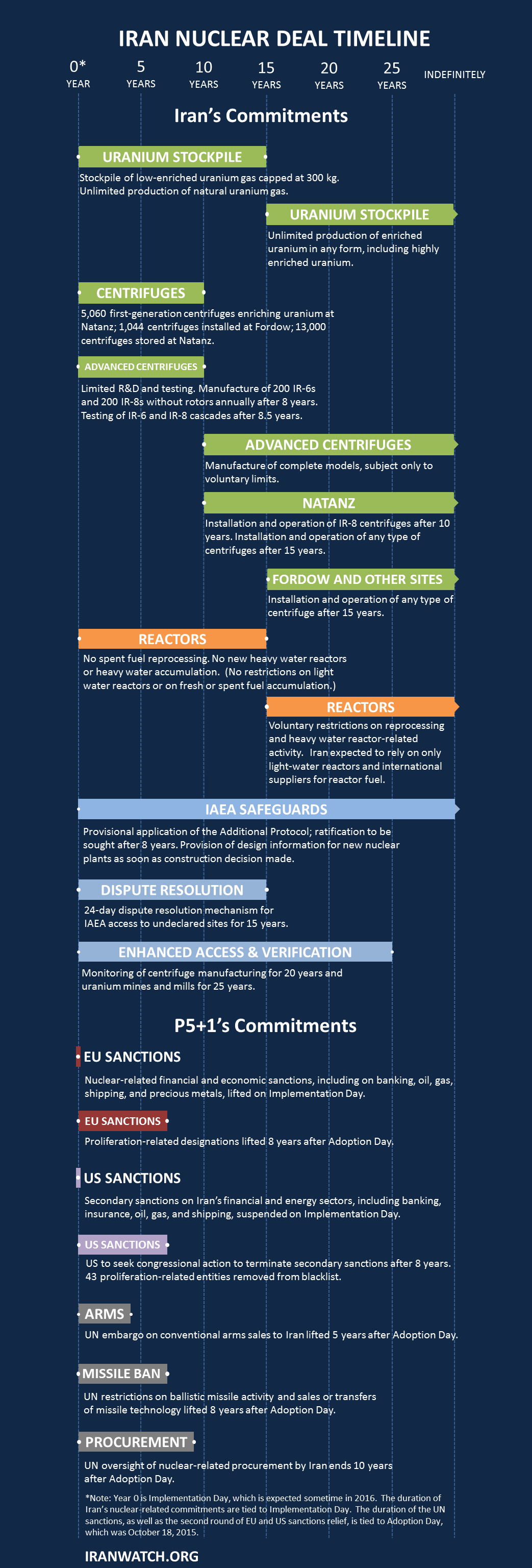
Iran Nuclear Deal Timeline – November 9, 2015


What to Watch for after Implementation Day – October 5, 2015

“As Implementation Day approaches, three issues should receive more scrutiny: how any future illicit procurement by Iran will be handled; the flow of licit Iranian procurement through a newly-established “white channel”; and the agreement’s dispute resolution mechanism.”


Parchin: A Troubling Precedent for Inspections in Iran – September 3, 2015

“There appears to be little precedent for managed access procedures in which IAEA inspectors are physically restricted from a site completely and monitor verification activity remotely.  Beyond the specifics of the investigation at Parchin, the reported arrangement could set a bad precedent for limiting access to other sites once the JCPOA is implemented.”


What the Iran Deal Says (and Doesn’t Say) about Iran’s Ballistic Missiles – July 30, 2015

“While Iran’s ballistic missile capabilities were not considered a core issue in the nuclear talks, the language of the new U.N. resolution and the terms of the JCPOA have consequences for the future of Iran’s ballistic missile program.  Iran’s efforts to advance its nuclear-capable ballistic missile program – through test launches, production, and illicit procurement – will be made easier, while attempts to punish or deter Iran’s ballistic missile activity will be made more difficult.”


How Will Inspections Work in Iran under the Nuclear Deal – July 14, 2015

“President Obama said that inspectors from the IAEA will ‘be able to access any suspicious location.  Put simply … the IAEA will have access where necessary, when necessary.  That arrangement is permanent.’  But what does ‘where necessary, when necessary’ mean in practice? How will inspections work under the newly signed nuclear agreement?  And will this inspections regime actually be ‘permanent’?”

Iran Air, Prospective Buyer of Boeing Planes, Linked to North Korean Missile Shipments

The House of Representatives approved two measures last week aimed at blocking Boeing from selling commercial aircraft to Iran.  The vote comes a few weeks after Boeing announced a preliminary agreement to sell commercial aircraft to Iran Air, Iran’s national carrier, in a deal worth an estimated $25 billion.  Iran Air was removed from the U.S. sanctions blacklist in January as part of the nuclear deal.  Critics of the proposed sale have cited Iran Air’s links to the Islamic Revolutionary Guard Corps and the Syrian regime and argued that the Boeing aircraft could be used to fly weapons into Syria and to support terrorism.   But there is another troubling link that has gone unnoticed in the current debate: Iran Air’s suspected facilitation of ballistic missile cooperation between Iran and North Korea.

According to a 2011 report by an expert United Nations panel on North Korea, North Korea and Iran allegedly shared ballistic missile technology with the assistance of Iran Air: “Prohibited ballistic missile-related items are suspected to have been transferred between the Democratic People’s Republic of Korea and the Islamic Republic of Iran on regular scheduled flights of Air Koryo and Iran Air, with trans-shipment through a neighboring third country.”[1]  The unnamed third country that served as a trans-shipment point was reportedly China, which blocked the official release of the report.[2]  When the U.S. Treasury Department sanctioned Iran Air in 2011, it also cited the carrier’s transport of missiles and military dual-use technology using passenger aircraft.[3]

While it is unclear to what extent Iran Air is still supporting Iran’s missile-related procurement, there is no evidence that its behavior has changed.  In response to a question at a press briefing on June 23, State Department spokesperson John Kirby refused to confirm that Iran Air was removed from the U.S. blacklist because it was no longer involved in the activities for which it was sanctioned, including shipping weapons to Syria, or even that the United States was convinced it was no longer engaged in those activities.  Instead, Mr. Kirby stated, “I’m not at liberty to go into the reasons behind the fact that it was removed from the SDN list.  All I could tell you is that we wouldn’t have done that if we weren’t comfortable doing so.”[4] Emanuele Ottolenghi, a senior fellow at the Foundation for Defense of Democracies, has noted that while Iran Air has mostly avoided the Iran-Syria route since the conclusion of the nuclear agreement in July 2015, there were three flights using Iran Air aircraft along known weapons routes to Syria last month.[5]

The Iran-North Korea ballistic missile nexus, cited by the U.N. report in 2011, resurfaced in the first round of U.S. sanctions after the implementation of the nuclear agreement in January.  The Treasury Department targeted five Iranian officials affiliated with the Ministry of Defense of Armed Forces Logistics (MODAFL), which coordinates Iran’s ballistic missile program, and two MODAFL subsidiaries: the Aerospace Industries Organization (AIO), which oversees missile production; and the Shahid Hemmat Industrial Group (SHIG), which is responsible for liquid-fueled missiles.[6]

According to Treasury, SHIG missile technicians and MODAFL officials have traveled to North Korea over the past several years to work on an 80-ton rocket booster being developed by the North Korean government.  This technology would help both countries extend the range of their missiles.  SHIG also coordinates shipments of missile-related goods to Iran from the Korea Mining Development Trading Corporation (KOMID), North Korea’s primary exporter of ballistic missile-related equipment that has been sanctioned by the United Nations, United States, and European Union.  These goods include valves, electronics, and measuring equipment that can be used in tests of liquid-fueled ballistic missiles and space launch vehicles.

These designations, along with a spate of recent tests, confirm that Iran’s ballistic missile program has not slowed, despite the nuclear agreement struck in July 2015.  They also confirm that Iran still relies on illicit procurement networks to fuel its missile progress.  A June report from Germany’s domestic intelligence service found that Iran’s “illegal proliferation-sensitive procurement activities in Germany […] persisted in 2015 at what is, even by international standards, a quantitatively high level.”[7]  The report also noted “a further increase in the already considerable procurement efforts in connection with Iran’s ambitious missile technology program.”  Another recent intelligence report, by Germany’s state of North Rhine-Westphalia, cited nearly 150 WMD-related procurement attempts in that state in 2015, about two-thirds of which were by Iran.[8] Two German intelligence officials interviewed by the Wall Street Journal about these reports said that such illegal procurement efforts by Iran have continued in 2016, though at a slower pace.[9]

Iran Air, therefore, offers a troubling case.  It has been linked by the United Nations to the facilitation of missile-related cooperation between Iran and North Korea—activity that led to the first new U.S. sanctions against Iran after the nuclear agreement was implemented this year.  The U.S. government has not explained publicly why Iran Air was removed from the U.S. blacklist or explicitly stated that Iran Air is no longer engaged in the activity for which it was originally sanctioned.  Meanwhile, Iran has resumed its ballistic missile tests and, as the German intelligence services report, continues to seek sensitive missile-related technology overseas, in violation of U.N. Security Council resolutions.  Given that Iran’s commitment to ballistic missile development is unchanged, even if the Boeing aircraft to be sold to Iran Air are intended for civil aviation purposes, there is no guarantee that these aircraft would not end up supporting Iran’s missile program or other malign activities.


Footnotes: 

[1] “Report of the Panel of Experts established pursuant to resolution 1874 (2009),” United Nations Security Council, May 2011, p. 40, unpublished (via Iran Watch): http://www.iranwatch.org/library/multilateral-organizations/united-nations/un-security-council/report-panel-experts-established-pursuant-resolution-1874-2009.

[2] Tania Branigan, “China Denies Role in North Korea-Iran Missile Trade,” Guardian (U.K.), May 18, 2011, https://www.theguardian.com/world/2011/may/18/china-denies-role-north-korea-iran-missile-trade.

[3] “Fact Sheet: Treasury Sanctions Major Iranian Commercial Entities,” U.S. Department of the Treasury, June 23, 2011 (via Iran Watch): http://www.iranwatch.org/library/governments/united-states/executive-branch/department-treasury/fact-sheet-treasury-sanctions-major-iranian-commercial-entities.

[4] Daily Press Briefing, U.S. Department of State, June 23, 2016 (via Iran Watch):  http://www.iranwatch.org/library/governments/united-states/executive-branch/department-state/state-department-spokesman-john-kirby-comments-boeing-sale-iran

[5] Emanuele Ottolenghi, “The Risks of the Iran-Boeing Deal,” The Hill, June 21, 2016, http://thehill.com/blogs/pundits-blog/international/284269-the-risks-of-the-iran-boeing-deal

[6] “Treasury Sanctions Those Involved in Ballistic Missile Procurement for Iran,” U.S. Department of the Treasury, January 17, 2016 (via Iran Watch): http://www.iranwatch.org/library/governments/united-states/executive-branch/department-treasury/treasury-sanctions-those-involved-ballistic-missile-procurement-iran

[7] Federal Ministry of the Interior, 2015 Annual Report on the Protection of the Constitution, June 2016, p. 30, https://www.verfassungsschutz.de/en/public-relations/publications/annual-reports/annual-report-2015-summary.

[8] Verfassungsschutzbericht des Landes Nordrhein-Westfalen über das Jahr 2015, July 4, 2016, pp. 214-217, https://www.mik.nrw.de/nc/publikationen/produktauswahl.html?tt_products%5Bcat%5D=11.

[9] Anton Troianovski and Jay Solomon, “Germany Says Iran Kept Trying to Get Nuclear Equipment After Deal,” Wall Street Journal, July 8, 2016, https://www.wsj.com/articles/germany-says-iran-kept-trying-to-get-nuclear-equipment-after-deal-1468006075.

Treasury Gives New Guidance, but Banks Still Wary

The U.S. Treasury Department released new guidance on June 8 that appears intended to reassure European and other non-U.S. banks wary of doing business with Iran.  In an updated explanatory document published by the Office of Foreign Assets Control, the Treasury Department stated that the U.S. financial system will remain open to foreign banks doing business with non-sanctioned Iranian financial institutions, as long as any U.S. employees in those foreign banks are “ring-fenced” from Iran-related business.  This new guidance, however, merely restates U.S. policy.  It falls well short of the specific assurances that have been sought by European bankers and officials.  As a result, the new guidance is unlikely to have much impact.

The updated guidance is a bit more specific than previous iterations.  It states: “U.S. financial institutions can transact with … non-U.S., non-Iranian financial institutions that … transact with Iranian financial institutions that are not on the SDN list.”   In other words, foreign banks that do business with Iran will still be able to access U.S. financial institutions, as long as they steer clear of sanctioned Iranian companies and individuals.  This statement, however, merely re-iterates a longstanding U.S. position.

The new guidance also reinforces three important U.S. prohibitions.  First, the reference to “the SDN list” implicitly renews the threat of U.S. sanctions by reminding foreign banks that blacklisted Iranian institutions remain off-limits.  These sanctions still target foreign entities for dealing with certain blacklisted Iranian sectors and entities, such as those linked to terrorism or to the Islamic Revolutionary Guard Corps (IRGC).  Second, foreign banks will still be forbidden from “rout[ing] Iran-related transactions through U.S. financial institutions or involv[ing] U.S. persons in such transactions.”  Third, while foreign companies with American managers or directors can do business with non-sanctioned Iranian companies, all U.S. persons “must be walled of or ‘ring-fenced’ from Iran-related business.”

Wary European banks and officials are unlikely to be satisfied by the new language.  According to a June 7 report in Bloomberg, European Union financial ministers unsuccessfully sought to gain more explicit guidance on the reach and application of remaining U.S. sanctions during talks in Brussels in May.  U.S. officials reportedly declined to provide any additional assurances beyond their publicly stated policy.  The Bloomberg report also quoted Francesco Fini, an EU official, as saying that several EU companies have lobbied the European Commission to bring their individual cases to the Treasury Department in order to gain legal clearance to do business with Iran.  France’s government is also reportedly in talks with OFAC in an attempt to gain legal assurance for companies seeking to enter the Iranian market.  The new OFAC guidance does not provide any mechanism for case-by-case clearance or review for individual companies.

The continued reluctance of European and other non-U.S. banks to re-enter the Iranian market is reinforced by their concern about the lack of transparency in Iran and Iran’s weak anti-money laundering and terrorist financing regulations.  As a result, it is difficult for banks to know whom they are dealing with, and whether that party is on the U.S. blacklist, or is controlled by a blacklisted entity.  Foreign companies risk violating remaining U.S. sanctions by doing business—even unknowingly—with blacklisted entities.  According to a report by the London-based law firm Clyde & Co, 58 of 100 British executives surveyed said they are staying out of the Iranian market because of fear of the regulatory penalties that have remained in place after the implementation of the nuclear deal. Thirty percent of the executives said they were so fearful of sanctions that they were even reluctant to discuss plans to enter Iran with their own banks.  Businesses are also fearful of the possibility that sanctions could be re-imposed if Iran violates the deal.

Iran has voiced frustration with the slow pace of the economic benefit it has received.  Iranian banks reportedly have had difficulty processing international financial transactions and repatriating billions of dollars in previously frozen oil revenue from overseas accounts.

Treasury spokeswoman Betsy Bourassa told Bloomberg that U.S. Treasury and State Department officials “have traveled worldwide to meet with government and private sector partners to provide additional clarity on our sanctions.”  Ms. Bourassa attributed some of the slow pace of Iran’s re-integration into the global economy to factors beyond U.S. control, such as Iran’s “destabilizing activity in the region” and a lack of transparency in its financial system.  Daniel Glaser, Assistant Secretary of the Treasury for Terrorist Financing, echoed this position in May, citing the limitations of Iran’s financial system: “If Iran wants access to the international financial system, and Iran clearly does and it’s something that they are entitled to, they need to understand that the international financial system is a rules-based system. And Iran understands those rules and Iran is working to put a system in place that implements those rules. This is something [that] is going to develop over time.”

Missile Sanctions Must Target Iran’s Suppliers

On May 9, a senior Iranian defense official announced the recent test of “a missile with a range of 2,000 kilometers and a margin of error of 8 meters.”[1]  Iran’s defense minister quickly refuted the specifics of this claim, but not the test itself.[2]  This appears to be the latest in a series of Iranian missile tests since last October, all of which are considered by Western officials to be “in defiance of” a new U.N. Security Council resolution that took effect on January 16— the same day as the nuclear agreement.

The response to such activity should be more sanctions aimed at Iran’s missile program.  New sanctions, unfortunately, will not be forthcoming from the United Nations, where they would have the broadest impact.  The new resolution is more permissive in its treatment of Iran’s ballistic missile activity than previous resolutions addressing the country’s missile program.  Instead, it will be up to the United States and other concerned countries to respond.  These sanctions should target not only Iranian entities supporting the missile program, but, more critically, Iran’s extensive network of foreign suppliers.

Since the nuclear agreement took effect, however, only the United States has taken—limited—action against these illicit procurement networks.  In January, a handful of companies and individuals operating in Hong Kong and the United Arab Emirates were blacklisted for supplying material and equipment related to carbon fiber production to Iran’s Navid Composite Materials Company.  These transfers took place “since at least early 2015,” according to the U.S. Treasury Department.  Navid Composite is a subsidiary of U.N.-sanctioned Sanam Industrial Group and carbon fiber can be used in ballistic missile components.  In March, the U.S. Commerce Department targeted a global network of companies supplying U.S.-origin items to “an Iranian party associated with the Iranian Defense Industry.”  This network operated in Hong Kong and U.A.E., but also in India, Malaysia, the Netherlands, Singapore, and Switzerland.

A focus on Iran’s illicit network of foreign suppliers will be critical going forward.  Iran remains dependent on imports to improve the range and accuracy of its missiles.  And the new U.N. resolution maintains restrictions on Iranian imports of missile and missile dual-use technology for a period of eight years.  But while dozens of Iranian missile developers remain on the U.N. blacklist, none of Iran’s foreign suppliers are listed.  The United Nations has never targeted these suppliers and is even less likely to do so now.  Most of these suppliers are not well known and could continue to operate in the absence of robust national enforcement.  National sanctions would help expose these networks, raise their transaction costs, and complicate their operations.

The case of Li Fang Wei (Karl Lee) is an example of the value—and limitations—of such national action.  His infamous case is an illuminating study of how the illicit procurement networks that have supplied Iran’s weapons program operate in practice.   Since at least the early 2000s, he has run a cluster of companies located in Dalian, a port city in northeastern China.  At first, Li traded with Iran using his own company, LIMMT Metallurgy and Minerals Company, or one of the firm’s many aliases.  As he came under greater scrutiny, Li shifted tactics.  He began to establish waves of front companies in China to help carry out transactions, moving on to a fresh set of companies whenever the previous batch came onto the radar of the U.S. government.

In response, Li has been heavily and repeatedly sanctioned by the United States.  He was indicted twice, in 2009 and 2014, for his fraudulent use of the U.S. financial system in carrying out sales to Iran.  He is also the subject of a $5 million reward for information leading to his arrest, a rarity in the proliferation/export control world.  And he has been under continual U.S. State and Treasury Department sanctions for a number of years, with the most recent round of State sanctions coming in September 2015.  But in the absence of action from the Chinese government to shut down individuals like Li and his network, they can continue to operate with relative impunity.

Li’s assistance to Iran’s missile program has been considerable, and reveals Iran’s reliance on foreign goods. The list of missile-related items he has supplied, or attempted to supply, includes accelerometers, gyroscopes, high-grade aluminum alloys, maraging steel rods, tungsten metal powder, tungsten-copper alloy plates, and graphite cylinders.  Equally troubling has been his customer list in Iran: subsidiaries of Defense Industries Organization (DIO) that are directly involved in missile development, including Khorasan Metallurgy Industries, Amin Industrial Group, Shahid Sayyade Shirazi Industries, and Yazd Metallurgy Industries.  Li has also done business with Shahid Bagheri Industrial Group, Iran’s key developer of solid-fueled ballistic missiles.  All of the above-mentioned entities are still sanctioned by the United Nations, because of their involvement in Iran’s missile program.

Iranian officials have made clear that they will not stop missile work as a result of the nuclear agreement.  This means not only the continuation of high-profile tests, but Iran’s continued reliance on foreign procurement networks that support missile development.  In the absence of new U.N. sanctions—or a vigorous oversight body like the now-disbanded U.N. Panel of Experts to investigate violations—it will be up to governments to investigate procurement networks and punish key suppliers, like Li.  This is especially important in the post-agreement environment, when trade with Iran is expected to flow more freely than it has in recent years.


Footnotes: 

[1] “Commander Says Iran Tests 2000km-Range Ballistic Missile,” Tasnim News, May 9, 2016, https://www.tasnimnews.com/en/news/2016/05/09/1070472/commander-says-iran-tests-2000km-range-ballistic-missile

[2] “Iranian DM Denies Test-Firing of Ballistic Missile,” Fars News, May 9, 2016, http://en.farsnews.com/newstext.aspx?nn=13950220001309

The Iran Nuclear Agreement: What Comes Next?

Remarks at the Heritage Foundation, Washington D.C.

The nuclear agreement between Iran and the P5+1 was officially implemented in January 2016.  As a result, Iran has agreed to restrict the most worrisome parts of its known nuclear program—in particular, its uranium enrichment capability—for a period of about ten years.  It is wrong to assume, however, that the proliferation problem has been resolved, or that the threat has gone away.  It has not; it has just shifted.  Over the long term, there is a risk of a vastly expanded nuclear program because the restrictions imposed on Iran are not indefinite.  What happens in ten years?  In the nearer term, there is the Iranian ballistic missile threat.  Iran’s ongoing development of nuclear-capable ballistic missiles is not an activity covered by the agreement.  There are also questions about how robustly the deal will be enforced because the agreement’s enforcement mechanisms have not been tested yet.

I would like to focus my remarks on these last two points: the enforcement of the nuclear deal—specifically inspections, the dispute resolution process, and the new procurement channel—and how the agreement has loosened restrictions on Iran’s missile work.

Inspections and Verification

Inspections are a major part of enforcing the terms of this agreement and ensuring the transparency the deal promised.  The IAEA is in charge of inspections and making sure that Iran maintains restrictions on its nuclear work.  The IAEA’s first report since the agreement was implemented came out in late February.  Instead of containing more information, there was less.

Before the agreement, the IAEA offered robust quarterly reporting, typically about 20 to 30 pages long.  This included detailed annexes, as well as updates on the IAEA’s investigation of allegations that Iran conducted nuclear weaponization work in the past—the so-called “possible military dimensions” or “PMD” investigation.   The February report, however, was only 10 pages long, offered very little detail, and offered no more reporting on the “PMD” investigation, which the IAEA officially closed despite not reaching definitive conclusions.  The result is less public visibility into Iran’s declared nuclear program, not more.

So there is already a question about IAEA reporting on standard, non-controversial access to declared nuclear sites in Iran.  What about undeclared sites?  If inspectors want access to a site not declared by Iran to be part of its nuclear program, then the IAEA needs to request a challenge inspection.  The agreement allows for this type of inspection, and obtaining access to such sites is a key part of ensuring that Iran is not operating secret sites as part of a clandestine nuclear program.  U.S. intelligence has long predicted that if Iran develops nuclear weapons, it will do so at covert facilities—not by “breakout” at its declared sites.  It is important to remember that many of the sites that today are known and part of Iran’s declared nuclear program were launched in secret.

The agreement is very specific about the process for launching a challenge inspection, which is supposed to take place within 24 days of an initial request by IAEA inspectors.  But how this will work in practice is not known.  The process has not been tested yet under the agreement, and past experience of trying to access undeclared sites in Iran has not been good.  There is the precedent of IAEA efforts to gain access to Parchin, a military site in Iran allegedly connected to nuclear weaponization work that the IAEA had been asking questions about for years.  After years of being stonewalled by Iran and observing extensive renovation at the site, the IAEA was reportedly granted the ability only to observe, via video monitoring, Iranian officials taking environmental samples at designated locations at Parchin.  The experience in other countries, such as Iraq and North Korea, is also cautionary.  In Iraq, inspectors had far more authority on the ground after the end of the First Gulf War, and it was still challenge—there were regular disputes and confrontations over access.

Dispute Resolution

Inspections of undeclared sites in Iran are just one area of likely dispute.  There is already disagreement about the pace of sanctions relief.  There could also be disagreement about the approvals or denials of transfers of nuclear technology to Iran.

A newly created Joint Commission was established to handle these disputes.  All parties to the agreement, including Iran, sit on this commission.  According the agreement, disputes are supposed to be resolved quickly—within 15 days.  This seems unlikely, however, because the procedures for how the commission will resolve disputes are highly bureaucratic.  The period of deliberation can be extended, outside advisors can be called in, and disputes can be sent up to the ministerial level.  The mechanism has not been tested, so it is difficult to pass judgment at this point.  But it will be critical to resolve any disputes—small or large—expeditiously and not let any ambiguities linger, or confidence in the agreement will gradually be undermined.

The Procurement Channel

The new U.N. procurement channel is the least well-defined aspect of the agreement and the least publicized.  The nuclear agreement established a dedicated procurement channel for authorized Iranian imports of sensitive nuclear and nuclear dual-use technology.  Before the agreement, Iran was not allowed to import any controlled nuclear and missile-related items, as well as most conventional arms.

The agreement relaxed some of these restrictions, specifically in the nuclear realm.  A Procurement Working Group was created to monitor the sensitive items Iran is now allowed to import.  It will operate for ten years and will review and decide on import requests for controlled nuclear goods.  The review process for requests is to take no more than 30 days.

The IAEA will be allowed to verify end-use locations of some approved nuclear imports that will be going to Iran’s nuclear sector.  Countries are allowed to verify the end use of approved nuclear imports that are intended for a non-nuclear civilian sector in Iran.  These are dual-use goods and technology that have other industrial or scientific application.

There are a number of open questions about how this channel will function:

  • The Procurement Working Group has met but does not appear to have reviewed any proposed sales.  When will goods start flowing into Iran?
  • Will procurement requests and decisions by the Group be made public?
  • How will the end-use of sensitive items from key supplier countries like Russia and China be monitored?  The reality is that countries with the most trade with Iran will be the least interested in doing robust end user or end-use checks.

It will be important to make sure that Iran strictly uses this channel for its imports of controlled technology.

Missiles

The nuclear agreement has made it more difficult to enforce restrictions on Iran’s ongoing development of nuclear-capable ballistic missiles.  Previously, the U.N. prohibited all activity related to missiles capable of carrying nuclear weapons.  U.N. sanctions could be imposed on this activity.

But missiles were not included in the nuclear agreement, meaning the deal’s “snapback provision”—which allows any country to unilaterally re-impose U.N. sanctions on Iran in the case of significant non-performance—does not apply to missile violations.  The restrictions on Iran’s missile program are covered by a new U.N. Security Council resolution that prohibits work on missiles designed to carry nuclear weapons.  This wording allows Iran’s work to proceed because Iran claims its missiles are not designed for this purpose—though the missiles are inherently capable of carrying nuclear weapons and meet the Missile Technology Control Regime’s definition of nuclear-capable missiles.

There is also no longer an explicit U.N. ban on Iranian activity related to ballistic missiles. Under the new resolution, Iran is simply “called upon” not to test.  Iran is not heeding this call, and there have been at least three tests of Shahab-3 missile variants since October 2015.

The new resolution does restrict sales of missile technology to Iran for eight years.  But there is a provision in the resolution under which any country that wants to sell missile technology to Iran can do so by petition to the U.N. Security Council.  The U.N. is expected to tightly control the most sensitive items for the eight-year period, but it may allow certain dual-use imports, ostensibly for civilian purposes.  For instance, imports for Iran’s expanding space program could directly support Iran’s efforts to extend the range of its ballistic missiles.

Going forward, it will be very important to keep strong restrictions on these programs—internationally, to the extent possible, through the U.N., and through national enforcement, including investigations, shutting down illicit procurement networks, interdiction, and sanctions.

Simmering Dissatisfaction on Both Sides of Nuclear Deal

Secretary of State John Kerry and Iranian Foreign Minister Javad Zarif met in New York on April 19 amid dissatisfaction on both sides about the implementation of the nuclear agreement.  Iran has voiced frustration with the slow pace of financial sanctions relief promised by the agreement, and Mr. Zarif said the meeting focused on how to “make sure that we will draw the benefits Iran is entitled to from implementation of the agreement.”[1]  The United States, meanwhile, is concerned about an increase in Iranian ballistic missile tests – an activity not directly addressed in the agreement but relevant to nuclear weapons.

Since the deal was implemented in January, Iranian banks reportedly have had difficulty processing international financial transactions and repatriating billions of dollars in previously frozen oil revenue from overseas accounts.  Speaking in Washington on April 15, Iran’s central bank governor, Valiollah Seif, said the Obama administration risks jeopardizing the nuclear deal unless it does more to facilitate Iran’s international financial transactions.  “They need to do whatever is needed to honor their commitments.  Otherwise, the [deal] breaks up under its own terms,” Mr. Seif said.  Specifically, Mr. Seif said that Iran should be permitted to access the U.S. financial system and dollar-denominated transactions through U.S. banks.[2]  U.S. law still prohibits Iran from accessing U.S. banks and the dollar, and U.S. officials have said they would not relent on either demand.

European rules about doing business with Iran are far less restrictive, but European banks have been reluctant to deal with Iran for fear of running afoul of U.S. Treasury regulations.[3]  As a result, the economic “windfall” that the Iranian government hoped to enjoy reportedly has not materialized.   At a dinner hosted by the J Street group on April 18, Secretary Kerry said that Iran, to date, has only recouped about $3 billion of its frozen assets—not the $55 billion to a $155 billion figure often cited. Secretary Kerry’s estimate, for which he did not provide an explanation, seemed to support the Iran’s complaint that it remains largely cut off from the financial system.[4]  The Obama administration reportedly has been exploring ways of facilitating Iranian trade by providing access to dollar-denominated trade without directly touching U.S. financial institutions located in the United States .

Meanwhile, U.S. officials are concerned about Iran’s renewed ballistic missile testing, which had been paused during negotiations.  Since October 2015, Iran has conducted at least three tests of variants of its single-stage, liquid-fueled Shahab-3 missile, which is nuclear-capable.  The most recent test occurred in March, when the Islamic Revolutionary Guard Corps conducted two days of large-scale ballistic missile exercises.[5]  The U.S. intelligence community has long judged that Iran “would choose ballistic missiles as its preferred method of delivering nuclear weapons, if it builds them”—a judgment it renewed in February.[6]

Yet neither the nuclear agreement nor the new U.N. Security Council resolution 2231 allows for sanctions to punish Iran’s missile tests.  The United States and its European allies have called Iran’s recent ballistic missile tests “inconsistent with” and “in defiance of” U.N. resolution 2231.  Yet Western diplomats admit that because of the weakness and ambiguity of the U.N. language, the resolution’s exhortation against Iranian ballistic missile activity is not legally binding and would not trigger new U.N. sanctions.[7]  Neither is there recourse under the terms of the nuclear agreement.  As Secretary Kerry has made clear, neither the conventional arms nor the missile restrictions in resolution 2231 are tied to the JCPOA’s “snapback” sanctions provisions.

The Obama administration has come under increasing pressure, not least from Congress, to take unilateral action in response to these tests, but thus far it  has only issued relatively minor sanctions against a few entities linked to Iran’s missile program.  Speaking on April 7 at a meeting with the foreign ministers of the Gulf Cooperation Council, Secretary Kerry, said that the U.S. and its Gulf allies were “prepared to work on a new arrangement to find a peaceful solution to these issues.”  Secretary Kerry said that the Iranians must first “make it clear to everybody that they are prepared to cease these kinds of activities that raise questions about credibility and questions about intentions.”[8]

This argument appears unlikely to change Iran’s behavior.  Mr. Zarif, speaking at a press conference in Tehran on April 10, rejected Secretary Kerry’s calls for a “new arrangement,” stating: “It is crystal clear that the Islamic Republic of Iran’s missile and defense capabilities are not negotiable, and if the US is serious about defense issues, it should decrease the amount of weapons sold to the regional countries.”[9]


Footnotes: 

[1] Louis Charbonneau, “U.S., Iran Discuss Fulfilling Nuclear Deal Pledges to Tehran,” Reuters, April 19, 2016, http://www.reuters.com/article/us-iran-nuclear-kerry-idUSKCN0XG2H9

[2] Jay Solomon, Asa Fitch, and Benoit Faucon, “Iran’s Central Bank Chief Warns Banking-Access Issues Jeopardize Nuclear Deal,” Wall Street Journal, April 15, 2016, https://www.wsj.com/articles/irans-central-bank-chief-warns-banking-access-issues-jeopardize-nuclear-deal-1460745930

[3] Jonathan Saul, “British Banks Seen Holding Back Iran Trade Due to Fear of U.S. Penalties,” Reuters, April 11, 2016, http://www.reuters.com/article/us-iran-banks-idUSKCN0X825G

[4] “Kerry Says Iran’s Cash ‘Windfall’ From Nuclear Deal only $3 Billion,” Radio Free Europe/Radio Liberty, April 19, 2016, http://www.rferl.org/a/us-secretary-state-kerry-iran-cash-windfall-from-nuclear-deal-only-3-billion/27683164.html

[5] “Iran Successfully Test-Fires Ghadr Missiles,” Iran Watch, News Brief, March 9, 2016,  http://www.iranwatch.org/news-brief/iran-successfully-test-fires-ghadr-missiles

[6] James R. Clapper, “Statement for the Record: Worldwide Threat Assessment of the US Intelligence Community,” Senate Armed Services Committee, February 9, 2016, https://www.dni.gov/files/documents/SASC_Unclassified_2016_ATA_SFR_FINAL.pdf.

[7] Louis Charbonneau, “Exclusive: Iran Missile Tests Were in ‘Defiance Of’ U.N. Resolution – U.S., allies,” Reuters, March 30, 2016, http://www.reuters.com/article/us-iran-missiles-idUSKCN0WV2HE

[8] Bradley Klapper, “US Open to ‘New Arrangement’ on Iran’s Missile Tests,” Associated Press, April 7, 2016, http://bigstory.ap.org/article/ff0aa48a68494bdd9eef9b26baba49bf/bahrain-kerry-treads-carefully-human-rights

[9] “Zarif: No JCPOA Possible Over Iran’s Defense Program,” Mehr News Agency, April 10, 2016, http://en.mehrnews.com/news/115693/No-JCPOA-possible-over-Iran-s-defense-program

New Guidance on U.N. Procurement Channel Raises Larger Questions about Iran Deal Enforcement

This week, the United Nations published some guidance about a critical part of the nuclear agreement with Iran: the procurement channel.  Sales to Iran of items controlled by the Nuclear Suppliers Group (NSG) and of non-listed items with nuclear applications must pass through this channel, following a review by the newly created Procurement Working Group.  The role of this group was set forth in the nuclear agreement, but little information had been released about how it will function in practice.

The recent guidance – in the form of two short PowerPoint presentations – comes about two months after the agreement was officially implemented, with Iran scaling back parts of its nuclear program in exchange for sanctions relief.  Because the deal was implemented faster than initially anticipated by Western diplomats, restrictions on Iran’s nuclear program have been loosened without the structure necessary to ensure that Iran, as well as any government or company that wants to engage in business with Iran, is complying with the remaining – and considerable – constraints.

A number of these restrictions relate to procurement.  Iran built up its nuclear and missile capabilities using material and equipment acquired illicitly from abroad.  The nuclear agreement is meant to guard against such procurement – at least on the nuclear side – by scrutinizing the sensitive items Iran is once again allowed to import, as well as the end-users in Iran allowed to participate in this trade.

The scrutiny is to be overseen by the Procurement Working Group, comprised of one member from Iran and one member from each of the P5+1 countries, plus the E.U. High Representative.  According to the information released this week, the group is one of several entities involved in monitoring and approving Iranian nuclear imports.  This bureaucracy may hinder the channel from functioning expeditiously, with the possibility of foot-dragging at each level.

Export proposals must be made by countries – not companies – to the U.N. Security Council, through a U.N. facilitator and the Security Council Affairs Division of the U.N. Department of Political Affairs.  Individual countries seeking to export goods through the procurement channel must establish their own internal mechanisms for putting forth proposals.  It is unclear whether many countries have had the necessary time to do so.

Each export proposal then will be passed from the Security Council to a Joint Commission that was established by the agreement.  The Procurement Working Group, which is subordinate to this Commission, reviews the request and issues a recommendation.  The group operates by consensus and is intended to make decisions within 30 working days.  Its recommendation is then sent back to the Security Council for a final decision, and the exporting state is informed.

This mechanism is meant to function for ten years and review transfers of not only tangible items but also the provision of “technical assistance or training, financial assistance, investment, brokering or other services related to the supply, sale, transfer, manufacture, or use” of these items. The broad scope of the procurement channel – and the sheer volume of requests that may pour in – could place enormous stress on the working group given the short timeline for reviewing proposals.

Each export proposal must include a description of the item, its proposed end-use and end-use location, as well as information about the exporting entity, the end-user in Iran, and any other parties to the transaction, including agents, brokers, consignees, or freight forwarders.  Proposals must also include an end-user certification form from either the Atomic Energy Organization of Iran (for the nuclear sector) or Iran’s Ministry of Foreign Affairs (for non-nuclear civilian sectors).  All of these elements must be screened and potentially investigated by the working group.

The recent guidance also confirms exceptions to the channel that were spelled out in the nuclear agreement, including light-water reactor technology and related reactor fuel, imports to modify the Arak heavy water reactor, and trade in natural and low-enriched uranium (LEU) to help maintain Iran’s 300 kg cap on LEU.  Transfers of these goods would have to be reported to the Security Council and to the International Atomic Energy Agency (IAEA), and supplier countries would be responsible for ensuring proper end-use.

The Joint Commission and the Procurement Working Group have additional functions, such as providing expertise on end-use verification to exporting states and responding to requests for guidance from third parties, within nine working days, according to the recent guidance.  Reports on procurement channel decisions will apparently be made every six months to the Security Council.  It is not clear if these reports will be made public, or if they will be combined into a more general report on implementation made by the U.N. Secretary General to the Security Council.  According to the guidance, “the operation of the procurement channel will be subject to the confidentiality of the U.N.”  This means that procurement requests, working group recommendations, and Security Council decisions may not be made public.

Violations of procurement rules will be handled by the Joint Commission and the Security Council.  Under prior United Nations resolutions, a dedicated U.N. committee was charged with monitoring the implementation of sanctions against Iran, and an expert panel focused on investigating and reporting on possible violations.  This Panel of Experts was one of the most valuable international instruments for scrutinizing and publicizing illicit Iranian activity.  However, in response to demands from Iranian negotiators, both the U.N. committee and the Panel of Experts were dissolved as part of the nuclear agreement.  It appears there will now be less transparency about procurement and sanctions violations than before, much like the reduced detail about Iran’s nuclear program included in IAEA reports since the implementation of the nuclear agreement.

The procurement channel is just one example of how former restrictions on Iran’s nuclear program were removed faster than new enforcement structures could be put in place.  It is unclear how long it will take for the United Nations, the new Joint Commission, and individual states to get the channel up and running—and whether sufficient information will be publicly released about the channel’s operations and decisions.  The implementation of the nuclear deal in January was hailed as a diplomatic milestone.  But the agreement’s success in reining in Iran’s nuclear ambitions cannot be known until it has been in place for some time and its enforcement mechanisms have been tested.

CEO of U.S. Metallurgical Company Charged with Illicit Export of Metallic Powder to Iran

The CEO of a New York-based metallurgical company has been arrested on charges of illegally exporting a specialized metallic powder from the United States to Iran, the U.S. Justice Department announced on March 1.  According to the criminal complaint, Erdal Kuyumcu, a naturalized U.S. citizen of Turkish descent, allegedly exported over a thousand pounds of a thermal spray powder to Iran, via transshipment through Turkey, in two shipments in 2013.  The metallic powder is composed primarily of cobalt and nickel and can be used to coat gas turbine components, which have aerospace, missile production, and nuclear applications.

Kuyumcu, the CEO of Global Metallurgy LLC in Woodside, New York, allegedly acted as an intermediary for a procurement network involving companies in Iran and Turkey.  According to the complaint, an Iran-based procurement agent placed orders for the metallic powder with a metallurgical company based in Istanbul, Turkey.  The owner of the Turkish company turned to Kuyumcu for help in fulfilling the orders.  Kuyumcu obtained the metallic powder from a supplier in Ohio, providing the name of the Turkish company as the false end-user.  The powder was then shipped from Global Metallurgical in New York to the Turkish company in Istanbul, after which it was sent to the unnamed end-user in Iran.  The complaint alleges two illicit shipments of the powder: the first in March 2013 of 670 pounds of the powder worth $22,076.50; and the second in July 2013 of 330 pounds of the material worth $11,170.50.

This case fits the pattern of Iran-based procurement networks using Turkey as a transshipment point for illicit exports of U.S.-origin goods.  Individuals and companies seeking to evade U.S. export restrictions rely on non-embargoed countries, such as Turkey, for transshipment to end-users in Iran.  According to the complaint, Turkey is often a transshipment point for American goods destined for Iran—goods that are accompanied by falsified end-user information.  In the Kuyumcu case, the Turkish metallurgical company was falsely represented to be the end-user of both shipments of the metallic powder.  The scheme was uncovered through a post-shipment verification check conducted by the U.S. Department of Commerce at the Turkish company.

Other recent high-profile export control cases have also involved transshipment through Turkey.  Arthur Shyu, a manager of Hosoda Taiwan Co. Ltd., was arrested in April 2015 for allegedly shipping sensitive U.S.-origin microelectronics to Iran using an Istanbul-based company called Golsad Istanbul Trading. AAG Makina, a Turkish equipment manufacturer, settled one charge in March 2015 of illegally forwarding U.S.-origin valve parts to Iranian petrochemical companies.

The Iranian procurement ring led by Hossein Tanideh that supplied specialized valves for the heavy water reactor at Arak in 2010 and 2011 also used Turkey as a transshipment point.  In this case, the procurement agents set up shell companies in Istanbul to obtain the valves and then shipped them to Modern Industries Technique Company (MITEC), the Iranian firm responsible for the design and construction of the Arak reactor.  MITEC, which had been under U.N., U.S., and E.U. sanctions, was removed from all three lists in January 2016, as part of the nuclear agreement.

As the cases described above demonstrate, Iran has relied on illicit procurement networks in strategic diversion points, such as Turkey, to advance its nuclear and missile programs.  Even with the nuclear agreement in place, Iran may continue to procure missile and arms related items illicitly because it does not accept an ongoing U.N. ban on such trade.  Therefore countries should exercise extra vigilance in exporting such items to known transshipment hubs, like Turkey.  If these countries served as a hub for illicit trade in the past – when stringent international sanctions were in place – there is every chance that their role will expand in the future, as trade flows to Iran increase.