
News

Major Iranian Nuclear Entities to Receive Early Sanctions Relief

As part of the nuclear agreement with Iran, 36 entities will be removed from the United Nations blacklist when the deal is implemented next year.  This represents about one-third of the entities on the U.N. list and covers entities that have been linked to undeclared nuclear work or illicit nuclear procurement.  The removals also set in motion similar action by the European Union and the United States.  The troubling result is that early on in the lifetime of the agreement, most of these entities may not appear on international screening lists.

The first round of U.N. sanctions relief will arrive on Implementation Day, the date when the International Atomic Energy Agency (IAEA) verifies that Iran has fulfilled its first set of nuclear-related commitments under the deal.  This is expected sometime in 2016.  This sanctions relief is not contingent upon the findings of the IAEA’s investigation into Iran’s alleged past nuclear weapons work.  And it will come well before the Agency has completed its longer-term assessment of Iran’s nuclear program and gives it a clean bill of health—the so-called “Broader Conclusion” that “that all nuclear material in Iran remains in peaceful activities.”  This conclusion will be reached only if Iran is fully cooperative with inspectors, has resolved concerns about its past nuclear activities, and addresses all of the Agency’s questions about its ongoing nuclear program.

In addition to removal from the U.N. list, these 36 entities will also be cleared from the European Union blacklist on Implementation Day.  And all but one of these entities will no longer be covered by U.S. secondary sanctions, meaning that non-U.S. entities may do business with them without risk of being sanctioned by the United States.

The majority of delisted entities are Iranian government officials and nuclear scientists and engineers (20).  Removals also include nuclear research and production facilities (11), subsidiaries of Iran’s national shipping company (3), and the Malaysian branch of Iran’s Bank Mellat.

The initial set of removals from the U.N. list includes the Atomic Energy Organization of Iran (AEOI), the main Iranian organization for research and development in the field of nuclear technology.  The AEOI and its subsidiaries have been repeatedly linked to undeclared nuclear work and illicit procurement.  In addition to the AEOI, the following are the key nuclear-related entities in Iran among the 36 individuals and organizations that will be de-listed by the U.N. on Implementation Day.

  • Esfahan Nuclear Fuel Research and Production Center (NFRPC) and Esfahan Nuclear Technology Center:  The AEOI’s center for nuclear fuel development.  It is the location of a conversion plant that produces the feedstock for uranium enrichment and of laboratories used for nuclear reactor fuel fabrication.  This facility was used by Iran for undeclared work with uranium compounds in the 1980s and 1990s and to store suspicious heavy water and equipment used in undeclared plutonium separation experiments.
  • Jabber Ibn Hayan:  An AEOI department involved in nuclear technology training and located at the Tehran Nuclear Research Center.  The location of undeclared uranium conversion experiments, including the production of uranium metal.  Iran used the laboratory to separate irradiated reactor fuel and as a storage location for separated plutonium.  This laboratory was also part of Iran’s undeclared laser enrichment program.​
  • Karaj Nuclear Research Center (aka Nuclear Research Center for Agriculture and Medicine):  Part of the AEOI research division.  Karaj has been linked to the procurement of vacuum pumps and mass spectrometers and has also been linked to laser and centrifuge enrichment activities.  It was the storage location for a large vacuum vessel and dismantled equipment from a laser enrichment pilot plant.  The Center also serves as a radioactive waste storage facility.
  • Kavoshyar Company:  A subsidiary of the AEOI involved in nuclear procurement.  According to the United Nations, the company sought “glass fibres, vacuum chamber furnaces and laboratory equipment for Iran’s nuclear programme.”  It has also tried to procure vacuum pumps and mass spectrometers and is a supplier of nuclear testing equipment to other entities in Iran.
  • Mesbah Energy Company:  An AEOI subordinate linked to illicit procurement for Iran’s IR-40 heavy water reactor at Arak.  It has repeatedly attempted to procure export controlled nuclear equipment for the reactor, including valves and gauges, pressure switches, cooling towers, and steam traps.
  • Modern Industries Technique Company (MITEC): An AEOI subordinate responsible for the design and construction of the IR-40 heavy water reactor in Arak.  The company “spearheaded procurement” for the reactor, according to the United Nations.  The United States will keep MITEC under sanctions, both primary and secondary, until eight years after the nuclear deal takes effect.
  • Novin Energy Company:  A company that operates within AEOI and has transferred millions of dollars on behalf of the AEOI to entities associated with Iran’s nuclear program.
  • Pars Trash Company:  A subsidiary of the Kalaye Electric Company, which was the primary site for Iran’s secret uranium enrichment program between 1997 and 2002.  The company also acts on behalf of the AEOI and was used as a storage site for centrifuge components, including some with traces of highly enriched uranium.
  • Pishgam (Pioneer) Energy Industries:  The main consulting engineer for the AEOI, providing engineering and technical support for AEOI projects.  It participated in the construction of the Uranium Conversion Facility at Esfahan, a yellowcake production plant, and a nuclear fuel manufacturing plant, among other projects.
  • Tamas Company:  An entity involved in uranium-enrichment activities that oversees four subsidiaries involved in uranium mining and milling, uranium processing, uranium enrichment, and radioactive waste.

Iran’s Nuclear Potential before the Implementation of the Nuclear Agreement

This report provides an estimate of how soon Iran could have fueled a nuclear weapon before the implementation of the new nuclear agreement reached in 2015.  It is phrased in the present tense from the standpoint of a reader looking forward from the autumn of 2015, shortly after the agreement was reached.   The data below, which are based on reports from the International Atomic Energy Agency, describe Iran’s uranium stockpile, its centrifuges, and the rate at which its nuclear capacity had grown.[a]

Highlights:

  • By using the approximately 9,000 first generation centrifuges operating at its Natanz Fuel Enrichment Plant as of October 2015, Iran could theoretically produce enough weapon-grade uranium to fuel a single nuclear warhead in less than 2 months. This timetable is longer if Iran operates fewer centrifuges, or feeds the machines with natural uranium rather than low-enriched uranium.
  • During a visit to Natanz on October 28, 2015, the IAEA observed that Iran had stopped feeding natural uranium into centrifuge cascades in order to perform an annual physical inventory at the plant.
  • Iran’s stockpile of low-enriched uranium is currently sufficient, after further enrichment, to fuel approximately seven nuclear warheads.
  • The restrictions on Iran’s centrifuges and its enriched uranium stockpile required by the Joint Comprehensive Plan of Action for ten years would extend the time it would take Iran to “breakout” and make fuel for one nuclear weapon to one year; the breakout time would decline after ten years, when restrictions on advanced centrifuge operations are eased.  Iran has begun implementing centrifuge restrictions, dismantling 4,112 IR-1 centrifuges and 160 IR-2m centrifuges from Natanz and 258 IR-1 centrifuges from Fordow as of November 15, 2015.
  • Because Russia has a ten-year contract to fuel Iran’s only power reactor at Bushehr, Iran has no present need for enriched uranium to generate civilian nuclear energy.
  • Iran could fuel approximately 25 first generation implosion bombs if it had the ability to enrich the uranium needed to supply the Bushehr reactor annually.

Bomb potential of Iran’s low-enriched uranium

  • Total amount of uranium hexafluoride (UF6) enriched to approximately 3.5 percent U-235 produced as of November 2015:
    16,142 kg[b]
  • Amount of this material ready for further enrichment (i.e., stored in gaseous form) as of November 2015:
    8,306 kg[c]
  • Amount theoretically needed to produce a bomb’s worth of weapon-grade uranium metal:
    1,053 kg[d]
  • Number of first generation implosion bombs this 8,306 kilograms could fuel, if further enriched:
    7[e]
  • Time needed to convert this  uranium to one bomb’s worth of finished uranium metal enriched to 90 percent U-235:
    3 – 12 months[f]
  • Date by which Iran’s  uranium stockpile probably was sufficient to fuel one first generation implosion bomb, if further enriched:
    February 2009[g]
  • Approximate number of first generation IR-1 centrifuges being fed with UF6 at the Natanz Fuel Enrichment Plant, as of October 2015:
    9,000[h]
  • Number of months theoretically needed for these 9,000 centrifuges operating at their estimated capacity to produce enough enriched uranium  for one bomb:
    1.6[i]

Civilian need for this uranium

  • Approximate amount of low-enriched uranium needed annually to fuel Iran’s sole civilian power reactor at Bushehr:
    21 metric tons[j]
  • Percent of this uranium Russia will supply under a ten-year fuel contract:
    100[k]
  • Number of years it would take the roughly 9,000 operating IR-1 centrifuges at Natanz to produce one year’s worth of fuel for Bushehr:
    10.7[l]
  • Approximate number of separative work units (amount of enrichment work)[m] Iran would need to generate in order to produce one year’s worth of fuel for Bushehr:
    100,000[n]
  • Approximate number of IR-1 centrifuges Iran would need to operate in order to produce this level of work annually:
    126,500[o]
  • Approximate number of first generation implosion bombs Iran could fuel if able to enrich the uranium needed to supply Bushehr annually:
    25[p]

Iranian Nuclear Breakout Times Under Different Scenarios

If Iran feeds its IR-centrifuges with natural uranium and operates:
  • 9,000 centrifuges (the number running in October 2015):
    6.8 months[q]
  • 6,104 centrifuges (the number allowed to be installed under the Joint Comprehensive Plan of Action):
    10 months[r]
  • 5,060 centrifuges (the number allowed to operate under the Joint Comprehensive Plan of Action):
    1 year[s]
If Iran feeds its IR-centrifuges with low-enriched uranium and operates:[t]
  • 9,000 centrifuges:
    1.6 months
  • 6,104 centrifuges:
    2.4 months
  • 5,060 centrifuges:
    2.9 months

Comments

  • Before using uranium in a warhead, it must be enriched to weapon-grade (90 percent or more U-235) and processed into a metallic shape sufficient to explode in a chain reaction.
  • This assessment assumes that Iran would use 16 kg of weapon-grade uranium (~90 percent U-235) in the finished core of each nuclear weapon.  Sixteen kilograms are assumed to be sufficient for an implosion bomb.  This was the amount called for in the implosion device Saddam Hussein was trying to perfect in the 1980’s, and the design for such a device has circulated on the nuclear black market, to which Iran has had access.  Some experts believe that Iran could use less material, assuming Iran would accept a lower yield for each weapon.  According to these experts, Iran could use as few as seven kilograms of this material if Iran’s weapon developers possessed a “medium” level of skill, and if Iran were satisfied with an explosive yield slightly less than that of the bomb dropped on Hiroshima, Japan.[u] If Iran chose to use an amount smaller than 16 kg, the time required to make each weapon would be less than estimated here.  Or, in the amount of time estimated here, Iran could make a greater number of weapons.  Iran could decide not to use such a smaller amount of weapon-grade uranium if Iran wanted to have more confidence that its weapons would work, or if it wanted to reduce the size of its weapons by reducing the amount of high explosive required.
  • Iran has converted 337.2 kg of 20 percent enriched uranium gas (or 227.6 kg of uranium) into oxide form, producing 162.3 kg of uranium, some of which has been used to produce fuel for the Tehran Research Reactor.  If it is not irradiated in the reactor, this material could be returned to gaseous form and enriched to weapon grade.  However, it would not be sufficient to fuel more than one nuclear weapon and it is unclear how long it would take to convert and further enrich the material.
  • Uncertainties about the number of centrifuges that Iran is operating make it difficult to draw a conclusion about the performance of individual machines.  An increase or decrease in the production rate could be attributed to the fact that more machines were operating when IAEA inspectors were not present at the plant, rather than because the machines were operating more efficiently.[v] A change in production rate could also be attributed to a decision by Iran to lower the output of its centrifuges.[w]
  • Following start-up, centrifuge cascades must be operated for a time without product withdrawal. This process is called passivation.

Growth of enrichment capacity at the Natanz Fuel Enrichment Plant

Date of IAEA InventoryIR-1 Centrifuges Being Fed
with UF6
Other IR-1 Centrifuges Installed
17 Feb 20070656
13 May 20071,312820
19 Aug 20071,968656
3 Nov 20072,9520
12 Dec 20072,952?
7 May 20083,2802,624
30 Aug 20083,7722,132
7 Nov 20083,7722,132
1 Feb 20093,9361,968
1 Jun 20094,9202,296
12 Aug 20094,5923,716
2 Nov 20093,9364,920
31 Jan 20103,7724,838
24 May 20103,9364,592
28 Aug 20103,7725,084
5 Nov 20104,8163,610
16 Nov 20100~ 8,426
22 Nov 2010~4,592~3,834
20 Feb 2011~5,184~2,816
14 May 2011~5,860~2,140
28 Aug 2011~5,860~2,140
2 Nov 2011~6,208~1,792
19 Feb 20128,808348
19 May 20128,818512
21 Aug 20129,156270
10 Nov 20129,1561,258
19 Feb 2013~8,990~3,680
15 May 2013~8,990~4,565
24 Aug 20139,1566,260
9 Nov 2013~8,800~6,620
10 Feb 2014~9,000~6,420
14 May 2014~9,000~6,420
13 Aug 2014~9,000~6,420
15 Oct 2014~9,000~6,420
8 Feb 20159,1566,264
17 May 20159,1566,264
22 Aug 20159,1566,264
28 Oct 2015011,308
Date of IAEA InventoryIR-2m Centrifuges Being Fed with UF6IR-2m Centrifuges Installed
19 Feb 20130180
15 May 20130689
24 Aug 201301,008
9 Nov 201301,008
10 Feb 201401,008
14 May 201401,008
13 Aug 201401,008
15 Oct 201401,008
8 Feb 201501,008
17 May 201501,008
22 Aug 201501,008
28 Oct 20150848

Footnotes: 

[a] The following estimates are based on information in quarterly reports by the International Atomic Energy Agency (IAEA), which is responsible for nuclear inspections in Iran.  These quarterly reports are available here: http://www.iranwatch.org/authoring-agency/iaea-report.

[b] Iran continues to produce low-enriched UF6, which is allowed under the interim accord.  In all, Iran has produced 16,141.6 kg of this material, which includes 115.6 kg that was produced from the downblending of UF6 enriched to 20%.  According to the IAEA, Iran has slowed the rate of production of low-enriched UF6, which was estimated to be an average of 5.9 kg each day (down from an average of 7.9 kg each day).

[c] Prior to the interim nuclear accord, Iran had used some of its stockpiled low-enriched UF6 (~3,400 kg) for the production of 20% enriched uranium gas.  Under the accord, this production has been suspended and Iran has downblended the 20% material to low-enriched UF6 or converted it to oxide form.  Iran is also using centrifuges that had been producing 20% enriched uranium gas for the production of low-enriched UF6.  In both cases, this has led to an increase in Iran’s stockpile of low-enriched UF6.  However, Iran has also begun converting a portion of its low-enriched UF6 stockpile accumulated since January 2014 (~4,334 kg) into oxide form, thus reducing the size of the stockpile.  As a result of these activities, Iran had approximately 8,306 kg of low-enriched UF6 as of November 2015, according to the IAEA.

[d] This is assuming uranium tails of 1% U-235, a feed assay of 3.5% U-235, a product assay of 90% U-235, a 20% loss of material during processing, and that 16 kg of finished uranium metal enriched to 90% are needed for a bomb.  See the Separative Work Unit (SWU) calculator published by URENCO, a European uranium enrichment consortium: web.archive.org/web/20021226100607/www.urenco.de/trennarbeit/swucal_e.html.

[e] If 1,053 kg of low-enriched uranium are required to produce a bomb’s worth of weapon-grade uranium (see note d), the 8,306 kg of low-enriched uranium in Iran’s stockpile as of November 2015 might be sufficient to fuel about seven first generation implosion bombs.

[f] The IAEA estimates the conversion time for low-enriched uranium to weapon-grade uranium metal to be approximately 3-12 months (www-pub.iaea.org/MTCD/publications/PDF/nvs-3-cd/PDF/NVS3_prn.pdf).

[g] According to the IAEA, Iran had produced about 1,010 kg of low-enriched UF6 by late January 2009.  Given the average daily production rate of this material at the time, Iran’s stockpile probably contained the requisite 1,053 kg by the following month.

[h] As of October 18, 2015, Iran was operating 54 cascades of approximately 9,000 first-generation IR-1 centrifuges (9,156 according to the IAEA) in Production Hall A of the Natanz Fuel Enrichment Plant.  Enrichment at the plant was suspended on October 28, 2015, as part of an annual inventory.  The November 2015 IAEA report does not indicate that enrichment resumed after that date, and if so, how many centrifuges were operating.

[i] According to production data at the Natanz Fuel Enrichment Plant, Iran’s IR-1 centrifuges have achieved an average annual output of about .79 Separative Work Units, or SWUs, per machine.  A SWU is a standard measure of the effort required to increase the concentration of the fissionable U-235 isotope within natural uranium.  Based on the assumptions set forth above (see note d), Iran would need approximately 955 SWUs to bring 1,053 kg of low-enriched UF6 to weapon grade.  If each of Iran’s roughly 9,000 operating centrifuges produces an average of .79 SWUs per year, their total output over one year would be 7,110 SWUs, or 592 SWUs per month.  Thus, it would take about 1.6 months to produce 955 SWUs.

[j] A typical 1,000 MWe pressurized light water reactor of the type Iran is operating at Bushehr requires about 21 tons of low-enriched uranium fuel each year.  See the nuclear fuel cycle simulation system published by the IAEA (http://infcis.iaea.org/NFCSS/NFCSSMain.asp?RightP=Calculation&EPage=2&Refresh=0&ReactorType=1).

[k] Russia and Iran signed a nuclear fuel agreement in 1995.  Under the agreement, Russia committed to supplying fuel for Bushehr for ten years and Iran committed to returning the spent fuel to Russia. Reportedly, the original 1992 nuclear cooperation agreement between Russia and Iran stipulated that Russia would supply fuel for the Bushehr reactor “for the entire lifespan of the nuclear power plant.”  See Mark Hibbs, “Iran’s Russia Problem,” July 7, 2014. (http://www.iranfactfile.org/2014/07/07/us-russia-split-wont-sink-iran-talks/)

[l] Iran has achieved a low-enriched UF6 production rate of about 2,900 kg/year (7.9 kg/day), which contains 1,960 kg of uranium.  At this rate, to produce 21 metric tons of reactor-grade uranium would take 10.7 years.

[m] The separative work unit, or SWU, is the standard measure of the effort required to increase the concentration of the fissionable U-235 isotope.  See http://www.urenco.com/index.php/content/89/glossary.

[n] See the nuclear fuel cycle simulation system published by the IAEA (http://infcis.iaea.org/NFCSS/NFCSSMain.asp?RightP=Calculation&EPage=2&Refresh=0&ReactorType=1).

[o] This result assumes that the efficiency level of each centrifuge stays at .79 SWU per machine (see note i).

[p] To produce a bomb’s worth of highly enriched uranium, it takes approximately 4,000 SWUs.  If Iran were able to produce 100,000 SWUs annually, and directed that power toward making nuclear weapon fuel, it could make enough fuel for about 25 bombs.

[q] As of November 2015, Iran was operating 54 cascades of approximately 9,000 first-generation IR-1 centrifuges (9,156 according to the IAEA) in Production Hall A of the Natanz Fuel Enrichment Plant.  To produce a bomb’s worth of highly enriched uranium from natural uranium, it takes approximately 4,000 Separative Work Units, or SWUs.  According to production data at the Natanz Fuel Enrichment Plant, Iran’s IR-1 centrifuges have achieved an average annual output of about .79 SWUs per machine.  Thus, 9,000 centrifuges could produce fuel for one nuclear weapon from natural uranium in an estimated 6.8 months.

[r] According to the Joint Comprehensive Plan of Action released July 14, 2015, Iran will be limited to 6,104 IR-1 centrifuges installed under the agreement (5,060 at Natanz and 1,044 at Fordow).  If these 6,104 centrifuges achieved an average annual output of .79 SWUs, Iran could produce fuel for one nuclear weapon from natural uranium in an estimated 10 months.

[s] According to the Joint Comprehensive Plan of Action released July 14, 2015, Iran will be limited to operating 5,060 IR-1 centrifuges under the agreement (all at Natanz).  If these 5,060 centrifuges achieved an average annual output of .79 SWUs, Iran could produce fuel for one nuclear weapon from natural uranium in an estimated 12 months.

[t] See assumptions and calculations above.

[u] Thomas B. Cochran and Christopher E. Paine, “The Amount of Plutonium and Highly Enriched Uranium Needed for Pure Fission Nuclear Weapons,” (Washington, DC: Natural Resources Defense Council, revised April 13, 1995).

[v] See “Implementation of the NPT Safeguards Agreement and Relevant Provisions of Security Council Resolutions in the Islamic Republic of Iran (GOV/2014/43),” International Atomic Energy Agency, September 5, 2014.

[w] See “ISIS Analysis of Safeguards Report,” Institute for Science and International Security,” February 19, 2015 (http://isis-online.org/uploads/isis-reports/documents/ISIS_Analysis_IAEA_Report_19February2015_Final.pdf).

Iran Nuclear Deal Takes Effect: What’s Next?

The nuclear agreement with Iran—the Joint Comprehensive Plan of Action—took effect on October 18, 2015.  On that date, called “Adoption Day,” the United States and European Union published the legal framework for future sanctions relief and Iran began the process of reining in some of its nuclear work.

This milestone comes 90 days after the adoption of a U. N. Security Council resolution endorsing the nuclear deal.  It sets in motion the process that will lead to “Implementation Day,” expected in 2016.  “Implementation Day” will arrive when the International Atomic Energy Agency (IAEA) verifies that Iran has fulfilled its first set of nuclear-related commitments under the JCPOA.  In return, the United States, European Union, and United Nations will provide a first round of sanctions relief.  The second round of relief will come in October 2023, on “Transition Day.”  On that day, some of the restrictions on Iran’s nuclear program will be relaxed.

The agreement is a trade-off.  The P5+1 have offered sanctions relief in exchange for temporary restrictions on Iran’s nuclear program.  These restrictions, if kept in place by Iran, will push Iran’s program further away from being able to fuel nuclear weapons for a period of time.  However, the agreement does not permanently block Iran’s pathway to a bomb because it allows Iran to build plants that can produce two types of nuclear weapon fuel: highly enriched uranium and plutonium.  Specifically, Iran can develop a large-scale uranium enrichment program after ten years and keep plutonium produced by nuclear reactors after 15 years.

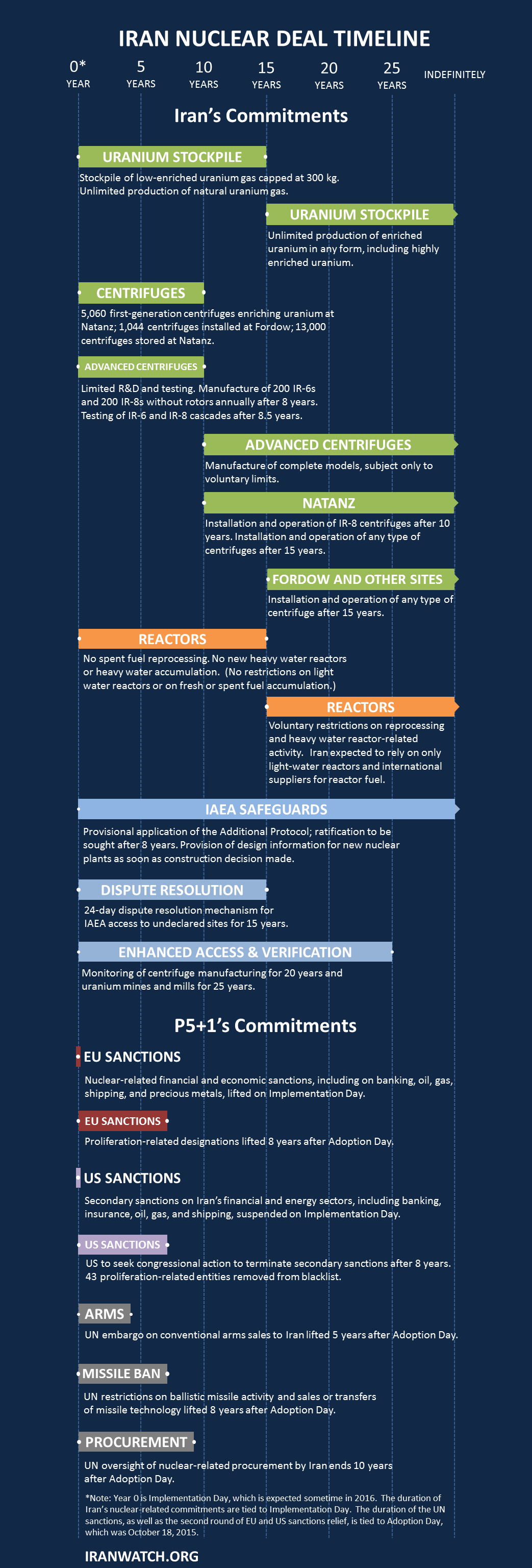
This narrative describes Iran’s commitments under the agreement and the commitments made by the United States and its negotiating partners in return.  The chart below traces the milestones of the nuclear agreement – showing how long restrictions are to be kept in place, when they are to be loosened, and when sanctions are to be eased.

[Click here to continue reading the report]

Click the image to enlarge
IRAN’S COMMITMENTS

Uranium Enrichment

Iran has two declared uranium enrichment plants, at Natanz and Fordow.  Under the terms of the deal, Iran has promised to reduce the number of operating centrifuges at both plants and to limit all of its enrichment activity for a period of 10-to-15 years.

Natanz

The commercial-scale plant at Natanz is the larger of the country’s two declared uranium enrichment facilities, with over 16,000 centrifuges installed, and a capacity to house over 50,000 centrifuges.[1]  Iran has promised to limit the number of first generation IR-1 centrifuges enriching uranium to 5,060 by Implementation Day and to maintain this level for the first ten years of the agreement.  All excess centrifuges – about 10,000 IR-1 centrifuges and 1,000 more advanced IR-2m centrifuges – will be removed from their installations and kept in storage at Natanz under IAEA monitoring.[2]

After eight years, Iran has the right to start manufacturing a limited number of advanced centrifuges and after ten years will be permitted to manufacture and install these centrifuges at a rate determined by Iran’s “enrichment and enrichment R&D needs.”[3]  These needs will be presented in a plan submitted to the IAEA as part of Iran’s implementation of the Additional Protocol.  This plan, however, will consist of only “voluntary commitments” and will be neither restrictive nor binding.[4]  In his October 21 letter to President Hassan Rouhani, Iran’s Supreme Leader Ali Khamenei called upon the government to develop a plan for the country’s nuclear industry to achieve an annual uranium enrichment capacity of 190,000 separative work units (SWU) within 15 years.[5]  If Iran were to achieve this output, and directed the power toward making nuclear weapon fuel, it could make enough fuel – annually – for almost 50 bombs.[6]

Iran has also promised to limit its total enriched uranium stockpile to 300 kilograms of up to 3.67% enriched uranium hexafluoride (UF6) for the first 15 years of the agreement and to limit all enrichment work to Natanz.  Between now and Implementation Day, Iran must reduce its 7,800 kg stockpile of low-enriched UF6 to this permitted level of 300 kilograms by either selling the excess abroad “in return for natural uranium” or by downblending the excess to a lower level of enrichment.[7]  The agreement allows Iran to continue to produce and stockpile an unlimited amount of natural uranium hexafluoride, which is the feedstock for enrichment using gas centrifuges, and which will add to the 550 tons currently on hand.[8]

After 15 years, Iran will be allowed to produce an unlimited amount of enriched uranium in any form,[9] including weapon-grade highly enriched uranium[10], and Iran may use any method of enrichment after ten years.[11]

Fordow and Other Plants

The Fordow Fuel Enrichment Plant is Iran’s second – and smaller – declared uranium enrichment site.  It is an underground facility that currently holds about 3,000 IR-1 centrifuges, 700 of which are enriching uranium.[12]  Fordow is of concern because it is heavily fortified to withstand most airstrikes, rather than because of the number and type of centrifuges installed there.

Iran has promised to convert Fordow into a “nuclear, physics, and technology center.”[13]  The agreement states that “international collaboration will be encouraged in agreed areas of research.”[14]  For the first 15 years of the agreement, Iran will not to enrich uranium at, or introduce nuclear material into the plant.[15]  Of the 1,044 IR-1 centrifuges that will remain in place, 348 will be operating for the production of stable isotopes.[16]  About 2,000 IR-1 centrifuges will be removed and kept in storage at Natanz under IAEA monitoring.

After 15 years, Iran will be permitted to resume uranium enrichment at Fordow and at any other declared facility, including with advanced centrifuges.


Plutonium

Arak is a 40 megawatt heavy water reactor that is nearly complete but not yet operational.  If completed, Arak would provide Iran with weapon quantities of plutonium in its spent fuel.

Under the agreement, Iran will redesign and rebuild the Arak reactor such as “to minimize the production of plutonium and not to produce weapon-grade plutonium in normal operation.”[17]  By Implementation Day, the existing core of the reactor must be removed and filled with concrete, rendering it unusable.[18]  Iran has also promised to ship out all spent fuel from Arak for the lifetime of the reactor[19] and, for 15 years, to sell “excess heavy water.”[20]  Heavy water has nuclear weapon applications and will be needed in smaller quantities for the redesigned reactor.

In addition, Iran has pledged not to reprocess spent reactor fuel or to build any new heavy water reactor for 15 years. [21]  However, the agreement does not place additional restrictions on the construction of power and research reactors during the term of the agreement.  Nor does it prevent Iran from keeping the spent fuel from its operating Bushehr reactor, which is governed by a separate contract with Russia.  Russia can continue to supply Iran with reactors and reactor fuel containing enriched uranium, which will not count against enriched uranium caps set in the agreement.[22]  Reactor fuel containing enriched uranium also can be made in Iran, as long as the fuel is approved by a Technical Working Group established through the agreement.[23]   The first core load of fuel for the Arak reactor will be made outside Iran, but future core loads can be made in Iran.[24]

After 15 years, plutonium-related restrictions become voluntary.  Iran is expected, but not required, to rely only upon light water reactors for power generation and research and on international suppliers for reactor fuel.[25]  In addition, according to the agreement, Iran “intends to ship out all spent fuel for all future and present power and research nuclear reactors.”[26]  And Iran “does not intend” to engage in spent fuel reprocessing, spent fuel reprocessing R&D, or the construction of a facility capable of spent fuel reprocessing.[27]  However, Iran will be free to change any of these intentions after 15 years.


A Covert Program

Under the agreement, the IAEA will be responsible for verifying that Iran is not conducting prohibited work at secret sites and for ensuring that Iran is abiding by the nuclear restrictions of the agreement.    Iran has agreed to “provisionally apply” the IAEA’s Additional Protocol,[28] which will give Agency inspectors broader access to nuclear-relevant sites, such as uranium mines and heavy water production plants.  And Iran has promised to “seek […] ratification” of the Protocol after eight years, “consistent with the Constitutional roles of the President and Parliament.”[29]

Iran has agreed to additional measures aimed at increasing transparency over the nuclear fuel cycle.  The IAEA will monitor production at uranium mills for 25 years[30] and will “implement continuous monitoring” on centrifuges in storage for 15 years.[31]  The IAEA will also keep an inventory of key centrifuges parts like rotors and bellows for 20 years, and will be allowed to monitor all locations containing centrifuge production equipment, also for 20 years.[32]

In addition, Iran has promised to supply the IAEA with design information for new nuclear facilities as soon as the decision is made to construct them – a requirement for countries under the modified Code 3.1 version of Agency safeguards.[33]

Iran has also agreed to a dispute resolution mechanism to resolve any disagreement over access to an undeclared site deemed suspicious by the IAEA.  If a dispute over access to a site arises during the first 15 years of the agreement, the IAEA will be able to petition a Joint Commission composed of the P5+1 countries, Iran, and the European Union.  A consensus of five of the eight members of this Commission would be sufficient to rule in favor of access, and a final decision must be made within 24 days of the IAEA’s request.[34]  This dispute resolution process offers the Agency stronger rights than it has under the Additional Protocol: there is a hard deadline for access, and the Joint Commission could grant inspectors broader rights than those available under the Additional Protocol, which is limited to environmental sampling.[35]

Restrictions on procurement are also intended to prevent Iran from building a covert nuclear program.  Iran has agreed to abide by the decisions of a newly established “white channel” that will review proposals for Iranian imports of nuclear-related and other proliferation-sensitive goods.  For up to ten years, the U. N. Security Council will control the import of all nuclear-related and nuclear dual-use items into Iran.  The IAEA will also monitor the end-use of some nuclear imports.[36]  U.N. restrictions on sales of missile-related technology to Iran will be legally binding for up to eight years, though the end-use monitoring of missile-related goods will be less stringent.  The new U.N. resolution only requires that Iran provide exporters of missile-technology with “appropriate end-user guarantees.”[37]


THE P5+1’S COMMITMENTS

European Union Sanctions

The European Union has agreed to lift its nuclear-related sanctions on Iran in two rounds.

On Implementation Day – expected in early 2016 – the EU will terminate all nuclear-related economic and financial sanctions, including restrictions on:

  • Transfers of funds between EU entities, including financial and credit institutions, and Iran.[38]
  • Banking activities, including the opening of new branches of Iranian banks in the EU and the opening by EU entities of new offices, subsidiaries, joint ventures, or bank accounts in Iran.[39]
  • Insurance and reinsurance for Iranian entities.[40]
  • The import of Iranian oil, gas, and petrochemical products.[41]
  • Investment in and the export of equipment for Iran’s oil, gas, and petrochemical sectors.[42]
  • The shipping, shipbuilding, and transport sectors.[43]
  • The export of gold, precious metals, and diamonds and the delivery of Iranian banknotes and coinage.[44]

Iran will also regain access to financial messaging services, including SWIFT, on Implementation Day, but banks that remain designated by the EU will remain cut off from those services until Transition Day.  The EU will also lift sanctions that impose asset freezes and travel bans on a first set of companies and individuals (mostly in the financial, energy, shipping, and transport sectors).[45]

A second round of sanctions relief is expected eight years after Adoption Day, or sooner if the IAEA should reach its so-called “Broader Conclusion” that all nuclear material in Iran remains in peaceful activities.”  This round covers all EU proliferation-related sanctions and the removal of a second, smaller set of individuals and entities from the EU blacklist – those designated for proliferation activity.[46]


United States Sanctions

The United States has also agreed to two rounds of sanctions relief, but this relief will only affect so-called secondary sanctions—the restrictions that the U.S. government places on non-U.S. persons and entities.

On Implementation Day, the United States has agreed to “cease the application of” the bulk of its secondary sanctions on non-U.S. persons engaged in Iran’s financial and energy sectors.  This will be done by executive waiver.  However, the agreement states that “U.S. persons and U.S.-owned or -controlled foreign entities will continue to be generally prohibited from conducting transactions of the type permitted pursuant to the JCPOA.”[47]

The secondary sanctions to be suspended in this first round include the restrictions on:

  • Financial and banking transactions with Iranian financial institutions.[48]
  • Transactions in Iranian Rial.[49]
  • The provision of U.S. banknotes to the Government of Iran.[50]
  • Purchase or facilitation of issuance of Iranian sovereign debt.[51]
  • Financial messaging services.[52]
  • Insurance and re-insurance.[53]
  • Sales, investment, and transport of Iranian oil, gas, and petrochemicals.[54]
  • Shipping, shipbuilding, and port sectors.[55]
  • Trade in gold and other precious metals.[56]
  • Automotive sector.[57]

The United States has also agreed to remove a set of entities from various restricted party lists (mostly Iranian financial institutions, individuals and entities designated for being part of the Government of Iran, as well as entities in the energy, transport, and shipping sectors).

A second round of sanctions relief is expected eight years after Adoption Day, or sooner if the IAEA should reach its Broader Conclusion.  At this time, the United States has promised to seek legislative action in Congress to terminate the secondary sanctions that will be suspended on Implementation Day.  The United States has also committed to “seek such legislative action as may be appropriate to terminate […] sanctions […] on the acquisition of nuclear-related commodities and services for nuclear activities contemplated in this JCPOA, to be consistent with the U.S. approach to other non-nuclear-weapon states under the NPT.”[58]  The United States has also promised to delist a second group of 43 entities, many of which have been involved with Iran’s illicit nuclear procurement.


United Nations Sanctions

The U.N. Security Council adopted resolution 2231 in July as a means of endorsing the nuclear deal and superseding the existing Iran-related resolutions.  On Implementation Day, resolution 2231 will terminate the provisions of resolutions 1696 (2006), 1737 (2006), 1747 (2007), 1803 (2008), 1929 (2010), and 2224 (2015).  Resolution 2231 itself will be terminated on October 18, 2025—ten years after Adoption Day.

Of the 121 individuals and entities currently blacklisted by the United Nations, 36 individuals and entities will be removed from the sanctions list on Implementation Day, while sanctions will remain in place on the remaining 85 entities for eight years, or until the IAEA reaches its Broader Conclusion.[59]

The following U.N. sanctions will also remain in place:

  • The U.N. conventional arms embargo (five years).[60]
  • The U.N. ban on ballistic missile technology imports and ballistic-missile related activity (eight years).[61] The language of the new U.N. resolution on the restrictions on ballistic-missile related activity appears to be more permissive than the existing ban under resolution 1737.[62]
  • The U.N. restrictions on nuclear-related procurement, overseen by the procurement channel discussed above (ten years).[63]


Technical Assistance

The P5+1 has agreed to provide technical assistance and support to Iran for several nuclear projects.  A newly formed Working Group will be established to facilitate the redesigning and rebuilding of the Arak reactor and its laboratories.[64]  The agreement also encourages international collaboration at Fordow once the facility is converted to a research center and calls for international cooperation to ensure that Iran will have the necessary supply of fuel for its future nuclear power and research reactors.[65]


Footnotes:

[1] http://www.iranwatch.org/sites/default/files/iaea_iran_safeguards_report_27aug2015.pdf pp. 5-6.

[2] JCPOA, Annex I, F.

[3] JCPOA, Annex I, K.

[4] JCPOA, Annex I, I.

[5] The separative work unit, or SWU, is the standard measure of the effort required to increase the concentration of the fissionable U-235 isotope.

[6] To produce a bomb’s worth of highly enriched uranium, it takes approximately 4,000 SWUs.  If Iran were able to produce 190,000 SWUs annually, and directed that power toward making nuclear weapon fuel, it could make enough fuel for about 47 bombs.

[7] JCPOA, Preamble and General Provisions, p. 7.

[8] http://www.iranwatch.org/sites/default/files/iaea_iran_safeguards_report_27aug2015.pdf , p. 18.

[9] JCPOA, Annex I, E(25)

[10] JCPOA, Annex I, F (28)

[11] JCPOA, Annex I, S (81),

[12] http://www.iranwatch.org/sites/default/files/iaea_iran_safeguards_report_27aug2015.pdf p. 7

[13] JCPOA, Annex I, ,H

[14] JCPOA, Annex I, H.

[15] JCPOA Annex I.H.

[16] JCPOA, Annex I H(46 and 50)

[17] JCPOA, Annex I, B.

[18] JCPOA, Annex I, B and Annex V, C(15.1)

[19] JCPOA, Annex I, B (11)

[20] JCPOA, Annex I C (14)

[21] JCPOA, Annex I, B(10)

[22] JCPOA, Annex I, J (59)

[23] JCPOA, Annex I, J (59)

[24] JCPOA, Annex I, B (9)

[25] JCPOA, Annex I D.

[26] JCPOA Annex I B(11)

[27] JCPOA Annex I B (12).

[28] JCPOA, Preamble and General Provisions, C.

[29] JCPOA, Preamble and General Provisions, Implementation Plan 34.iv

[30] JCPOA, Annex I, O

[31] JCPOA Annex I F (29).

[32] JCPOA Annex I R.

[33] JCPOA Annex I L; “Subsidiary Arrangement,” International Atomic Energy Agency, p. 7, https://www.iaea.org/sites/default/files/online_version_sg-fm-1170_-_model_subsidiary_arrangement_code_1-9.pdf

[34] JCPOA Annex I Q.

[35] “Model Protocol Additional to the Agreement(s) Between State(s) and the International Atomic Energy Agency for the Application of Safeguards,” INFCIRC/540, Articles 5-6, September 1997, https://www.iaea.org/sites/default/files/infcirc540.pdf

[36] JCPOA Annex IV, Section 6.

[37] U.N. Resolution 2231 (2015), Annex B, Paragraph 4.

[38] JCPOA, Annex II, Section 3.2.1

[39] JCPOA, Annex II, Section 3.2.2

[40] JCPOA, Annex II, Sections 1.1.3 and 3.2.3

[41] JCPOA, Annex II, Section 1.2.1

[42] JCPOA, Annex II, Section 1.2.3-1.2.4

[43] JCPOA, Annex II, Section 1,3

[44] JCPOA, Annex II, Section 1.4

[45] JCPOA, Annex V, Section 16.3

[46] JCPOA, Annex V, Section 20.

[47] JCPOA, Annex II, Section 4, Footnote 6.

[48] JCPOA, Annex II, Sections 4.1.1 and 7.2.

[49] JCPOA, Annex II, Sections 4.1.2 and 7.2.

[50] JCPOA, Annex II, Sections 4.1.3 and 7.2.

[51] JCPOA, Annex II, Sections 4.1.5 and 7.2.

[52] JCPOA, Annex II, Sections 4.1.6.

[53] JCPOA, Annex II, Sections 4.2 and 7.3.

[54] JCPOA, Annex II, Section 4.3 and 7.4

[55] JCPOA, Annex II, Sections 4.4 and 7.5.

[56] JCPOA, Annex II, Sections 4.5 and 7.6.

[57] JCPOA, Annex II, Section 4.7 and 7.8

[58] JCPOA, Paragraph 24.

[59] U.N. Resolution 2231 (2015), Annex B, Paragraph 6(c) and Attachment.

[60] U.N. Resolution 2231 (2015), Annex B, Paragraph 5.

[61] U.N. Resolution 2231 (2015), Annex B, Paragraph 3-4.

[62] http://www.iranwatch.org/our-publications/nuclear-iran-weekly/what-iran-deal-says-doesnt-say-about-irans-ballistic-missiles

[63] U.N. Resolution 2231 (2015), Annex B, Paragraph 2.

[64] JCPOA, Annex I, Section B.4.

[65] JCPOA, Annex I, Section H.44 and D.16.

Iran Test Fires Nuclear-Capable Ballistic Missile in Apparent Violation of U.N. Resolutions

Iran’s Defense Ministry announced the successful test of a new ballistic missile on October 11.  The test is an apparent violation of U. N. Security Council resolutions and raises troubling questions about Iran’s strategic intentions even after it accepted an international agreement restricting its nuclear program in July.

The missile, called the “Emad” (Pillar), is an upgraded version of Iran’s liquid-fueled Shahab-3 and could serve as a means of delivering nuclear weapons.  According to Iranian Defense Minister Brigadier General Hossein Dehqan, the Emad is the country’s “first long-range missile … capable of hitting and destroying the targets with high-precision.”[1]

The Emad, according to defense analysts, represents a significant advance in accuracy over Iran’s Shahab-3 missile.  In a report last December, Anthony Cordesman of the Center for Strategic and International Studies assessed that the Emad has a 1,700 kilometer range with a 750 kilogram payload and 500 meter accuracy (circular error probable).[2]  This is a marked improvement over the Shahab-3’s CEP of approximately 2,000 meters.  According to Dr. Cordesman, the Emad is equipped with a maneuvering reentry vehicle system and satellite navigation for improved accuracy.  Uzi Rubin, the former head of Israel’s Missile Defense Organization, wrote in an e-mail that “the Emad signifies a quantum leap in Iran’s strategic capability.  It can now launch precision attacks on military and value targets anywhere in the Middle East.”  Mr. Rubin also noted that the Emad’s reported 500-meter CEP “could be improved.”

A State Department spokesman called the test “deeply concerning” and said that it “does appear to be a violation of U.N. Security Council resolution 1929, and we’ll obviously raise this at the [Security Council] as we have done with previous launches.”[3]  Resolution 1929, which remains in force until the nuclear agreement’s “Implementation Day” (expected in early 2016), bans “any activity related to ballistic missiles capable of delivering nuclear weapons, including launches.”[4]

The Emad’s reported technical specifications meet the Missile Technology Control Regime’s definition of a “nuclear capable” missile (a 300 kilometer range with a 500 kilogram payload).[5]  Iranian official statements after the test, however, have emphasized that the missile test does not violate the Joint Comprehensive Plan of Action (JCPOA) or U.N. Security Council resolution 2231, which will supersede the existing Iran-related resolutions on Implementation Day.  Iranian Foreign Ministry spokesperson Marziyeh Afkham said on October 13 that “Iran’s missile test is no violation of the Joint Comprehensive Plan of Action at all and there is no reference in the JCPOA to Iran’s defensive power, including missiles.”[6]

Indeed, the missile test does not appear to violate the JCPOA or the new U.N. resolution 2231.  Using weaker language than U.N. resolution 1929, the new U.N. resolution seeks to restrict only “activity related to ballistic missiles designed to be capable of delivering nuclear weapons” (emphasis added).  Ms. Afkham, the Foreign Ministry spokesperson, told Fars News Agency that Iran’s ballistic missiles have not been designed to carry nuclear warheads.[7]  Iran is interpreting the resolution as referring to missiles explicitly designed for nuclear delivery rather than dual purpose missiles.  Of course, as Mr. Rubin noted writing for Defense News on October 5, “many ballistic missiles that have been mainly built for conventional missions, such as the ex-Soviet Scud, are capable of carrying a nuclear warhead.”[8]  Furthermore, the section in U.N. resolution 2231 referring to Iran’s ballistic missile activity uses non-mandatory language—the Security Council is merely exhorting Iran (“Iran is called upon”) to refrain from such activity.

In his official statement celebrating the successful test of the Emad, Iranian Defense Minister Dehqan singled out the contributions of the Aerospace Industries Organization (AIO), the entity that oversees Iran’s missile development and production.  AIO has been sanctioned by the European Union and the United States and will remain under E.U. and U.S. sanctions even after the JCPOA is implemented.  While AIO is not on the U.N. sanctions list, U.N. sanctions will remain in place on two of AIO’s principal subsidiaries, the Shahid Hemat Industrial Group (SHIG) – responsible for Iran’s liquid-fueled missiles – and the Shahid Bagheri Industrial Group (SBIG), for up to eight years.  Yet even as these firms remain blacklisted, governments must be vigilant for ongoing illicit procurement by them via front companies, many of which do not appear on any sanctions list.

Finally, this test stands out because of its timing.  It comes following a pause of nearly two years since Iran’s last known medium-range ballistic missile test and days before the Iranian parliament passed a motion endorsing the nuclear agreement on October 13.  White House Press Secretary Josh Earnest called the timing “no coincidence.”[9]


Footnotes: 

[1] “Iran Successfully Test-fires New Home-Made Long-Range Missile,” Fars News Agency October 11, 2015, http://en.farsnews.com/newstext.aspx?nn=13940719000427

[2] Anthony H. Cordesman, Iran’s Rocket and Missile Forces and Strategic Options, Center for Strategic and International StudiesDecember 2014, http://csis.org/files/publication/141218_Cordesman_IranRocketMissileForces_Web.pdf

[3] State Department Spokesman Mark Toner’s Comments on Iranian Ballistic Missile Test, October 13, 2015, http://www.iranwatch.org/library/governments/united-states/executive-branch/department-state/state-department-spokesman-mark-toners-comments-iranian-ballistic-missile-test

[4] U.N. Security Council Resolution 1929, /library/multilateral-organizations/united-nations/un-security-council/resolution-1929-2010

[5] “Frequently Asked Questions (FAQs), Missile Technology Control Regime, http://mtcr.info/english/FAQ-E.html

[6] “FM Spokeswoman: N. Agreement Not to Affect Iran’s Defensive Capabilities,” Fars News Agency, October 13, 2015, http://en.farsnews.com/newstext.aspx?nn=13940721000994

[7] “FM Spokeswoman: N. Agreement Not to Affect Iran’s Defensive Capabilities,” Fars News Agency, October 13, 2015, http://en.farsnews.com/newstext.aspx?nn=13940721000994

[8] Uzi Rubin, “The Nuclear Agreement Boosts Iran’s Missile Threat,” Defense News, October 5, 2015, http://www.defensenews.com/story/defense/commentary/2015/10/05/nuclear-agreement-boosts-irans-missile-threat/73388484/

[9] White House Press Secretary Josh Earnest’s Comments on Iranian Ballistic Missile Test, October 13, 2015, http://www.iranwatch.org/library/governments/united-states/executive-branch/white-house/white-house-press-secretary-josh-earnests-comments-iranian-ballistic-missile-test

What to Watch for after Implementation Day

Foreign ministers from the P5+1 countries and Iran met on September 28 for the first time since the nuclear agreement was finalized in July.  The parties are focused on the agreement’s implementation, which should now be able to proceed following the failure of U.S. congressional opponents to pass a resolution of disapproval by a September 17 deadline.

In remarks following the meeting, European Union foreign policy chief Federica Mogherini confirmed that “implementation day” is expected early next year.[1]  On that day, Iran – notably its financial and energy sectors – will receive sanctions relief in exchange for restricting its nuclear work for a ten-year period.

Most attention in recent weeks has been on Congress and on the International Atomic Energy Agency’s investigation of Iran’s alleged past weaponization work.  But as implementation day approaches, three issues should receive more scrutiny: how any future illicit procurement by Iran will be handled; the flow of licit Iranian procurement through a newly-established “white channel”; and the agreement’s dispute resolution mechanism.

1. Illicit Procurement

Iran has well-established illicit procurement networks that have enabled it to supply its nuclear, missile, and military programs despite layers of international sanctions and national and multilateral restrictions on transfers of sensitive technology.  These networks have brought a steady flow of critical U.S. and European origin items to Iran, often using complicated arrangements involving transshipment through third countries, middlemen, and front companies.

Will Iran continue to operate these networks?  The British government reported as recently as April 2015 about “an active Iranian nuclear procurement” involving two well-known companies, both of which have been sanctioned by the European Union and the United States: Iran’s Centrifuge Technology Company (TESA) and Kalaye Electric Company.[2]  Tracking illicit Iranian procurement will be one of the most effective ways of detecting secret nuclear sites, as Iran would need to supply these sites covertly.  Like North Korea, Iran may decide to comply with the agreement at declared sites but pursue unauthorized work at undeclared sites.  Many of Iran’s now-declared sites were originally secret.

The agreement, however, is vague on the question of illicit procurement, while reportedly doing away with the U.N. structure that has been tracking Iranian procurement for nearly a decade.  The Security Council created a special committee – the 1737 Committee – to monitor the implementation of sanctions against Iran following the adoption of resolution 1737 in December 2006.[3]  This Committee’s mandate included investigating alleged violations and taking action in response to confirmed violations, including by designating additional entities for targeted sanctions.

Since 2010, the 1737 Committee has received support from a Panel of Experts charged with carrying out in-country investigations of alleged non-compliance, government outreach on sanctions implementation, and an analysis of trends and best practices regarding sanctions enforcement.  According to a U.N. fact sheet, this Panel is composed of “members with specialized technical backgrounds in relevant fields” and is intended “to provide neutral, fact-based assessment and analysis.”[4]  Its reports, which have been published annually since 2012, have included some of the most comprehensive publicly available information on Iran’s efforts to evade sanctions, as well as guidance for governments and industry to avoid contributing to these efforts.

With the termination of resolution 1737 by the new U.N. Security Council resolution on Iran (2231) effective implementation day, the future is uncertain for the 1737 Committee, as well as the Panel, which is reportedly being disbanded as a concession to Iran.  Secretary of State John Kerry confirmed in August that another, as yet undefined, U.N. body could take its place.  Would this new international body also include outside experts?  Would it be authorized to mount in-country investigations?  Secretary Kerry also said that much of the Panel’s work could be done by the United States and its allies.[5]  However, national efforts to catch and punish illicit procurement will be uneven; countries may be reluctant to mount investigations or bring enforcement cases that risk unravelling the agreement.

The deal does provide a mechanism for any party to the agreement to “refer a procurement-related activity to the Joint Commission under the dispute resolution mechanism if it is concerned that such activity is inconsistent” with the agreement.[6]  But it is unclear how this mechanism would interact with a new U.N. monitoring body.

2. Licit Procurement

The nuclear agreement establishes a dedicated “procurement channel” for authorized Iranian imports of sensitive nuclear and dual-use technology.  A Procurement Working Group, comprised of one member from Iran and one member from each of the P5+1 countries, plus the E.U. High Representative, will review and decide on Iranian requests for imports of controlled goods on a case-by-case basis within 30 days.  The procurement channel will operate for the first ten years of the agreement and will oversee all potential sales of items on the Nuclear Suppliers Group (NSG) Parts 1 and 2 lists, as well as non-listed items with nuclear applications.

According to the agreement, the E.U. High Representative will forward each proposal for a nuclear-related transfer to the Procurement Working Group for review.  Proposals will only be approved by a consensus of the Working Group: a proposal will be recommended for approval when all participants agree, or if the proposal receives no formal disapprovals within 30 working days.[7]  Otherwise, the proposal will be recommended for disapproval.  The support of two Working Group members can trigger an appeal of a disapproved proposal.  The appeal will be decided by the agreement’s Joint Commission, which will rule by consensus within 10 working days.  If a consensus cannot be reached in the Joint Commission, the dispute would be elevated to the ministerial level.[8]

The structure of the Procurement Working Group appears to establish a high bar for the approval of nuclear-related procurement for ten years.  However, the new U.N. Security Council resolution has carved out a number of exceptions: light-water reactor technology and related reactor fuel, imports to modify the Arak heavy water reactor, and trade in natural and low-enriched uranium (LEU) to help maintain Iran’s 300 kg cap on LEU.  Transfers of these goods would not require advance approval, though such transfers would have to be reported to the Security Council and to the International Atomic Energy Agency, and supplier countries would be responsible for ensuring proper end-use.[9]

What the agreement leaves unclear is what other goods, in practice, Iran will be allowed to import through this mechanism in the first ten years of the deal, and what criteria will be used to approve or deny requests.   Will Iran be allowed to procure goods prospectively – for example, to stockpile critical materials and technology that will be needed to expand the country’s centrifuge enrichment program?  Under the agreement, such an expansion is delayed for ten years, but Iran may want to start importing for the program in advance.

The deal also establishes procedures for end-use monitoring of imported goods, though it is uncertain how rigorous those arrangements will be.  The IAEA will have access to the locations of intended use of the most sensitive nuclear goods (the NSG Part 1 list).  But with nuclear-related dual-use goods (the NSG Part 2 list), the agreement will rely upon exporting countries for end-use monitoring.  The Procurement Working Group, as a condition of a sale, can “provide expertise to the exporting state, including experts, as needed, to participate in the end-use verification.”[10]  Will the Working Group rely on this option to strengthen end-use verification?  And if it does, will exporters simply disregard this “expertise”?

It is the U.N. Security Council, rather than the Procurement Working Group, that must authorize any imports of missile and military related items.  Because any Security Council member may veto a request, authorized imports are unlikely in the coming years.  Iran is prohibited from importing items on the Missile Technology Control Regime lists, both direct and dual-use technologies, for a period of eight years, unless approved by the Security Council.  Arms sales to Iran also require the approval of the Security Council and are restricted for five years.[11]  However, Iran objects to these restrictions and has declared its intention to continue advancing both its missile and military efforts, including through foreign procurement.

Both the Institute for Science and International Security (ISIS) and Project Alpha at King’s College have published reports on the role of the “white channel” and have raised concerns about how it will function.  ISIS’s report on the procurement channel questioned whether the Procurement Working Group would have sufficient resources to review transfer proposals adequately within 30 days and whether supplier states have the ability to detect and prevent illicit nuclear-related procurement by Iran.  ISIS also recommended that the Security Council extend the term of the procurement channel for an additional ten years, so that nuclear-related imports would be controlled for a total of 20 years.[12]  Ian Stewart, head of Project Alpha, also noted in an article that the likely high-volume of dual-use requests would pose a challenge for the Working Group, as would “the resource-intensive task” of end-use monitoring for many potential supplier states.[13]

3. Dispute Resolution

The nuclear deal’s Joint Commission, which will oversee the Procurement Working Group, will also act as the overall dispute resolution mechanism for the agreement.  The Commission, which will have the same eight members as the Procurement Working Group, is expected to meet for the first time “soon after adoption day” – in mid-October – according to Ms. Mogherini.[14]  With the exception of disputes over IAEA access to sites in Iran, the Joint Commission is intended to operate by consensus decision-making (that is, all parties must agree, or at least, no one formally disagree).  The Commission will adjudicate all manner of disputes, ranging from questions about sanctions relief, nuclear transfers, and other non-performance issues.  (Questions of IAEA access can be decided by a majority vote of five members out of the eight members of the Commission.)  This requirement for consensus decisions in the Joint Commission – and the multiple levels of bureaucracy involved in the dispute resolution process – could become a recipe for inaction.

Under the terms of the agreement, the Joint Commission has 15 days to reach a decision on any dispute, unless the time period is extended by consensus.  After Joint Commission consideration, any party can refer the issue to the ministerial level.  The Ministers have 15 additional days to resolve the decision, a timeframe that is also extendable by consensus.  In parallel with, or instead of, ministerial review, any party can also refer a dispute to a three-member Advisory Panel, which will have 15 days to issue a non-binding opinion.  The Joint Commission, then, would consider the opinion of the Advisory Board for 5 days, in a last ditch effort to resolve the dispute by consensus.  If, however, the issue is not resolved to the satisfaction of the complaining party, that country “could treat the unresolved issue as grounds to cease performing its commitments” under the agreement.[15]

These procedures will challenge the Joint Commission’s ability to operate efficiently – to resolve disputes before they fester and undermine the agreement.  A group of former weapons inspectors and non-proliferation experts, convened for a roundtable discussion by the Wisconsin Project in April, warned of this possibility.  While a consultative commission of some kind has been a feature of every successful arms control agreement, the group concluded that the agreement with Iran would succeed only if the Joint Commission effectively meditates disputes and resolves ambiguities or disagreement that could weaken the agreement over the long-term.

Judging from its pattern of behavior over the past decade, Iran probably will not commit a glaring violation of its commitments under the agreement.  Rather, the P5+1 countries are more likely to encounter inconsistencies, ambiguities, or selective opacity.  Iran may choose to test the limits of the agreement in minor ways that do not rise to the level of a material breach.  Resolving these ambiguities expeditiously, through the Joint Commission, will be essential for the effective monitoring and verification of the nuclear agreement.


Footnotes: 

[1] Laurence Norman, “Parties in Iran Nuclear Deal Aim for Implementation Day in Early 2016,” Wall Street Journal, September 28, 2015, https://www.wsj.com/articles/parties-in-iran-nuclear-deal-to-talk-again-1443473276

[2] “Final report of the Panel of Experts established pursuant to resolution 1929 (2010),” United Nations Security Council, S/2015/401, June 2, 2015, p. 14, available at http://www.iranwatch.org/sites/default/files/un-panelofexpertsreport-060215_0.pdf

[3] “Fact Sheet: The 1737 Committee and its Panel of Experts,” The United Nations Security Council, http://www.un.org/sc/committees/1737/pdf/Fact_Sheet_en.pdf

[4] “Fact Sheet: The 1737 Committee and its Panel of Experts,” The United Nations Security Council, http://www.un.org/sc/committees/1737/pdf/Fact_Sheet_en.pdf

[5] “Secretary of State John Kerry’s Interview With Sir Harold Evans, Thomson Reuters Editor-At-Large,” August 11, 2015, available at http://www.iranwatch.org/library/governments/united-states/executive-branch/department-state/secretary-state-john-kerrys-interview-sir-harold-evans-thomson-reuters-editor

[6] Joint Comprehensive Plan of Action, Annex IV, 6.6.

[7] The E.U. High Representative will not take part in the decision-making of the Procurement Working Group.  See Joint Comprehensive Plan of Action, Annex IV, 4.5.

[8] Joint Comprehensive Plan of Action, Annex IV, 6.4.3-6.4.5.

[9] U.N. Resolution 2231 (2015), Annex B, Paragraph 2(c).

[10] Joint Comprehensive Plan of Action, Annex IV, 6.7-6.8.

[11] U.N. Resolution 2231 (2015), Annex B, Paragraphs 4-5.

[12] David Albright and Andrea Stricker, “Preliminary Assessment of the JCPOA Procurement Channel: Regulation of Iran’s Future Nuclear and Civil Imports and Considerations for the Future,” Institute for Science and International Security, August 31, 2015, http://www.isis-online.org/uploads/isis-reports/documents/Procurement_Channel_JCPOA_analysis_31Aug2015_final_1.pdf

[13] Ian J. Stewart, “The Iranian Nuclear Procurement Channel: the most complex part of the JCPOA?” World ECR, https://www.worldecr.com/wp-content/uploads/Iranian-Nuclear-Procurement-Channel_WorldECR1.pdf

[14] “Remarks by the HR/VP Federica Mogherini following the E3/EU+3 meeting with Iran, New York, 28 September,” European Union External Action, September 28, 2015, https://eeas.europa.eu/headquarters/headquarters-homepage/5930/intervention-de-la-haute-representante-et-vice-presidente-federica-mogherini-la-suite-de-la_fr

[15] Joint Comprehensive Plan of Action, Preamble and General Provisions (Dispute Resolution Mechanism), paragraph 36.

In Shadow of Nuclear Deal, State and Commerce Sanction Iran Proliferators

The U.S. State Department issued a new round of sanctions against individuals and companies linked with Iranian proliferation on September 2,[1] even as the nuclear deal with Iran moved closer to clearing key procedural hurdles in Congress.  About one month earlier, the Commerce Department restricted trade with ten entities in China and South Korea because they illicitly procured sensitive U.S. items for end use in Iran.  These designations may signal the White House’s commitment to maintaining certain kinds of sanctions against Iran even after the nuclear agreement enters into force.  The sanctions target firms supporting Iran’s missile program, as well as entities tied to Iran’s sponsorship of terrorism.

The State Department sanctions were imposed under the Iran, North Korea, and Syria Nonproliferation Act (INKSNA), which punishes entities for the transfer of technology and goods related to weapons of mass destruction or missile systems.  Under the terms of the nuclear deal, the United States has agreed to seek legislation to lift the INKSNA sanctions on the Iranian “acquisition of nuclear-related commodities and services of nuclear activities contemplated in the” nuclear agreement, though not until “transition day,” or about 2023.  From that point forward, the United States will treat Iran like “other non-nuclear-weapon states” under the Nuclear Non-Proliferation Treaty for the purposes of nuclear-related procurement.[2]  INKSNA’s other restrictions would presumably remain in place.

However, the measures imposed by the INKSNA are not meaningful penalties for the type of entity that the Act generally targets, and the sanctions last only two years.  Sanctioned entities cannot receive U.S. government assistance, procure from the U.S. government, or purchase U.S. Munitions List items or any U.S. dual-use items that require a license.  These measures do apply to any successor, subsidiary or subunit of the sanctioned entity.[3]

The new State Department designations include well-known and previously sanctioned Iranian entities, such as the Iranian Revolutionary Guard Corps’ Qods Force and its commander, Qasem Soleimani.  Soleimani’s apparent inclusion in a listing of individuals to be removed from European Union sanctions under the nuclear deal set off a firestorm of controversy over the summer, before E.U. officials confirmed that Soleimani would remain under sanctions for terrorism and human rights violations.

In addition, the designations renew sanctions against established suppliers to Iran’s missile program, like infamous Chinese proliferator Li Fang Wei (a.k.a. Karl Lee) and his company LIMMT Metallurgy and Minerals Company Ltd.  Other entities on the State Department list are targeted for the first time, including:

  • Eliya General Trading (United Arab Emirates): This company was linked in a leaked State Department cable to procurement for Iran’s missile program.  According to an August 2009 cable, Eliya “was working to provide specialty alloys produced by the German firm NMT to Iran’s Kian Metals Company.”  Specifically, Eliya General Trading sold Kian Metals 195 metric tons of aluminum and titanium, including one alloy suitable for the production of missile motor cases and reentry vehicles for ballistic and cruise missile systems.  “Kian Metals is a cover name used by Iran’s Samen al-A’emmeh Industries Group (SAIG) […] and Sanam Industries Group (SIG),”[4] according to the State Department.  SAIG (also known as the Cruise Missile Industry Group) and SIG have both been sanctioned by the U. N. Security Council[5] and are subordinate to Iran’s Aerospace Industries Organization (AIO), which oversees Iran’s missile production.
  • Rock Chemie (Iran): This company claims to be one of the largest chemical manufacturers and exporters in Iran.[6]  According to a January 2012 report from Taraf Online, Turkish officials reportedly seized four Iranian trucks bound for Syria containing ballistic missile parts originating from Rock Chemie.  The cargo reportedly included four large cylindrical tanks measuring six meters in length, heat resistant materials, and 66 tons of sodium sulfate. Shipping documents listed the cargo as tanning chemicals.[7]

The designations also target a Turkish company previously sanctioned for ties to Iran’s missile program:

  • Multimat Ic Ve Dis Ticaret Pazarlama Limited (a.k.a Multimat Import and Export): This company is already on the U.S. Treasury Department’s blacklist, and has been sanctioned by the European Union, Japan, and several other governments.  It is not slated to be removed from the E.U. sanctions list until “transition day.”[8]  According to the Treasury Department, Multimat is part of a multi-million dollar procurement network supporting Iran’s Aerospace Industries Organization.  The company is run by Milad Jafari, himself sanctioned by a number of governments.  Reportedly, according to a 2006 investigation by Turkish customs, Multimat was involved in shipping dual-use materials, including aluminium, steel, iron, and electronic equipment to Iran.

These State Department sanctions come just over one month after action by the U.S. Commerce Department to add ten individuals and organizations to its Entity List, many for “illicitly procuring sensitive U.S. items for unauthorized end-use in China and Iran.”[9]  In addition to eight Chinese firms, Commerce added to two South Korean entities to its List, including Korean Automation Industry (KAI) and Joseph Choi, an individual affiliated with KAI.  According to Commerce, KAI and Choi “violated U.S. export laws by supporting the illicit procurement efforts of ballistic-missile related parties in Iran since at least 2011.”


Footnotes: 

[1] “Imposition of Nonproliferation Measures Against Foreign Persons, Including a Ban on U.S. Government Procurement,” Department of State, Federal Register Volume 80, Number 170, p. 53222, September 2, 2015, http://www.gpo.gov/fdsys/pkg/FR-2015-09-02/html/2015-21778.htm

[2] Joint Comprehensive Plan of Action, Annex II, p. 12.

[3] “Imposition of Nonproliferation Measures Against Foreign Persons, Including a Ban on U.S. Government Procurement,” Department of State, Federal Register Volume 80, Number 170, p. 53222, September 2, 2015, http://www.gpo.gov/fdsys/pkg/FR-2015-09-02/html/2015-21778.htm

[4] “EFFORTS BY UAE-BASED FIRM TO PROVIDE GERMAN-MADE ALLOYS TO IRANIAN MISSILE ENTIITIES,” Department of State Cable: 09STATE82240_a, August 7, 2009, available at https://www.wikileaks.org/plusd/cables/09STATE82240_a.html

[5] United Nations Security Council Resolution 1747 (2007), /library/multilateral-organizations/united-nations/un-security-council/resolution-1747-2007

[6] “About Us,” Rock Chemie World Wide Web site, http://rockchemie.com/about-us.html, accessed on September 15, 2015

[7] “Turkey: Daily Says Chemical Warhead Missile Parts Seized En Route to Syria,” Huseiyn Ozkaya, Taraf Online, January 20, 2012, http://www.iranwatch.org/news-brief/turkey-daily-says-chemical-warhead-missile-parts-seized-en-route-syria

[8] Joint Comprehensive Plan of Action, Annex V, Annex II, Attachment 2 – Part I

[9] “Addition of Certain Persons to the Entity List; and Removal of Certain Persons From the Entity List Based on Removal Request,” Department of Commerce, Bureau of Industry and Security, 15 CFR Part 744, Federal Register Volume 80, Number 144, p. 44846, July 28, 2015, http://www.gpo.gov/fdsys/pkg/FR-2015-07-28/html/2015-18511.htm

Parchin: A Troubling Precedent for Inspections in Iran

Iran continues construction on a military site linked to nuclear weapons work, according to an August 27 report by the International Atomic Energy Agency.  The Agency has been barred from the site, known as Parchin, since 2005 and is monitoring changes there using satellite imagery.  In its report, the IAEA noted “the presence of vehicles, equipment, and probable construction materials” and the construction of a “small extension to an existing building” at the site.  The report assessed that Iran’s apparent sanitization efforts “are likely to have undermined the Agency’s ability to conduct effective verification.”

The Agency’s findings follow an August 19 Associated Press report describing a secret agreement between Iran and the IAEA that would allow Iranian officials, rather than IAEA inspectors, to take environmental samples from Parchin.  According to a draft of the agreement published by the AP, IAEA inspectors would not be permitted physical access to Parchin and would rely upon some kind of remote monitoring to oversee environmental sampling.  Further, Iran would be required to provide only a limited number of environmental samples from a specific building at Parchin, plus an unspecified number of samples at two points near the site.  Iran would also provide the Agency with photos and videos of the locations in question.  According to the leaked agreement, the sampling “will be carried out using Iran’s authenticated equipment, consistent with technical specifications provided by the Agency, and the Agency’s containers and seals.”  The Agency “will ensure the technical authenticity” of the sampling, though the agreement does not offer further details on how this would be accomplished.

The agreement is intended to resolve the IAEA’s investigation of long-standing allegations that Iran built a large explosives chamber at Parchin to conduct experiments that the Agency says would be “strong indicators of possible nuclear weapon development.”  This is one of a dozen specific allegations included in the IAEA’s on-going investigation of the “possible military dimensions” (PMD) to Iran’s nuclear program.

IAEA Director General Yukiya Amano expressed concern about the implications of the AP report in a statement on August 20: “I am disturbed by statements suggesting that the IAEA has given responsibility for nuclear inspections to Iran.  Such statements misrepresent the way in which we will undertake this important verification work.”  Amano maintained that while he could not divulge the details of the confidential agreement with Iran, “I can state that the arrangements are technically sound and consistent with our long-established practices. They do not compromise our safeguards standards in any way.”  The IAEA, however, has not disputed the authenticity of the draft agreement published by the Associated Press.

Olli Heinonen, former Deputy Director-General for Safeguards at the IAEA, has been the most prominent critic of the IAEA’s special arrangement for inspecting Parchin.  In a report for the Iran Task Force, Heinonen argued, “If the reporting is accurate, these procedures appear to be risky, departing significantly from well-established and proven safeguards practices.”  Inspectors, according to Heinonen, “must ensure the chain of verification,” including “the physical presence of IAEA inspectors where the collection was done.”  Heinonen also raised the concern that Parchin “will likely become the standard for access given to other military and suspect sites” under the broader nuclear agreement with Iran.

Those who accept the arrangement present two arguments.  The first is, essentially, “trust the IAEA”:  even if IAEA inspectors do not themselves take the swipe samples at Parchin, the Agency’s remote monitoring and other practices are sufficiently robust to maintain the integrity of the verification process.  In an August 21 op-ed for The Hill, Mark Hibbs and Thomas Shea, a former safeguards official at the IAEA, concluded, “While IAEA inspectors are subject to some limitations, these will not prevent the IAEA from drawing conclusions which are free from manipulation or obfuscation.”  The second response is to dismiss the importance of Parchin because inspectors are unlikely to uncover anything.  Previous inspections have failed to yield a smoking gun, and after years of sanitization work another IAEA visit will most likely not produce a different result.  For this camp, access to Parchin is not important enough to risk blowing up the larger nuclear deal.

IAEA access to military sites and other sensitive locations has, in the past, been the subject of contentious negotiation and compromise.  Under the principle of “managed access,” countries are allowed to protect proprietary or commercially sensitive information from inspectors, for example by shrouding some equipment or turning off computers.

There appears to be little precedent, however, for managed access procedures in which IAEA inspectors are physically restricted from a site completely and monitor verification activities remotely.   In the case of Iran, between 2003 and 2005, negotiations over access to military sites, including Kohladouz, Lavisan-Shian, and Parchin, led to IAEA visits and in-person environmental sampling.  In Brazil, negotiations over IAEA access to Resende, an enrichment facility containing centrifuges designed and installed by the Navy, led to a 2004 agreement which reportedly restricts inspectors’ visual access to the centrifuges but allows visual access to supporting piping, and full access to feed and withdrawal stations.  Arms control analyst Jeffrey Lewis has raised the example of South Africa as a precedent for Parchin.  In 1993, South Africans destroyed nuclear test shafts in the Kalahari desert and video-recorded their destruction for IAEA review.  Yet an IAEA team visited and assessed the site before the video-recorded demolition and made a subsequent visit to confirm that the test shafts had been rendered useless.

Beyond the specifics of the investigation into past activities at Parchin, the reported arrangement could set a bad precedent for limiting access to other undeclared sites once the Joint Comprehensive Plan of Action (JCPOA) is implemented.  The White House’s statements on Parchin also signal that resolving the IAEA’s PMD investigation is not a priority for the administration.  It is now clear that the P5+1 has left to the IAEA the challenge of clearing up Iran’s past nuclear record.  Responding to the AP report, the White House stated: “The United States has already made our judgment about the past.  We are focused on moving forward.”  This statement is consistent with Secretary of State John Kerry’s remarks in June that the United States is “not fixated on Iran specifically accounting for what they did at one point in time or another […] We have absolute knowledge with respect to the certain military activities they were engaged in.”

What the Iran Deal Says (and Doesn’t Say) about Iran’s Ballistic Missiles

One of the final hurdles in the nuclear talks between Iran and the P5+1 recently concluded in Vienna was the United Nations sanctions on Iran’s ballistic missile program and conventional arms purchases.  In testimony before the House Foreign Affairs Committee on July 28, Secretary of State John Kerry recounted that a compromise reached in the final days of negotiations led to the extension of the U.N. arms embargo for five years and the missile ban for eight years.  According to Secretary Kerry, Russia, China, and Iran wanted to lift the restrictions immediately, while the four Western nations did not.

The extension of the arms embargo and missile ban came in U.N. Security Council resolution 2231, which was unanimously adopted on July 20.  The new resolution endorses the nuclear deal, known as the Joint Comprehensive Plan of Action (JCPOA), and implements certain aspects of the agreement, including a procurement channel for exports of proliferation-sensitive items to Iran.

While Iran’s ballistic missile capabilities were not considered a core issue in the nuclear talks, the language of the new U.N. resolution and the terms of the JCPOA have consequences for the future of Iran’s ballistic missile program:

  • The U.N. resolution removes the existing ban on Iranian activity related to nuclear-capable ballistic missiles, including launches.
  • The U.N. restrictions on sales of missile technology to Iran are extended for up-to eight years, but missile imports will be less strictly controlled than nuclear imports, relying primarily on reporting from Iran and due diligence by its suppliers.
  • The agreement does not allow the “snapback” of sanctions in response to illicit missile procurement.
  • Sanctions will be lifted early next year on several banks that have facilitated illicit missile-related transactions in the past.

Iran’s efforts to advance its nuclear-capable ballistic missile program – through test launches, production, and illicit procurement – will be made easier, while attempts to punish or deter Iran’s ballistic missile activity and illicit procurement will be made more difficult.

Here is how the new U.N. resolution and the JCPOA control – or, mostly, don’t – Iran’s ballistic missile program:

1.  The U.N. restrictions on Iran’s ballistic missile activity, including launches, are not mandatory.

U.N. resolution 2231 draws a clear distinction between the restrictions it imposes on two aspects of Iran’s ballistic missile program: 1) Iran’s domestic ballistic missile activity, including testing, production, and launches; and 2) Iran’s acquisition of sensitive missile technology from abroad.  The restrictions on the latter are legally binding, but the ban on the former is not mandatory.

According to the new U.N. resolution:

  • “Iran is called upon not to undertake any activity related to ballistic missiles designed to be capable of delivering nuclear weapons, including launches using such ballistic missile technology, until the date eight years after the JCPOA Adoption Day or until the date on which the IAEA submits a report confirming the Broader Conclusion, whichever is earlier.”[1]

As with several other components of the JCPOA, Iranian compliance with a ban on ballistic missile activity is non-mandatory.  The Security Council is merely exhorting Iran (“Iran is called upon”) to refrain from such activity.

In contrast, U.N. Security Council resolution 1929 from 2010, which established the existing missile ban, used stronger, legally binding language:

  • “[The Security Council] Decides that Iran shall not undertake any activity related to ballistic missiles capable of delivering nuclear weapons, including launches using ballistic missile technology, and that States shall take all necessary measures to prevent the transfer of technology or technical assistance to Iran related to such activities.”[2]

When Iran was under the restrictions of resolution 1929, the U.N. Panel of Exports found that Iran had violated its Security Council obligations with its launches of nuclear-capable ballistic missiles.  In its 2013 report, the Panel concluded that launches of the Shahab 1 and Shahab 3 missiles in July 2012 constituted a violation of resolution 1929.  In its 2014 report, the Panel reported on continued ballistic missile activity, including missile tests.

The Iranian Foreign Ministry, meanwhile, has interpreted the language of the new U.N. resolution as not applicable to its missile program.  After the adoption of the new U.N. resolution on July 20, Iranian Foreign Minister Javad Zarif told Iran’s parliament: “This paragraph speaks about missiles with nuclear warheads capability and since we don’t design any of our missiles for carrying nuclear weapons, therefore, this paragraph is not related to us at all.”[3]  Zarif appears to be basing his interpretation on a subtle but crucial shift in language between the two U.N. resolutions.  Resolution 1929 bans “activity related to ballistic missiles capable of delivering nuclear weapons,” while the new resolution refers to “ballistic missiles designed to be capable of delivering nuclear weapons.”  In the same session of parliament, Zarif also referred to the new resolution’s paragraph on ballistic missiles as a whole as “non-binding.”


2.  The U.N. restrictions on missile technology sales to Iran are binding for a maximum of 8 years.

The U.N. restrictions on sales of missile-related technology to Iran are legally binding for eight years (or until the International Atomic Energy Agency reaches its so-called “Broader Conclusion” that all nuclear activity in Iran is peaceful).  Invoking Article 41, Chapter VII of the U.N. Charter, resolution 2231 requires that “all states shall comply” with the U.N. restrictions on the “supply, sale or transfer” of missile technology to Iran, as well as on the provision of any training or financial assistance in support of Iran’s acquisition of such technology.

So while the resolution does not impose binding restrictions on Iran’s ballistic missile activity, the U.N. Security Council will control Iranian imports of missile technology.  These imports controls will cover all items included in the Missile Technology Control Regime Annex.  According to the resolution, the Security Council will “decide… on a case-by-case basis to permit such activity.”[4]  This review most likely will be undertaken by the Procurement Working Group, which was established by the JCPOA to oversee the import of sensitive items into Iran.  After eight years, the procurement channel will no longer monitor Iranian missile imports.

Even during those eight years, oversight of Iran’s missile-related imports will be less strict than oversight of its nuclear-related imports.  The agreement establishes strong provisions for the monitoring of the most sensitive nuclear-related goods imported into Iran through the U.N. procurement channel.  Iran will be required to “provide the IAEA access to location of intended use of all items” on the Nuclear Suppliers Group’s “Trigger List.”  Iran must also allow exporting states to verify the end-use of imports on the NSG’s list of dual-use items.  If requested, the countries of the P5+1 can provide expertise in end-use verification to the exporting country.[5]

In contrast, the new U.N. resolution only requires that Iran provide exporters of missile-technology with “appropriate end-user guarantees.”[6]  While the U.N. Security Council will likely tightly control imports of sensitive missile technology for the duration of the ban, it could allow certain dual-use imports, ostensibly for civilian purposes.  Such imports could be diverted to advance Iran’s ballistic missile program in the absence of strict end-use verification. Imports to Iran’s space launch program could also help extend the range of Iran’s ballistic missiles and improve their accuracy.


3.  The nuclear agreement does not allow the “snapback” of sanctions to punish illicit Iranian procurement of missile technology.

How will this eight-year U.N. ban on Iranian missile imports be enforced?  The nuclear agreement, which does not mention ballistic missiles at all, does not appear to provide a clear mechanism to punish Iranian violations of the U.N. missile restrictions.

The JCPOA does include an enforcement mechanism for the U.N. restrictions on nuclear-related procurement.  The agreement requires that Iran “not use, acquire, or seek to procure” items on the NSG’s lists of nuclear and nuclear-related dual-use items.[7]  The deal also allows any party to “refer a procurement-related activity to the Joint Commission under the dispute settlement mechanism.”[8]  This could lead to the “snapback” of sanctions on Iran in the case of “significant non-performance.”  Under the terms of the agreement, any single member of the P5+1 could unilaterally trigger the re-imposition of the old U.N. sanctions.

By design, the JCPOA is silent on the issue of Iran’s ballistic missile program, and the text of the agreement is ambiguous as to whether the “procurement-related activity” that can be referred to the deal’s dispute resolution process encompasses missile procurement.  However, given that the agreement does not mention missile-related procurement, as well as the practical unlikelihood that a P5+1 country would undertake the step of re-imposing the U.N.’s nuclear-related sanctions in response to a missile violation, it appears that “snapback” is not a viable response to illicit Iranian procurement of missile technology.*

*[Note: On August 11, Secretary Kerry confirmed that the U.N. missile restrictions and arms embargo are “not tied to the snapback” provision of the JCPOA.]

The U.N. resolution does allow the Security Council to sanction individuals and entities linked to “the development of nuclear weapon delivery systems, including through the involvement in procurement of prohibited items.”[9]  However, these would be designations of specific individuals and entities, rather than the “snapback” of all U.N. sanctions.  The designation process is also time-consuming.  In its May 2011 report, the U.N. Panel of Experts recommended that Ali Akbar Tabatabaei – a member of the Qods Force – and two other entities be sanctioned for the illicit export of arms from Iran to Nigeria.  It took the Security Council almost a year – until April 2012 – to impose the sanctions.

Overall, the practical deterrent to Iran’s continued illicit procurement of ballistic missile technology or the diversion of dual-use technology is low.  Even when under the restrictions of previous U.N. resolutions, Iran violated repeatedly these resolutions through ballistic missile tests and missile-related procurement.


4. The nuclear agreement will soon lift sanctions on banks that have facilitated procurement for Iran’s ballistic missile program.

In the first round of sanctions relief due to arrive in early 2016 (on “Implementation Day”), the European Union will lift sanctions on the following entities associated with Iran’s ballistic missile program, including banks that have facilitated illicit procurement and handled transactions linked to the missile program in the past:

  • Banco Internacional De Desarrollo CA: A Venezuelan bank owned by the Export Development Bank of Iran.  It provided financial services to Iran’s Ministry of Defense and Armed Forces (MODAFL), which supports Iran’s nuclear and ballistic missile programs.
  • Bank Melli: An Iranian bank that provides banking services for entities involved in Iran’s nuclear and ballistic missile program and has facilitated purchases of sensitive materials for those programs.
  • Bank Tejarat: An Iranian bank that provides financial services to entities linked to Iran’s nuclear and ballistic missile programs, including MODAFL.
  • Europaisch-Iranische Handelsbank AG: A German bank that reportedly has done over a billion dollars of business for Iranian companies associated with Iran’s conventional military and ballistic missile procurement programs, including Defense Industries Organization (DIO), Aerospace Industries Organization (AIO), and the Iranian Revolutionary Guard Corps (IRGC).
  • Export Development Bank of Iran: An Iranian state-owned bank that has provided financial services to companies associated with Iran’s nuclear and missile programs.  It has provided services to MODAFL, facilitated procurement activities, and has handled transactions linked to Iran’s defense and missile entities.
  • Machine Sazi Arak: An Iranian manufacturing company linked to Iran’s ballistic missile program.

Footnotes: 

[1] U.N. Resolution 2231 (2015), Annex B, Paragraph 3.

[2] U.N. Resolution 1929 (2010), Paragraph 9.

[3] “Iranian FM: Using Ballistic Missiles No Violation of U.N. Agreement,” Fars News Agency, July 21, 2015, http://en.farsnews.com/newstext.aspx?nn=13940430000489

[4] U.N. Resolution 2231 (2015), Annex B, Paragraph 3.

[5] JCPOA, Annex IV, Sections 6.7 and 6.8.

[6] U.N. Resolution 2231 (2015), Annex B, Paragraph 4.

[7] JCPOA, Annex IV, Section 6.5.

[8] JCPOA, Annex IV, Section 6.6.

[9] U.N. Resolution 2231 (2015), Annex B, Paragraph 6(c).

How Iran Could Get Sanctions Relief under the Nuclear Deal Sooner than Anticipated

The nuclear deal between Iran and the P5+1 reached in Vienna on July 14, 2015 establishes a step-by-step sequence for Iran to receive relief from the sanctions that have crippled its economy.  The most damaging economic sanctions will be lifted in months, while nuclear, missile, and arms restrictions are meant to come off in no fewer than five years.  However, a close reading of the Joint Comprehensive Plan of Action and a draft U.N. resolution suggests that the timing on this second round of sanctions relief could come sooner.

The first round of relief will arrive when the International Atomic Energy Agency (IAEA) verifies that Iran has implemented certain restrictions on its nuclear work, such as reducing its number of operational centrifuges and reducing its stockpile of enriched uranium gas.[1]  This is expected by early next year and will lift the toughest financial and energy sanctions.

A second round of relief from U.S. and E.U. sanctions will come eight years after the deal’s adoption and lifts most proliferation-specific sanctions.[2]  Similar U.N. sanctions will come off earlier, according to the draft Security Council resolution circulated this week: the international arms embargo after five years; restrictions on ballistic missile technology imports after eight years; and restrictions on sensitive nuclear technology after ten years.[3]

Yet many of the sanctions set to be lifted in the latter years of the agreement could be removed sooner than those milestone dates:  Removal would also be triggered when the IAEA reaches “the Broader Conclusion that all nuclear material in Iran remains in peaceful activities.”[4]  This “Broader Conclusion” – a term of art defined by the Agency – could come earlier than the five or eight or ten-year milestones, if Iran is fully cooperative with inspectors, has resolved concerns about its past nuclear activities, and addresses all of the Agency’s questions about its ongoing nuclear program.

What is the IAEA’s “Broader Conclusion” and how is it reached?

Every year, the IAEA evaluates each country with a nuclear safeguards agreement in force and draws conclusions based on IAEA verification activities, a country’s nuclear declarations, and the resolution of any questions raised by the Agency.[5]  The IAEA reaches the “Broader Conclusion that all nuclear material remained in peaceful activities” in a country if the Agency finds:

1) “No indication of the diversion of declared nuclear material from peaceful nuclear activities” and

2) “No indication of undeclared nuclear material or activities.”[6]

The “narrower conclusion” – that the IAEA finds “no diversion of declared nuclear material from peaceful nuclear activities” – is a lower bar to reach than the “Broader Conclusion,” which also requires the determination that there is no undeclared nuclear material or activity in a country.  In its 2014 Safeguards Statement, the IAEA was able to conclude that “declared nuclear material in Iran remained in peaceful activities.”  But it was unable to reach the “Broader Conclusion” about undeclared material or activities because Iran had not implemented the Additional Protocol and had not resolved the Agency’s long-standing concerns about the “possible military dimensions” of Iran’s nuclear program – the allegations that Iran had conducted nuclear weaponization work in the past.[7]

In fact, the IAEA will only reach the “Broader Conclusion” for countries with an Additional Protocol in force.  The Additional Protocol allows for greater access to nuclear-relevant sites, such as uranium mines and heavy water production plants, and includes a more robust inspections regime.  For the “Broader Conclusion,” the IAEA must also have:

  • Conducted a comprehensive evaluation, including determinations that all aspects of a state’s nuclear-related activities are consistent with its declared nuclear program;
  • Accessed undeclared sites, as necessary, under the terms of the Additional Protocol; and
  • “Addressed all anomalies, discrepancies and inconsistencies identified in the course of its evaluation and verification activities.”[8]

For the 118 states with an Additional Protocol in force in 2014, the IAEA was able to reach the “Broader Conclusion” for 65 countries; the remaining 53 countries only met the requirements for the narrower conclusion.[9]

How soon could the IAEA reach the “Broader Conclusion” for Iran?

In a press conference in June 2015, IAEA Director General Yukiya Amano said that it is impossible to tell in advance how long it will take the IAEA to reach the “Broader Conclusion” that Iran’s nuclear program is fully peaceful: “But it’s a matter of years at least.  Not months.  Not weeks.  Years or years and years.”  According to Director General Amano, the Agency inspectors will require an extended period of access to sites in Iran: “We will continue these activities for quite a prolonged period of time and then, after making our efforts, we come to the point when we can provide credible assurance that there is no indication of activities other than peaceful activities.  This is a long process and full cooperation from the country is needed.”[10]

But how many years?  According to David Kay, former U.N. Chief Weapons Inspector, the IAEA could reach the “Broader Conclusion” sometime in the earlier years of the implementation of the agreement, provided that Iran first fully resolves the IAEA’s concerns about the “possible military dimensions” (PMD) of its nuclear program – which Iran is required to do under the deal within 90 days of the passage of a new U.N. Security Council resolution (set to be voted on Monday).

Dr. Kay, speaking this week with Iran Watch, noted that the IAEA will initially “be cautious to reach a Broader Conclusion” and could issue a provisional statement that the Agency’s evaluation regarding undeclared nuclear materials and activities “remains under evaluation.”  Yet while this provisional statement “would probably be acceptable” in the early stages of the agreement, it could become “politically very unsatisfactory for 2016 and beyond” – once the deal is implemented and “fully in effect.”

This will be especially true if the PMD issue is resolved and the IAEA’s questions about past activities are answered, Dr. Kay said.  With the Agency’s concerns about Iran’s nuclear past addressed, “then the task of the IAEA to reach conclusions concerning undeclared materials and activities relates solely to how effective it judges the implementation of the agreement and the verification activities carried out under it.”  At some point after the deal is implemented, if the IAEA “has to report […] that it cannot reach a Broader Conclusion, it is really reporting that Iran is not living up to the terms of the agreement,” Dr. Kay said.

Still, Iran would have to demonstrate a high level of cooperation on a range of sensitive issues (which it has been reluctant to do in the past) in order to win the IAEA’s approval.  Iran would have to resolve the PMD questions, satisfy the Agency’s requests for access to suspicious sites, implement the Additional Protocol, and explain discrepancies and inconsistencies identified by the Agency during inspections.  Iran may also have to ratify, rather than merely provisionally apply, the Additional Protocol, which it is not required to do under the agreement for up to eight years.

What sanctions will be lifted when the IAEA reaches the “Broader Conclusion”?

The following sanctions would be lifted sooner than the milestone date cited in the agreement and the draft U.N. Security Council resolution if the IAEA reaches the Broader Conclusion that Iran’s nuclear program is fully peaceful:

  • The U.N. arms embargo, U.N. restrictions on ballistic missile technology, and the U.N. procurement channel, which will control imports of sensitive items on the Nuclear Suppliers Group list and nuclear-related dual-use items.[11]
  • The second phase of E.U. sanctions relief, including from the E.U. arms embargo, restrictions on ballistic missiles, and sanctions on financial messaging services, metals, and software.

For its part, the United States would seek legislative action to terminate a range of sanctions previously lifted by presidential waiver in the first round of relief, including: restrictions on financial and banking transactions, insurance, the energy and petrochemical sectors, shipping, gold and other precious metals, the automotive sector, and trade in software and metals.

The United States would also seek legislative action to terminate sanctions on the acquisition of nuclear-related commodities and services (consistent with the final agreement).  In addition, 43 entities would be removed from the U.S. blacklist, including numerous entities linked with procurement and design work for Iran’s nuclear program.


Footnotes: 

[1] Joint Comprehensive Plan of Action, Annex V, Section C, July 14, 2015.

[2] JCPOA, Annex V, Section D, July 14, 2015.

[3] Draft UN Security Council Resolution (July 14), Annex B, Paragraphs 2, 4, and 5, July 14, 2015.

[4] JCPOA, Annex V, Section D, July 14, 2015.

[5] International Atomic Energy Agency, “Safeguards Statement for 2014,” GOV/2015/30, June 2015, p. 1, 5. (https://www.iaea.org/sites/default/files/sir_2014_statement.pdf)

[6] Ibid., p. 5.

[7] Ibid., p. 7-8.

[8] Ibid., p. 5.

[9] Ibid., p. 1.

[10] Quoted in Laurence Norman, “Nuclear Inspectors Will Need Access to Iran for Years, Says Head of IAEA,” Wall Street Journal, June 8, 2015, http://www.wsj.com/articles/nuclear-inspectors-will-need-access-to-iran-for-years-says-head-of-iaea-1433773668

[11] Draft UN Security Council Resolution (July 14), Annex B, Paragraphs 2, 4, and 5, July 14, 2015.

How Will Inspections Work in Iran under the Nuclear Deal?

President Barack Obama, speaking this morning from the White House after the successful conclusion of talks in Vienna, declared that the nuclear agreement with Iran “is not built on trust; it is built on verification.”  Addressing an issue that had been a key sticking point in the negotiations, President Obama said that inspectors from the International Atomic Energy Agency (IAEA) will “be able to access any suspicious location.  Put simply […] the IAEA will have access where necessary, when necessary.  That arrangement is permanent.”[1]

But what does “where necessary, when necessary” mean in practice?  How will inspections work under the nuclear deal described in today’s Joint Comprehensive Plan of Action?  And will this inspections regime actually be “permanent”?

IAEA-led Inspections Teams

  • The IAEA will have the responsibility of monitoring and verifying the nuclear-related provisions of the agreement.  The Agency will provide regular updates to the IAEA Board of Governors and to the U.N. Security Council.[2]
  • The IAEA will have a team of 130-150 designated inspectors for Iran.  According to the agreement, Iran “will generally allow the designation of inspectors from nations that have diplomatic relations with Iran”—meaning Iran would bar inspectors from the United States and could also wield veto power over certain inspectors.[3]
  • IAEA inspectors will have access to “modern technologies,” including automated data collection, electronic seals, on-line enrichment measurement, and other advanced surveillance equipment for real-time monitoring.[4]  Inspectors will no longer have to rely upon older technologies, such as metallic seals, and the manual gathering and transmission of data to IAEA headquarters in Vienna—a process that takes days.[5]
  • IAEA inspection teams will be able to access “locations of intended use of all items, materials, equipment, goods and technology” imported through a dedicated nuclear procurement channel.[6]

How will routine inspections work in Iran?

  • Inspections will be governed by Iran’s standard Safeguards Agreement with the IAEA, as well as the Additional Protocol, which Iran has agreed to “provisionally apply.”  Iran is not required to “seek ratification” of the Additional Protocol for up-to 8 years.[7]  The Additional Protocol allows for broader access to nuclear-relevant sites, such as uranium mines and heavy water production plants.
  • Iran has agreed to fully implement the IAEA’s modified Code 3.1, which requires countries to submit design information for new nuclear facilities as soon as the decision is made to construct or authorize construction of the facility.[8]
  • Iran has also agreed to further “transparency measures” that go beyond the Additional Protocol, including: IAEA monitoring of uranium ore concentrate produced at  all uranium mills for 25 years and containment and surveillance of centrifuge rotors and bellows for 20 years.  All existing and newly produced rotors and bellows will be inventoried and verified.  In addition, Iran will declare and the IAEA will continuously monitor equipment used for centrifuge production.[9]

How will the IAEA access suspicious, undeclared sites in Iran?

One of the most contentious issues in the talks was the authority the IAEA would have to access suspicious sites in Iran not officially declared as part of the country’s nuclear program—including military sites.

In practice, under the terms of deal, inspections “where necessary, when necessary” translates to: inspections where necessary, within 24 days, if five of the parties to the deal agree, for a period of 15 years.

Here are the steps for the inspections process related to undeclared sites[10]:

  • “Request for clarification” (Day 0): If the IAEA has concerns about undeclared nuclear activities or sites, or any potential violations of the agreement, it will first “provide Iran the basis for such concerns and request clarification.”
  • “Request for access” (Days 1-14): If Iran’s explanations do not satisfy the IAEA, the Agency may submit a request to access the suspicious sites in question.  The IAEA “will provide the reasons for access in writing and make available any relevant information.”  Within 14 days, Iran and the IAEA must either 1) agree on the procedures to inspect the sites in question, or 2) resolve the IAEA’s concerns by alternative arrangements without inspections.
  • “Dispute resolution” (Days 15-21): If Iran and the IAEA cannot reach a resolution within 14 days of the IAEA’s request for access, the issue will be brought before the Joint Commission established by the agreement for dispute resolution.  A consensus of 5 of the 8 members of the Joint Commission (the P5+1 nations, plus Iran, plus the EU High Representative) would issue a ruling and determine the course of action within 7 days.  This means, Iran, China, and Russia could not block a consensus without the support of one Western country.
  • “Implementation” (Days 22-24): Following the determination of the Joint Commission, Iran would have 3 additional days to implement the decision.

Will this inspections regime be permanent?

It appears not.  The section of the agreement summarizing the “transparency measures” that Iran will implement includes: “a reliable mechanism to ensure speedy resolution of IAEA access concerns for 15 years”[11]—the mechanism described above.  In describing IAEA inspections as “permanent,” President Obama could have been referring to the implementation of the IAEA’s Additional Protocol, which is not time-limited by the agreement, but does not include the same dispute resolution mechanism for inspections and provides inspectors with more limited authority to access undeclared sites.

What about the IAEA’s investigation of “possible military dimensions” to Iran’s nuclear program?

These questions are meant to be resolved by the IAEA, with Iran’s cooperation, before the end of the year.

According to a “road map” signed today by the IAEA Director General and the head of Iran’s Atomic Energy Organization:[12]

  •  Iran will submit a written explanation to the IAEA by August 15.  This submission will address all 12 allegations of military-nuclear work described by the Agency in its November 2011 report.
  •  The IAEA will then review Iran’s explanations and submit questions by September 15, after which both sides will meet and discuss ways to resolved remaining “ambiguities.”
  • The road map refers to a “separate arrangement” regarding access to the controversial Parchin site, a military complex linked to nuclear explosive testing.
  • All questions must be resolved by October 15, after which the IAEA will prepare a “final assessment” of PMD issues, which the Agency’s director will present by December 15.

Iran’s compliance with the IAEA’s investigation, according to the timeframe set forth today’s road map, is listed as one of the “transparency and confidence-building measures” in the nuclear agreement.


Footnotes: 

[1] Full text of President Obama’s remarks, July 14, 2015: http://www.iranwatch.org/library/governments/united-states/executive-branch/white-house/statement-president-joint-comprehensive-plan-action

[2] Joint Comprehensive Plan of Action (JCPOA), Preamble and General Provisions, July 14, 2015:  http://www.iranwatch.org/library/multilateral-organizations/european-union/joint-comprehensive-plan-action

[3] JCPOA, Annex I, Section N, July 14, 2015.

[4] JCPOA, Annex I, Section N, July 14, 2015.

[5] For background on IAEA technology in Iran, see David E. Sanger and William J. Broad, “Awaiting Iran Deal, Nuclear Sleuths Gather Sophisticated Tools,” New York Times, July 6, 2015, https://www.nytimes.com/2015/07/07/world/middleeast/nuclear-inspectors-await-chance-to-use-modern-tools-in-iran.html?_r=0

[6] JCPOA , Annex IV, Section 6.7, July 14, 2015.

[7] JCPOA, Annex V, Section D, July 14, 2015.

[8] JCPOA, Annex I, Section L, July 14, 2015.

[9] JCPOA, Annex I, Sections O and R, July 14, 2015.

[10] JCPOA, Annex I, Section Q, July 14, 2015.

[11] JCPOA, Section C.15, July 14, 2015.

[12] IAEA Director General’s Statement and Road-map for the Clarification of Past and Present Outstanding Issues regarding Iran’s Nuclear Program, July 14, 2015:  http://www.iranwatch.org/library/multilateral-organizations/international-atomic-energy-agency/iaea-director-generals-statement-road-map-clarification-past-present-outstanding.