

News

Comments on the Al Qa’qa Bomb

In February 1996, Iraq gave the United Nations a report that purported to cover an Iraqi program to develop and test a nuclear radiation bomb in 1987. The report, which was labeled “top secret,” explained the design of the bomb and the steps Iraq took to develop it. Iraq had irradiated zirconium oxide in a nuclear research reactor, placed the irradiated material inside a cylinder made of lead, inserted the cylinder into a high-explosive aerial bomb, dropped the bomb on a test range, and measured the radiation that the bomb created after it exploded and dispersed the zirconium oxide into the air and soil. The principal radioactive isotope that would result from irradiating natural zirconium oxide is zirconium-95, which has a 64-day half life.

The apparent reason for making the bomb was to irradiate enemy military units or to contaminate areas such as airports, railroad stations, bridges, and fortified defense installations. The levels of radiation achieved, however, were not high enough to accomplish any significant military objective.

To better understand the report, a number of points should be kept in mind. First, each irradiated charge loses its potency quickly through radioactive decay. The report states that the bombs cannot be stored for more than a week or two without losing their effectiveness. Thus, a reactor is needed to continuously irradiate new charges while a bombing campaign is going on. The Russian-supplied IRT 5000 reactor in which Iraq made the charges has been destroyed and Iraq has no other known reactor in which to irradiate charges.

Second, the report reveals that the bomb produced only minimal levels of radiation. Measurements following the third test (the most successful, conducted in calm wind conditions) found that the maximum level of radiation was only 3 milli rem per hour at a distance of 10 meters from the point of impact. According to the report, this is only equal to the dose allowed to be received internationally by radiation workers (i.e., the occupational dose). [This is roughly the same as the occupational dose in the United States, which is five rem per year]. Such a dose, by definition, would have little or no health effect over the lifetime of the person receiving it, even if the person worked eight hours per day, five days per week within 10 meters of the bomb crater, which is highly unlikely. There would be no short-term impact on troops.

Third, the report contains errors and internal contradictions. It does not, in the opinion of an experienced U.S. nuclear weapon expert, “reflect the participation of competent technical personnel.” From other Iraqi technical documents, the UN inspectors know that Iraq did have competent technical personnel within the country. It is unclear why the report did not benefit from the aid of such personnel. The report uses incorrect methods to estimate dose rates, which resulted in an overestimation of the doses that would be received. The report also fails to explain why zirconium oxide was chosen as the material to be irradiated when other materials would be more suitable.

Fourth, the report makes confusing claims about effectiveness. The report claims on page 2 that “the required charge to cover one square kilometer is 71 charges.” This claim comes in the context of “hitting the enemy” with a dose of 200 rem in a target “occupying 12 square kilometers.” It appears impossible, however, to produce an average dose of 200 rem over one square kilometer with 71 bombs each of which produces a dose of only 3 millirem (a millirem is one thousandth of a rem) per hour 10 meters from the point of impact. The numbers don’t add up. A person spending an entire lifetime on the edge of a bomb crater would still not get a dose of 200 rem. In addition, the report says that “calculations show” that “hitting a point with 33 bombs will lead to the deaths of all personnel within a ten-meter radius of the center, given normal weather conditions…the cause of death will be exposure to radiation.” It is important to remember that each bomb contains about a ton of high-explosives. One can visualize a group of people, standing in a circle between the goal line and twenty yard line of a football field, receiving 33 one-ton bombs within the circle. After the first bomb hit, very few of these persons would have to worry about the second bomb, let alone radiation doses.

Fifth, UN inspectors visited the Iraqi test site with radiation monitors and found nothing. One inspector who was there in the early 1990’s reported that the level of radioactivity was so low that it was difficult to obtain a reading.
Document Reveals 1987 Bomb Test by Iraq

The New York Times
April 29, 2001, p. A8

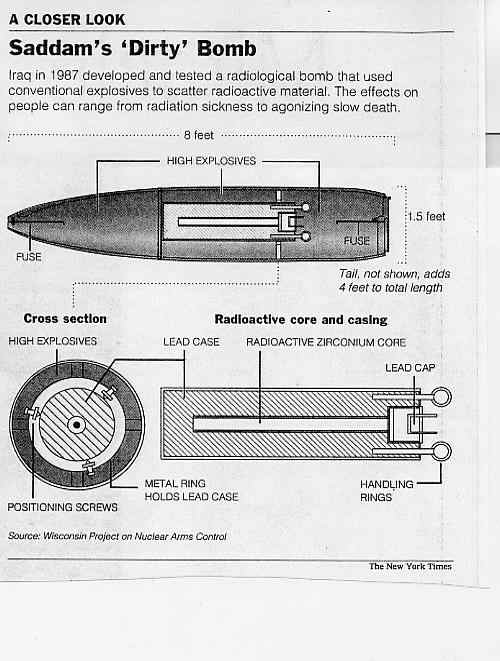
Iraq tested a bomb in 1987 that cast a radioactive cloud in the open air and was designed to cause vomiting, cancer, birth defects and slow death, according to a secret Iraqi report on the weapon’s construction and testing.

Radiation sickness from the bomb, the document said, would “weaken enemy units from the standpoint of health and inflict losses that would be difficult to explain, possibly producing a psychological effect.” Death, it added, might occur “within two to six weeks.”

The bomb, 12 feet long and weighing more than a ton, according to the document, could be dropped on troop areas, industrial centers, airports, railroad stations, bridges and “any other areas the command decrees.”

While the existence of Iraq’s effort to build a radiological weapon has been known for several years, the 1987 report sheds light on the secret effort. The New York Times obtained the document from the Wisconsin Project on Nuclear Arms Control, a private group in Washington that said it acquired it from a United Nations official.

Radiation or radiological weapons, sometimes known as “dirty nukes,” are the poor cousins of nuclear arms. Their conventional high explosives scatter highly radioactive materials to poison targets rather than destroying them with blast and heat. Their effects on people can range from radiation sickness to agonizingly slow death, which is why military experts often see them as ethically bankrupt.

“It shows what kind of guy we’re dealing with,” said Gary Milhollin, the group’s director, of the Iraqi leader, Saddam Hussein. The bomb, he added, was “nasty stuff meant to kill people over a long period of time” and thus, he said, “crossed the line into moral barbarism.”

It was basically a dud, however, Mr. Milhollin said, and that caused the Iraqis to scrap the project. The radiation levels were considered too low to achieve the grisly objectives.

The episode nonetheless “shows Iraq’s intention” to develop weapons of mass destruction, he added. The official who disclosed the document, Mr. Milhollin said, is “concerned that Saddam is going to get the bomb.”

The United Nations rarely discloses documents gathered in Iraq, but David Albright, formerly a nuclear inspector in Iraq, said he had seen the document and that it he did not doubt it was authentic.

He and other experts agreed that the document, which is to be posted on a Web site Monday, gives away no secrets that could aid weapons development and no indication that the project was a resounding failure.

Nuclear experts say Iraq today has neither programs to develop radiological weapons nor the reactors needed to make radioactive materials for them, and no fuel for nuclear arms. The reactor used in making the prototype radiological weapon was itself bombed during the gulf war in 1991, and inspectors tried to keep Iraq from resuming its nuclear efforts for years afterward.

But today the inspectors are largely gone and American experts worry that Iraq may be quietly shopping for bomb fuel and parts on the international black market.

“There’s growing concern that Iraq is reconstituting its nuclear weapons program and will make steady progress because it knows so much already,” said Mr. Albright, president of the Institute for Science and International Security, an arms control group in Washington.

Iraq’s testing of its radiological weapon was done in 1987 as it waged a war of attrition against Iran and considered the radiation bomb as a way to cripple enemy forces. The document said the work was undertaken by Atomic Energy Agency and the Al Qa-Qa and Al Muthanna centers of the Iraqi Military Industrial Commission.

To make the radioactive materials, Iraqi engineers prepared special metals to irradiate in a reactor at Tuwaitha, Iraq’s primary nuclear site. The document said the metal was mostly zirconium, which is often used in atomic reactors because it resists corrosion. The zirconium mixture also included hafnium, uranium and iron.

Zirconium was chosen, the document said, because a production process for it already existed since the metal was used for incendiary bombs. When finely powdered, the metal ignites spontaneously in air.

The half-life of zirconium 95, the document said, was 75.5 days. This relatively short period of radioactive decay, it said, “helps to dissipate the effect of the bomb after several weeks so that it is difficult to track, analyze, or recognize.” The brevity, it added, gives “the desired biological effects” while making it “possible for our units to go to the bombed area without great danger after this period has expired.”

The document has many diagrams. They show at the bomb’s core a thick three-foot lead case, shielding workers from its radioactive rays, that held the zirconium. This leaden case fit inside an eight-foot casing that held fuses and explosive charges and was capped by tail fins four feet long.

The weapon and its parts were tested three times in 1987, the document said. The first sought to see if the thick lead case holding an irradiated charge could be blown apart, in order to discharge. It could.

The second test was of a bomb sitting on the ground. “The explosion was awesome,” said the report. “We saw the blast wave moving out of the center of the explosion in the form of a circle moving at great speed.” The radioactive cloud rose more than 600 feet.

In the third test, the Iraqi Air Force dropped two bombs, which again produced huge clouds. “We must point out,” the report said, “that a significant part of the fallout went with the cloud into the air and it was not possible to follow this small amount of radioactive matter by means of the portable equipment.”

Radiation readings on the ground were rather low, in one case “290 times above the highest level allowed nationally for foodstuffs.” The document reported no readings taken in the air — a critical oversight for a weapon meant to hurt and kill people largely through the inhalation of radioactive particles.

The main flaws of the weapon, the report said, were that its radioactive charges lost strength quickly. The irradiatiated charge had to be used within a week. Calm weather was also essential. Another drawback, it said, was that the work had to be done in strict secrecy, “even with regard to those doing the work, so as not to give rise to psychological feelings leading to hesitation because of a fear of radiation.”

A final problem, it said, was that an alert enemy might come to realize that the exploding bombs packed a lingering punch, allowing the future development of defensive precautions. It even suggested that satellites might be able to spot radiation from “a concentrated strike,” a feat that seems unlikely.

Iraq gave the document to the inspectors and the United Nations apparently referred to it in a April 1996 report of the United Nations special commission set up to monitor Iraq’s disarmament. “Iraq declared,” it said, “that no order to produce radiological weapons was given and the project was abandoned.”

The document is to be posted Monday at www.iraqwatch.org, a new initiative of the Wisconsin Project. The main supporter of the Web site is the Smith-Richardson Foundation, a private group in Westport, Conn., that specializes in issues of national security.

Mr. Milhollin of the Wisconsin Project said that the radiation effort was clearly a flop, despite the report’s upbeat language.

“When you read this, you get the impression that the guys in Iraq were trying to put best face on the results, to exaggerate them,” he said. “But if you look at the figures, it’s obvious it didn’t work.”

Remarks in Honor of Jerry Brubaker

I am honored to be able to say a few words today about Jerry Brubaker.

Without any exaggeration, I can say that Jerry was one of the most committed, consistent and effective leaders in America’s attempt to stop the spread of the bomb. I say “leader” because Jerry was always an example and an inspiration to others. He certainly was to me.

I met Jerry almost twenty years ago, when our country was still trying to absorb the news that India had tested a nuclear weapon. Jerry was still working in Congress, and anyone could see that he was deeply worried about what the spread of the bomb would mean.

Jerry and I became friends very quickly, probably because we were both from small towns in the Midwest. We recognized immediately that this made us morally superior to most other people.

Jerry was worried that nuclear weapon material might find its way into the channels of civilian commerce, so he opposed the extraction of plutonium from spent nuclear reactor fuel. He also opposed the construction of the Clinch River breeder reactor, which would have used such plutonium as fuel. Because of Jerry and his allies, the United States decided not to put plutonium into commerce, and not to build the Clinch River reactor. Those were disasters we were lucky to miss. Unfortunately, the misguided Clinton administration revived this plutonium notion, so we may have to fight this battle again.

Jerry was also influential in controlling exports. Jerry realized that the United States cannot rely on high-technology for its military security and at the same time export that technology to its rivals. He fought countless battles to prevent sensitive American technology from falling into the wrong hands. He worked especially hard on supercomputers. This caused him to go head to head with powerful corporations who had lots of political influence. I am proud to say that I was able to provide some modest assistance to Jerry in these endeavors.

Jerry had a little motto that he used to repeat about proliferation. If I don’t get it right, I’m sure that several people here today could correct me. He used to say that our policy on proliferation should consist of three principles: we don’t assist it, we don’t pay for it, and we don’t lie about it. I’m sure many of us can still hear Jerry saying those words. These are sounds principles today and they will be sound tomorrow.

I would like to end with a comment about public service. Jerry always put the public first and the career second. Why is this important? Because every day we witness a miracle in Washington. Despite the discouragement, the frustration, the low pay and the pettiness of small people in big jobs, the government goes on. The public’s business gets done. The good is stronger than the evil.

Why is that true? Because a certain number of persons in public service really care about the ends they are trying to achieve. They are trying to do good in the world, even at the cost, sometimes, of their own personal advancement. There aren’t a lot of them, but there are enough to make the common enterprise succeed.

Jerry was one of those persons, and we need to keep that in mind at his passing.

Sanctions Busting: Technology Two-Timing

The Asian Wall Street Journal
March 19, 2001

After U.S. jets bombed anti-aircraft installations in Iraq last month, the American government was quick to explain that the sites had become a growing threat to its pilots, who must patrol them daily to keep Saddam Hussein in check. What it did not say, however, was that the potency of those sites has been increased by a company that owes its success to American technology, and is seeking to import more.

U.S. intelligence sources confirm (despite a denial from the Chinese government) that Huawei Technologies, one of China’s leading makers of communication networks, has helped Iraq outfit its air defenses with fiber optic equipment. The assistance was not approved by the United Nations, and thus violates the international embargo against Iraq. Unless Huawei leaves Iraq and takes its equipment with it, the United States should force American companies to cut Huawei’s technology lifeline.

Motorola would be first. It has applied for a U.S. export license to teach Huawei how to build high-speed switching and routing equipment — ideal for an air defense network. The equipment allows communications to be shuttled quickly across multiple transmission lines, increasing efficiency and immunizing a network from air attack. Motorola proposes to provide this know-how to Huawei free of charge, in the hope of later selling the large number of chips needed to make the equipment work. Huawei could then export the equipment to Iraq.

Other American firms have been selling Huawei the supercomputers and other technology it needs to develop high-speed communications. During the Clinton administration, the U.S. Commerce Department allowed Huawei to buy high-performance computers worth $685,700 from Digital Equipment Corporation, $300,000 from IBM, $71,000 from Hewlett Packard and $38,200 from Sun Microsystems. In addition, Huawei got $500,000 worth of telecommunication equipment from Qualcomm.

Still other American firms are transferring technology to Huawei through joint operations. Last year, Lucent Technologies agreed to set up a new joint research laboratory with Huawei “as a window for technical exchange” in microelectronics. AT&T signed a series of contracts to “optimize” Huawei’s products so that, according to a Huawei vice president, Huawei can “become a serious global player.” And IBM agreed to provide switches, chips and processing technology. According to a Huawei spokesman, “collaborating with IBM will enable Huawei to . . . quickly deliver high-end telecommunications to our customers across the world.” Does IBM know that one of these customers may be Saddam Hussein?

As a result of deals like these, Huawei’s sales rocketed to $1.5 billion in 1999, to $2.65 billion in 2000, and are projected to reach $5 billion in 2001. These are extraordinary heights for a company that began in 1988 as a $1,000 start-up. Real growth did not begin until the mid-1990s, when American help started rolling in. Texas Instruments started its assistance in 1994 and by 1997 had set up laboratories to help Huawei train engineers and develop digital signal processing technologies. Also in 1997, Motorola and Huawei set up a joint laboratory to develop communication systems.

This sudden flood of help was unleashed by the Clinton administration, which decided in 1994 to remove requirements for prior government approval of the export of fiber optic, switching and telecommunication transmission equipment. The first President Bush had resisted pressure from AT&T, Lucent and US West to decontrol fiber optics, but Clinton freed up the technology over the objection of the National Security Agency, which argued that the widespread use of fiber optics would cripple its eavesdropping ability.

The U.S. General Accounting Office found that in the first two years after the decontrol, China bought large amounts of telecommunication equipment suitable for military command and control and intelligence gathering, as well as for civilian uses. It is highly likely that Huawei was one of the buyers.

The U.S. government has the means to defend its interests. First, the Commerce Department should deny Motorola’s export license. American technology should not go to a company that is violating U.N. sanctions and helping Iraq take better aim at U.S. Air Force pilots. Second, President Bush should invoke the 1992 Iran-Iraq Nonproliferation Act against Huawei. This U.S. law forbids the transfer of American technology to a company that helps Iraq acquire communication systems that “destabilize the military balance.” Under the act, such a company could not receive U.S. export licenses for two years.

Third, President Bush should ask the American companies that are cooperating with Huawei to cut off their assistance. Do American firms really want to aid Huawei’s illegal quest to outfit the likes of Saddam Hussein? And are they content to watch American pilots risk their lives to bomb things that they helped develop? It is folly to think that the United States can supply powerful technology to a country like China without eventually paying the price.

Ms. Motz and Mr. Richie are researchers at the Wisconsin Project on Nuclear Arms Control.

Grab for Money Could Arm Enemies of the U.S.

Los Angeles Times
March 4, 2001, p. M5

The Bush administration is conducting a top-to-bottom review of America’s defenses to see whether they can handle, among other things, the growing threat from “rogue nations” (now called “states of concern”). At the same time, a Senate committee is pushing a bill that would make it easier for such nations to import the means to make nuclear weapons, chemical weapons and the missiles to deliver them.

The bill, sponsored by Sen. Mike Enzi (R-Wyo.) and backed by high-tech firms hungry for markets, would severely restrict the president’s ability to control the export of strategically sensitive American equipment.

Among the items that could wind up for sale are the high-precision electronic switches needed to detonate atomic bombs. As recently as 1998, Iraq tried to buy 120 of these devices (known as nuclear weapon “triggers”) by claiming they were needed as “spare parts” for medical equipment. Under Enzi’s bill, the sale of switches will probably be decontrolled.

The bill could also lift restrictions on the glass and carbon fibers needed to make missile nose cones and the “maraging” steel needed for centrifuges that process uranium to nuclear weapon grade. In the 1980s, our export laws thwarted attempts to smuggle U.S.-made carbon fibers to a Iraqi missile project, and to smuggle U.S.-made maraging steel to Pakistan’s nuclear-weapons program.

These three items and scores of others have been controlled by the U.S. and its allies for two decades, specifically to combat the spread of mass-destruction weapons. But if Enzi gets his way, many of them may become available to foreign arms makers. Releasing these items for export would dismay our allies and destroy American credibility on arms control.

Under the Enzi bill, the secretary of Commerce would be required to decontrol any item that is available in “volume” in the country that produces it. Nuclear-weapon triggers, carbon fibers and maraging steel are all available in volume in the United States, but that doesn’t mean they are readily available to countries trying to build the bomb. The evidence, in fact, points the other way. Western controls on high-tech goods during the Cold War left the Soviet Union in a technological abyss, where it is still languishing. The controls helped win the Cold War, even though the goods they restricted–essential to Western economic development–were available in great volume where produced.

The bill also requires the Commerce secretary to free for sale anything a “controlled” country like Pakistan is able to buy from “sources outside the United States.” In fact, Pakistan is now importing missile components from China and North Korea. Under the Enzi bill, U.S. firms would be authorized to sell the same equipment, allowing Pakistan to do its missile shopping in the U.S.

This obviously raises a moral question: Should the United States sell anything another country does, just to make money? German firms have supplied turn-key poison gas plants to Libya and Iraq, China has essentially created Pakistan’s A-bomb program and Russia is now outfitting Iran with ballistic missiles. Should the U.S. decry the fact that our companies missed these sales? Shouldn’t America be proud that, when the Israelis found Scud missile parts in shattered buildings in Tel Aviv during the Gulf War, the logos on the parts were German and not American? America should not let a grab for money by exporters bring America down to the level of the lowest common offender.

The Enzi bill also would make bureaucratic changes. It would take away the power of the experts in the Pentagon to determine what items should be controlled. Only the Commerce Department would have this power. The exporters obviously believe that the business-friendly folks at Commerce, whose main job is promoting trade, should not be pestered by people concerned with defending the country.

The White House should not put up with this. Current law gives President Bush broad authority to control any item he deems important to U.S. national security. He should keep things that way. Under the Enzi bill, he would have less power than his own Commerce secretary. If the secretary decided to free an item for sale–even one controlled by U.S. allies under an international agreement–the president could not overturn the decision without making burdensome findings within 30 days. And the bill forbids him to delegate the job to his staff. Can anyone imagine the president personally plowing through data on nuclear weapon triggers?

The bill’s backers hope to sneak it through Congress before the administration gets organized. The White House should quash these efforts. As the U.S. tries to strengthen our defenses against potential enemies, it would be folly to weaken export controls, which are the best means of preventing such enemies from arming themselves.

Fast Computers, Deadly Enemies

The New York Times
January 31, 2001, p. A25

As President Bush sifts through the pile of his predecessor’s last-minute directives to spot the executive orders he wants to – and can – overturn, there is one he should put at the top of the list. Just days before leaving office, President Bill Clinton – in a last-minute gift to Silicon Valley – moved to lower the controls on the export of America’s most powerful computers.

If Mr. Clinton’s directive stands (Congress has 60 days to overturn it, but probably won’t), a host of foreign countries will be able to build better weapons with American equipment.

Today, he who computes fastest wins wars. The United States has always used its most powerful computers to design nuclear warheads. And in modern warfare, computers are used for surveillance, communications, targeting and the precision-guiding of munitions.

Mr. Clinton’s directive will allow computers that perform up to 85 billion operations a second to be sold to countries like China, India and Pakistan – all of which are building nuclear and missile arsenals – and to Russia, which is helping Iran do the same. These computers are 44 times more powerful than the ones these countries’ military plants could buy from America only about a year ago. The result will be a big increase in foreign arms production.

In a press release about the new directive, the Clinton administration said that such export relaxation is inevitable. Controls on high-speed computers, it claimed, are “becoming ineffective” because of what’s known as “clustering” – the ability to achieve fast computing speeds by connecting together a number of lower-speed computers. Indeed, Mr. Clinton went so far as to recommend that export controls on all computers might as well be dropped, a suggestion that, if followed, would include the export of the multimillion-dollar (and multithousand-chip) machines in our national laboratories now trying to simulate atomic explosions.

The truth is that clustering works, but not as well as a single fast machine. It is quite difficult to assign pieces of a complex calculation to different computers and then combine the results. Among other things, the connections between the computers slow the speed. That is why foreign buyers still pay top dollar for the fastest American computers they are allowed to buy: They can’t get the same result with a bunch of laptops hooked together with cables.

In a mid-December report, the General Accounting Office criticized Mr. Clinton’s previous computer-export relaxation, which raised the top allowable speed to 28 billion operations a second from 12.5. The agency said the new ceiling failed to assess “the national security impact on the United States of Russia, China, or other countries obtaining high-performance computing.” That presidential directive, issued last August, goes into effect at the end of February.

And while the G.A.O. found that in some cases clustering is a successful substitute for higher-powered computers, it recommended convening a panel of experts to figure out what to do about clustering – not wholesale export deregulation.

The new administration should heed this advice and get its best brains working on the computer export problem. In the meantime, it should rescind, if it can, our outgoing president’s hasty and ill-considered directive.

Libya Nuclear/Missile Milestones – 1996-2000

April 1996: Libya announces that it has no intention of acquiring nuclear weapons and signs a treaty declaring a nuclear-free zone in Africa.

October 1997: Russia announces that it is ready to begin talks with Libya on overhauling the Tajura nuclear research center.

December 1997: Engineers at Libya’s Great Man-made River Project tell the New York Times that they suspect the project may have some clandestine military purpose.

June 1998: It is reported that Chinese technicians are working with Libya to develop missiles.

April 1999: According to the Washington Post, Russia is planning to supply Libya with S-300 air defense missile complexes.

September 1999: Long-range missiles, aircraft and tanks are displayed in a five-hour parade to celebrate Muammar Gadhafi’s 30 years in power.

January 2000: British officials confirm that in November 1999 they seized 32 crates of Scud missile components disguised as car parts, that originated in Taiwan and were bound for Tripoli via Malta.

April 2000: It is reported that the China Precision Machinery Import-Export Corporation (CPMIEC) has been cooperating with Libya to develop its al-Fatah long-range missile since March 1999.

April 2000: U.S. intelligence reports claim that China is training Libyan technicians at a Chinese wind tunnel facility.

July 2000:It is reported that a Maltese company has offered to sell “hundreds” of nuclear weapons-related items and scientific data to the Tajura nuclear research facility.

April 2000: Two executives of Thane-Coat, a now defunct company based in Houston, are indicted for illegally selling 3.1 million liters of pipe coating to Libya between 1993 and 1996 for use in the Great Man-made River Project.

September 2000: The Jerusalem Post reports that Libya has received the first of four deliveries of Nodong surface-to-surface missiles and launchers from North Korea. Included were nine North Korean engineers and technicians to help make the missiles operational.

Iran Missile Update – 2000

Iran continues to mount one of the largest ballistic missile efforts in the Middle East. In September 2000, CIA Intelligence Officer Robert D. Walpole testified before Congress that the United States will probably face an intercontinental ballistic missile threat from Iran during the next 15 years. Iran has already deployed hundreds of short-range missiles, which can reach most of Iraq and various targets around the Persian Gulf, and will soon deploy the medium-range Shahab-3 ballistic missile, which can reach Israel, Saudi Arabia and Turkey. Iran has also announced the development of the longer-range Shahab-4 missile, and “has mentioned plans” for a Shahab-5 missile which, according to a U.S. Department of Defense spokesman, “could have an intercontinental range.” Iran continues to import technology and materials from China, North Korea and Russia that will allow it to produce missile systems indigenously.

Recent developments

In July 2000, Iran conducted the second successful test flight of the Shahab-3 missile in two years. In a third test two months later the missile exploded shortly after launch. The road-mobile 1,300 kilometer-range liquid-fueled missile is reported to carry a 750 kilogram payload. The Shahab-3 consists of the imported North Korean Nodong missile enhanced with Russian-supplied technology. In February 1999, Iranian Defense Minister Ali Shamkhani stated that manufacture of the missile was underway. According to Mr. Walpole, “Tehran probably has a small number of Shahab-3s available for use” in a crisis. In July 2000, the commander of Iran’s Islamic Revolutionary Guards Corps announced the formation of five new units which will be equipped with the Shahab-3.

Reports say the Shahab-4 missile has an approximate range of 2,000 kilometers and can carry a 1,000 kilogram warhead. The Shahab-4 is reportedly based on the obsolete Soviet SS-4 “Sandel” liquid-fuel missile. Defense Minister Shamkhani announced in February 1999 that the Shahab-4 was in production – as a space launch vehicle with no military application.

According to Mr. Walpole, Iran has “mentioned plans” to develop a Shahab-5 missile which would have a longer range. CIA analysts assess that Iran could flight test an ICBM armed with a nuclear payload – using Russian technology – in the latter half of the next decade.

In January 2000, Defense Minister Shamkhani announced that Iran had commissioned projects to produce HTPB resin, aluminum powder and potassium chlorite at the Ministry of Defense’s Education and Research Institute to help in the indigenous production of solid rocket fuel.

Foreign assistance

Mr. Walpole also testified that “entities in Russia, North Korea and China continue to supply the largest amount of ballistic missile-related goods, technology and expertise to Iran.” A month later, CIA Nonproliferation Center Director John Lauder told Congress that “Russian entities have helped the Iranian missile effort in areas such as training, testing and components.” He noted that Russian assistance “has helped Iran save years in its development of the Shahab-3…and is playing a crucial role in Iran’s ability to develop more sophisticated and longer-range missiles.”

In February 1999, the United States imposed sanctions on ten Russian entities for providing to Iran technologies related to weapons of mass destruction: the Baltic State Technical University, Europalace 2000, Glavkosmos, the State Scientific Research Institute of Graphite (NIIGRAFIT), the Russian Scientific and Production Center (Inor), the MOSO Company, the Polyus Scientific Production Association, the Mendeleyev University of Chemical Technology, the Moscow Aviation Institute, and the Scientific Research and Design Institute of Power Technology (NIKIET).

In April 2000, the United States imposed sanctions on North Korea’s Changgwang Sinyong Corporation and four Iranian entities (the Ministry of Defense and Armed Forces Logistics (MODAFL), the Aerospace Industries Organization, the Shahid Hemmat Industrial Group, and the Sanam Industrial Group) for engaging in “missile technology proliferation activities.” In addition, it was reported that North Korea sold Iran 12 Nodong missile engines in November 1999.

Iranian exports

Iran is also becoming a supplier of missile technology. In October 1999, the press reported that Iran sold an undisclosed number of short-range Scud B and C missiles to the Congo. According to the report, a delegation of Iranian technicians was sent to assemble the missiles, which were the first export of Iranian-made versions of a Scud.

Brazil’s Rockets and Missiles Update – 2000

Brazil established a commission to develop a national space program in the early 1960s, and since then has developed four sounding rockets and a satellite launch vehicle, the VLS. Although the only two test flights of the VLS have failed, Brazil continues to advance in rocket technology. A successful VLS could be converted into a ballistic missile with intercontinental range. Brazil’s short-range ballistic missile program, active during the 1980s, has been closed down, and Brazil became a member of the Missile Technology Control Regime (MTCR) in 1995.

Sonda program

Brazil’s began its space effort with the development of the Sonda-1 sounding rocket at the Aerospace Technical Center (CTA). Three other Sonda rockets followed and the last, the Sonda-4, was primarily conceived to develop and test technologies that could be used for Brazil’s satellite launch vehicle, the VLS (Veiculo Lancador de Satelites).

VLS program

The VLS is a four-stage rocket comprised of a core and four strap-on motors. The first, or booster stage, has four solid fuel motors strapped to the center second-stage core motor. Much of the rocket motor technology used on the VLS is derived from the Sonda-3 and Sonda-4 sounding rockets. The VLS is designed to deploy 100 to 380 kilogram satellites into 200 to 1200 kilometer equatorial circular orbits, or to deploy 75 to 275 kilogram payloads into 200 to 1000 kilometer polar circular orbits. Configured as a missile, the VLS could fly 3,600 kilometers with a 500 kilogram nuclear payload.

The first launch of the VLS ended in failure on November 20, 1997, when it was destroyed 65 seconds into the flight. According to reports, the rocket was off course and tilting to one side because one of the four solid rocket propellant strap-on motors failed to ignite. In December 1999, a second VLS had to be destroyed just three minutes into the flight when the rocket again veered off course.

During the 1980s, two Brazilian firms, Orbita and Avibras, tried to develop ballistic missiles, but both programs were shut down because of funding problems. Development of the VLS was also slowed by the export controls implemented through the Missile Technology Control Regime (MTCR). The United States blocked Brazilian requests for telemetry and inertial guidance equipment as well as stage separation, fuel component and atmospheric reentry technologies.

Before joining the MTCR, Brazil created the civilian-run Brazilian Space Agency (AEB) in February 1994 to coordinate and plan all satellite and space launch programs, and in August 1995, President Fernando Henrique Cardoso announced that “Brazil no longer possesses, nor does it produce or intend to produce, to import or to export long-range military missiles capable of carrying weapons of mass destruction.” Brazil became an official member of the MTCR in October 1995. As a member, Brazil was permitted to retain its space launch program, and agreed to terminate its ballistic missile projects and to pass legislation that would tighten export control laws for dual-use items.

Foreign assistance

Brazil’s rocket programs have always depended on foreign assistance. The press has reported, for example, the sale of Russian carbon fiber technology for use in rocket motor cases, test benches for liquid fueled rocket motors developed with the assistance of Russian scientists, and instruction by Russian scientists in the use of liquid propellants.

For more information, see “Brazil: First Flight of VLS Space Launcher Fails,” and “Brazil’s Rockets,” in Volume 4, Issue 1 (January-February 1998) of the Risk Report, “Brazil: General Confirms Import of Russian Missile Materials,” in Volume 2, Issue 4 (July-August 1996) of the Risk Report, and “Brazil: Trying to Give Up Missiles,” in Volume 1, Issue 3 (April 1995) of the Risk Report.

China Nuclear Milestones – 1955-2000

1955-59: Six Sino-Soviet nuclear cooperation and assistance agreements are signed, ranging from joint uranium prospecting to the transfer of Soviet nuclear weapon technology.

1960: Soviet advisers and technicians leave China, effectively terminating all nuclear assistance.

1964: China detonates its first atomic bomb at the Lop Nur test site.

1967: China tests its first thermonuclear warhead.

1983: China agrees to provide Algeria a 15-megawatt research reactor; construction begins three years later and is completed in 1993; U.S. intelligence discovers China gave Pakistan a tested nuclear bomb design.

1984: U.S.-China nuclear cooperation agreement is signed but never ratified.

1991: China concludes a nuclear cooperation agreement with Pakistan calling for the supply of a 300-megawatt power reactor.

1992: China refuses to join Russia, Britain, France and the United States in a moratorium on nuclear testing; China joins the Nuclear Nonproliferation Treaty (NPT).

1993: France completes China’s first 900-megawatt power reactor at Daya Bay.

1994: Iran signs a contract to buy two 300-megawatt power reactors from the China National Nuclear Corporation (CNNC).

1995: China conducts its 43rd nuclear test at Lop Nur, and says it will stop testing only when a Comprehensive Test Ban Treaty enters into force in 1996.

May 1997: With observer status, China attends its first meeting of the Zangger Committee. Membership would require China to limit its nuclear exports.

September 1997: China issues new rules to control the export of nuclear material and equipment. Sales now require approval by the State Council.

September 1997: China announces that it will join the Zangger Committee as a full member, but diplomatic sources say China will keep its policy of not requiring full-scope safeguards for its nuclear exports.

October 1997: China gives the United States a written pledge that it will make no new nuclear deals with Iran. President Clinton responds by announcing that he will approve the export of advanced U.S. nuclear technology to China.

December 1997: Peter Lee, an American physicist working at the Los Alamos National Laboratory, pleads guilty to passing classified information relating to nuclear weapon simulations to the Chinese Government in 1985.

March 1998: It is reported that in January 1998 the U.S. National Security Agency discovered China negotiating the secret sale of millions of dollars worth of a material used to process uranium to weapon grade (anhydrous hydrogen fluoride – AHF) to the Isfahan Nuclear Research Center in Iran. U.S. officials claim the deal was dropped after U.S. protests.

March 1998: The China National Nuclear Corporation (CNNC), China’s chief organization in charge of nuclear research, engineering, development, and materials production, is quietly abolished as part of a program to reform China’s nuclear power industry.

April 1999: U.S. intelligence officials say April 2 intelligence report reveals that China has “revived” negotiations with Iran regarding the construction of a graphite production facility. The talks are between the China Non-Metallic Minerals Industrial Import-Export Corporation and the Atomic Energy Organization of Iran (AEOI)

May 1999: U.S. officials say that in 1995, the Central Intelligence Agency (CIA) obtained a 1988 Chinese military document describing significant details of six U.S. nuclear warheads and the ballistic missiles that carry them. The material is key to an investigation of whether American nuclear weapon secrets were passed to the Chinese.

May 1999: The U.S. Senate responds to allegations of Chinese spying by passing legislation aimed at tightening security at U.S. nuclear laboratories and adopting a set of proposals that expands Congressional oversight of technology exports to China.

July 1999: China boasts that it mastered the technology to build a neutron bomb in the 1970s and 1980s.

September 1999: China’s Foreign Ministry spokesman Sun Yuxi tells reporters that Chinese “nuclear weapons will not be directed towards … Taiwan.”

October 1999: It is reported that the Chinese government has decided to allot $9.7 billion to boost its nuclear second strike capabilities.

November 1999: Sha Zukang, China’s top arms control official, warns that an American national missile defense system could lead to a nuclear arms race, and would threaten plans to bring China into the Missile Technology Control Regime (MTCR).

January 2000: It is reported that Chinese spies stole Canadian nuclear secrets to build in Beijing a copy of the Slowpoke research reactor, developed by Atomic Energy of Canada Ltd.

May 2000: Pakistan’s nuclear power plant, Chashma, goes critical.

May 2000: China blocks the implementation of a 1985 nuclear cooperative agreement with the United States by refusing to provide assurances that it will not sell U.S. technology to other nations. The Chinese government claims it will be too difficult to distinguish between indigenously developed technology and U.S. technology.