Pakistan has an extensive nuclear-capable ballistic missile program, as the April 1998 test-firing of the Ghauri missile illustrates. The program is almost entirely imported, despite official Pakistani claims to the contrary. Most recently, Pakistan has received assistance from the People’s Republic of China and the Democratic People’s Republic of Korea (DPRK). Pakistan’s limited scientific and industrial base has forced it to rely on continuous outside help. Pakistan possesses both the 300 km M-11 (Hatf III) missile acquired from China and the 1000 km Nodong (Ghauri) missile bought from North Korea. Pakistan has also imported plants to manufacture these missiles.
Pakistan’s missile program is important for two reasons. First, Pakistan is a nuclear weapon state. Missiles give Pakistan the means to deliver its nuclear warheads farther and with more certainty than it could with aircraft. Second, the May nuclear weapons tests of both Pakistan and India illustrate the high tensions and spiraling arms race in South Asia. Ballistic missiles, which shorten warning times, increase the chances of accidental or preemptive nuclear conflict.
Ghauri
The most recent development in Pakistan’s ballistic missile program was the flight testing of the Ghauri (Hatf-V) missile in April 1998. The Ghauri is liquid-fueled and is Pakistan’s imported version of the North Korean Nodong, itself a fancy Scud. Official Pakistani statements claim the missile has a maximum range of 1500 km carrying a 700 kg payload, but analysis by the U.S. Department of Defense of the Nodong puts the range closer to 1000 km. According to Dr. A. Q. Khan, who is credited with being the father of Pakistan’s nuclear and ballistic missile programs, the Ghauri flew 1100 km in its flight-test in April, supporting the Pentagon’s analysis. Press reports put the tested range as being between 700 km and 1200 km.
The Ghauri is reported to have a relatively large diameter – 1.25 m. Pakistan is capable of producing nuclear warheads approximately the size of a soccer ball and weighing 400 kg, a size which would easily fit on a 1.25 m missile. Dr. Khan claims the Ghauri is now “fully operational.” And when asked if Pakistan is now capable of deploying nuclear weapons, he replied, “No doubt about it, one should not be under any illusions.” He said it could be done within “not months, not weeks, but within days.”
North Korea has been an important missile partner for Pakistan. North Korea admitted publicly in June 1998 that it is developing and exporting ballistic missiles to make money, though it did not specify to whom. The Commission to Assess the Ballistic Missile Threat to the United States , led by the Honorable Donald Rumsfeld (Rumsfeld Commission), believes that in addition to supplying the Nodong, North Korea supplied production facilities for the missile. This enables Pakistan to indigenously produce a fleet of missiles and reduce its dependence on imports.
Intelligence and satellite images reportedly have revealed the delivery of warhead canisters from North Korea to Pakistan’s Kahuta Research Laboratories (KRL) in June 1998 and have disclosed increased activity at KRL’s missile facility, suggesting that production of the Ghauri may be in full swing. And U.S. intelligence has reportedly concluded that Pakistan received a shipment of maraging steel from Russia, useful for missile production, via the North Korean Changgwang Sinyong Corporation (aka North Korea Mining Development Trading Corporation). The United States Department of State imposed sanctions against both Changgwang Sinyong Corp. and KRL for this relationship.
In return for its help as a supplier, North Korea is able to receive performance data from Nodong tests by its customers. North Korea itself has only tested the Nodong once, to a 500 km range. But most important, Pyongyang receives hard currency, meaning that its exports will continue to fuel rogue states’ missile programs.
M-11
The Rumsfeld Commission confirmed that complete M-11 missiles were sent to Pakistan from China. Pakistan has reportedly received more than 30 M-11s, which have been observed in boxes at Pakistan’s Sargodha Air Force Base west of Lahore. Intelligence officials believe Chinese M11s have probably been in Pakistan since November 1992, when China was “reconsidering” its stance on missile exports after the sale of U.S. F-16 aircraft to Taiwan. Since then, Pakistan has been constructing maintenance facilities, launchers and storage sheds for the missiles, all with Chinese help. China and Pakistan deny these reports.
Pakistan calls the M-11 the Hatf-III. The missile has a range of more than 300 km and a payload of 500 kg. It is a two-stage, solid-propelled missile capable of carrying nuclear warheads. The missile was reportedly test-fired in July 1997.
China has also been helping Pakistan construct its own facility to produce the M-11. China has provided blueprints and equipment to help build an M-11 factory near Rawalpindi. U.S. intelligence has reportedly been aware of the site since 1995, when construction is said to have begun. The Rumsfeld Commission states that the Pakistani version of the M-11 will be called the Tarmuk. U.S. officials reportedly expect a test-firing of the Tarmuk in the near future.
Other missile developments
According to Samar Mobarik Mand, a scientist at Pakistan’s Atomic Energy Commission (PAEC), Pakistan also has a 435 mile nuclear-capable missile ready for a test-launch, the Shaheen-I. Mr. Mand also claims that Pakistan is developing the Shaheen-II, a nuclear-capable missile that will have a range of 1250 miles. U.S. officials, however, say they have no knowledge of any such missile development.
In the future, an even longer-ranged missile is likely, according to the Rumsfeld Commission. The Commission estimates that Pakistan’s current ballistic missile infrastructure “will support development of a missile of 2,500-km range,” which would put all of India within range.
This is a brief history of Iraq’s attempt to build germ weapons. It begins with a chronology that emphasizes individual facilities and germs, although many important details were never revealed to the UN inspectors who were on the ground in Iraq until the end of 1998. It is their findings on which the history primarily relies. A second set of inspections in Iraq was carried out from September 2002 to March 2003, but answered few of the many remaining questions about Iraq’s biological weapon program. After the chronology, a second section discusses Iraq’s interest in anthrax in more detail. The third section is a primer on the effects of the germs and viruses Iraq was working on.
Iraq managed to produce anthrax, aflatoxin, botulinum toxin, gas gangrene, ricin, and wheat smut, and was also known to be working on cholera, mycotoxins, shigellosis, and viruses (including camelpox, infectious hemorrhaghic conjunctivitis and rotavirus) as well as genetic engineering. There are suspicions that Iraq was also working on smallpox.
Iraq denied that it ever had an offensive BW program until the defection of Hussein Kamal, Saddam Hussein’s son-in-law and head of the WMD program in Iraq, in 1995. Even then, Iraq continued to hide as much information, equipment and material from UN inspectors as it could. Thus, many aspects of Iraq’s biological weapon program remain unknown. These unknowns include the total amount of germ agent Iraq produced and the status of Iraq’s unaccounted for stocks of biological growth media, agents, production equipment and handbooks, as well as munitions and warheads. Furthermore, inspectors say that Iraq became self-sufficient, meaning it no longer needed imports to fuel its BW program. The uncertainties that surround this program made it all the more threatening in the absence of inspections and monitoring.
The chronology below shows that Iraq’s germ weapon program began at a single site – the Al-Hazen Institute – in the 1970s. By the end of the 1980s, Iraq had several more dedicated sites (Al Salman, Al Muthanna, the Technical Research Center at Al Salman, and Al Hakam among them) and had broadened the scope of its research to include just about every major weaponizable germ and many viruses. In the late 1980s, Iraq began field tests, although new germs and new sites were still being added. Iraq had also weaponized germ agents before the first Gulf war, and some weapons had even been deployed. Little of this activity was discovered by the UN inspectors until 1995.
I. Chronology of Germ Weapons in Iraq
According to the UN Special Commission on Iraq (UNSCOM) , Iraq’s biological weapon program ran from 1973 until at least 1991. Iraq claimed that the program began with the establishment of the Al-Hazen Institute as a dedicated BW facility. From 1974 to 1978, the Institute studied several germs – botulinum toxin, anthrax spores, Shigella, and cholera – as well as viruses. The Institute was closed on 16 January 1979 because of fraud by its Chairman (Major Ghazan Ibrahim) and some senior staff.
Before the apparent “resurrection” of the program in 1985, some biological weapon work continued at Al-Salman, where Iraq constructed buildings and an animal house. Iraq also began research into wheat smut at Al-Salman in 1984 and continued throughout the 1980s. The smut research was initially a civilian study, but after 1987 offensive weapon research began.
General Nizar Attar, the Director of Al-Muthanna Establishment, formally requested the addition of BW research to the responsibilities of Muthanna, and his request appears to have been granted in 1983. Work seems to have started substantively in 1985, when Dr. Rihab Taha, a senior Iraqi biologist, was transferred from the University of Baghdad to Al-Muthanna. General Attar told UN inspectors in 1995 that a plan had been formulated in 1986 to achieve weaponization within 5 years (which actually happened), though Iraq still claimed it had no plans for the large-scale production, weaponization and storage of biological agents. Iraq claimed that research and development at Al-Muthanna was restricted to botulinum toxin and anthrax spores, but UNSCOM determined Al-Muthanna also received Clostridium perfringens (gas gangrene) on 10 November 1986.
In 1987, Iraq transferred the bulk of its biological weapon work to Al-Salman’s Technical Research Center in order to maintain the program’s secrecy. After the move Al-Muthanna continued to collaborate on both laboratory and field experiments. Al Salman pushed forward with work on anthrax spores and botulinum toxin, including research into pilot scale production and storage. In April 1988, Al Salman, like Muthanna before it, began research on gas gangrene. UN inspectors also found that Iraq expanded the program at Al-Salman to include mycotoxins in 1987/88 and viruses and genetic engineering in 1990. The virus studies at Al Salman focused on camelpox, infectious hemorrhagic conjunctivitis and rotavirus.
To actually produce biological agents, Iraq established a factory at Al Hakam in 1988. At first, Iraq claimed that Al Hakam only produced pesticides for plants and food for animals, but in 1995 Iraq admitted that Al Hakam had produced 19,000 liters of botulinum toxin, 8,500 liters of anthrax, and had experimented with gases that produced gangrene. The facility reportedly produced hundreds of liters of gas gangrene before the first Gulf war.
Iraq began field testing in late 1987 or early 1988. Iraq never revealed the extent of this testing, and it disavowed some tests it previously acknowledged to inspectors. But Iraq did admit that Al Hakam had conducted biological weapon tests. These were done in addition to Al Hakam’s research, development, and industrial-scale production activities.
Between 1988 and 1990, Iraq began research into additional biological agents. Iraq claimed it began aflatoxin research in 1988, but it did not present a coherent account of the initiation of this work. Iraq declared that actual aflatoxin production began only in 1990 and took place at Al Safa’ah (also called Al-Fudhaliyah). Inspectors believed Iraq also began research into ricin in 1988, but the origin and extent of this program are unclear as well.
In 1990, the Daura Foot and Mouth Disease Vaccine facility was taken over by Iraq’s Technical Research Center for the biological warfare program, according to Iraq’s 1995 disclosure to the inspectors. Iraq admited that large-scale production of botulinum toxin took place at Daura. Inspectors determined that Daura also researched the viral agents camelpox, enterovirus 70, rotavirus, and hemorrhagic conjunctivitis. Iraq further declared that it initiated a genetic engineering research and development program for biological warfare purposes at the facility. Daura was also known as Al Manal during the time of biological weapon production, according to Iraq.
By 1989-1990, both Al Hakam and Daura (Al Manal) were producing botulinum toxin on an industrial scale. By September 1990, Iraq had also achieved industrial-scale production of anthrax — at Al Hakam and possibly at Al Manal. The activities undertaken in 1989 and 1990, which included field testing of aerial bombs, rockets and other munitions, the expansion of research and agent production, and the acquisition of additional facilities (Al Manal), have never been fully understood, and the inspectors were unable to draw conclusions about the full extent and scope of Iraq’s program.
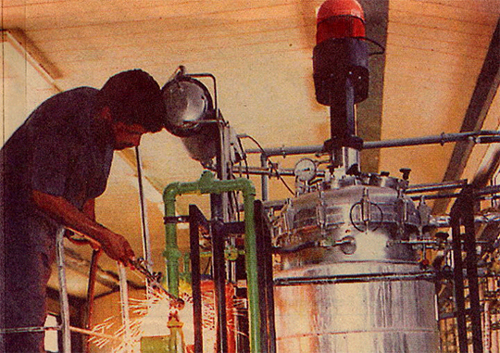
Destruction of an Iraqi fermenter AP Photo, New York Times, 12-20-98
Iraq admitted that it weaponized biological agents between December 1990 and January 1991. The types of munitions under development for use with biological weapons included Al Hussein missile warheads, R-400 aerial bombs, aircraft drop tanks, pilotless aircraft, helicopter-borne spraying systems (“The Zubaidy Device”), 122 mm rockets, LD-250 aerial bombs, and fragmentation weapons.
Iraq also admitted that it deployed germ weapons between January and July 1991, but the numbers and location of weapons deployed remain uncertain due to inconsistent Iraqi accounts. Because Iraq falsely stated that the BW program was obliterated in July 1991, observers of Iraq believed Iraq never gave a credible account of the program. It remained the least understood part of Iraq’s WMD effort in the run up to the second Gulf War.
Fueled by this uncertainty, there were reports of additional categories of biological weapons in Iraq’s arsenal. According to the New York Times, a secret U.S. intelligence assessment completed in late 1998 concluded that Iraq may have been concealing the smallpox virus. The assessment was said to be based on evidence that Iraq had recently manufactured smallpox vaccine. Inspectors had also reportedly found a freeze-drier labeled “smallpox” at a maintenance shop at Iraq’s Kimadia site in the mid-1990s.
II. Iraq, Anthrax and Terrorism
When assessing the potential links among Iraq, anthrax and terrorism, it is important to untangle the knowns from the unknowns. UN inspectors were certain that Iraq did not account for all the biological agents that it made before the first Gulf War, and that it produced anthrax on an industrial-scale. Iraq also filled actual warheads with anthrax. In addition, Iraq admitted it filled R-400 bombs and developed drop tanks to deliver anthrax, as well as developed and tested the so-called “Zubaidy” device for helicopter dissemination. Finally, Dr. Rihab Taha, a senior Iraqi biologist, told inspectors that one goal of the Iraqi genetic engineering team was to develop a strain of anthrax that was resistant to antibiotic treatment. In sum, Iraq had the capability to manufacture weapon-grade anthrax.
Worrisome unknowns include the whereabouts of enough unaccounted for growth media to produce three to four times the amount of anthrax Iraq admitted having made, the whereabouts of the warheads Iraq admitted to having filled with anthrax, and the whereabouts of much of the equipment Iraq used to make germ weapons. As already noted, the status of Iraq’s drop tank project, its program to make helicopter-borne spraying equipment, and its drying program were also a mystery. Thus, some observers concluded that Iraq’s biological weapon capability still existed and was an active threat prior to the second Gulf War.
Less clear is exactly how Iraq made and processed its anthrax. The New York Times reported that Iraq first processed anthrax into a “wet slurry” that was loaded into bombs and warheads. UNSCOM inspectors were monitoring Iraq’s “ability to isolate micro-organisms from fermenter slurry . . . and to create particles of a size appropriate for biological warfare,” among other biological capabilities, until December 1998. The New York Times also reported that Iraq initially had trouble drying anthrax for dissemination as an aerosol (despite buying special nozzles to outfit crop dusters), but that Iraq learned to make high-grade dried anthrax thereafter. Dr. Richard Spertzel, former head of biological inspections in Iraq, confirmed that Iraq tested crop dusters to spread anthrax before the first Gulf war but had trouble getting them to work. In particular, there was a problem with nozzle design.
Dr. Spertzel also confirmed that Iraq had made progress in drying anthrax; he said that instead of grinding anthrax into a fine powder, Iraq used a dryer and chemical additives. According to Dr. Spertzel, the Iraqi technique was a novel one-step process that involved drying spores in the presence of aluminum-based clays or silica powders. He said inspectors destroyed one of two industrial dryers that Baghdad used in its static-free experiments, but had not managed to destroy or remove the other, which could have remained available for use. Thus, Iraq had learned how to dry its anthrax and how to get it to a size that would allow it to be an effective weapon.
US scientists determined that the anthrax in the letters received in the United States in the fall of 2001 came from the Ames strain, which was discovered in Iowa in 1980. The Ames strain is not the strain Iraq was known to be developing. According to Dr. Spertzel, Iraq was turned down when it tried to buy it. What Iraq is known to have procured was the Vollum strain, and it is reported to have also bought the Sterne strain and the A-3 strain from France’s Institut Pasteur. However, the Ames strain is widely available, and Iraq had many procurement sources around the world.
Less well known is what happened at a series of meetings reported (and disputed) between al Qaeda and Iraqi agents. No proof of an Iraqi connection to terrorism on U.S. soil has ever emerged.
In 2001, two Iraqi defectors described a terrorist training camp at Salman Pak that operated during the 1990s. At the training camp, students practiced taking over a Boeing 707 – the same type of plane used in the terrorist attacks on America. Charles Duelfer, in his capacity as Deputy Director of UNSCOM, confirmed that during inspection visits to Salman Pak, he had seen the 707 exactly where the defectors claimed it was. He said the Iraqis reported that the camp and plane were used for counter-terrorist training, but that inspectors “automatically took out the word ‘counter’.” Before the first Gulf war, Salman Pak was among Iraq’s premier biological weapon sites.
III. The power of germs and viruses – A Primer
Iraq conducted research into many different germs and viruses. Below, some of their characteristics and effects are summarized.
Germs:
Aflatoxin: Iraqi scientists studied how to produce liver cancer using aflatoxin. Aflatoxin has no direct military value, as its cancerous effects take years to develop. Iraq produced more than 2000 liters of aflatoxin,and admitted putting it into missile warheads and R-400 bombs.
Anthrax spores: One gram of dried anthrax spores has been estimated to contain about 10 million lethal doses. The US Army estimates that a person inhaling 8,000 spores (weighing about .08 millionths of a gram) would be likely to die in less than a week. However, as the attacks on the United States made clear, far fewer spores can cause death in some victims. It is apparent that age and other factors may increase susceptibility. Anthrax spores enter the lungs when inhaled, then move to the lymph nodes of the chest. Bacteria then move through the bloodstream to damage the body’s tissues – resulting in uncontrollable bleeding. A person infected with inhalation anthrax would experience the gradual onset of flu-like symptoms, followed in 2-3 days by the sudden onset of severe respiratory distress. Death usually follows within 24-36 hours. Pulmonary anthrax infections are not contagious. If not treated until symptoms appear, pulmonary anthrax is almost always fatal. A less severe form of anthrax attacks its victims through the skin, producing lesions, followed by achiness, fever, and nausea. This “cutaneous” anthrax is treatable with antibiotics and is only fatal to about 20% of untreated victims. Anthrax can also be ingested through contaminated food, resulting in death in 25 to 60 percent of its victims. Iraq declared that it produced 8445 liters of anthrax, and inspectors determined that at least three times this much could have been produced with the equipment and growth media Iraq had at its disposal.
Botulinum toxin: Botulinum toxin is the most poisonous substance known – the average man would only have to inhale about 70 billionths of a gram for it to be fatal. Eighty percent of victims die within 1-3 days of being infected. However, the toxin decomposes quickly when exposed to sun, air or heat, which limits its effectiveness. Botulinum toxin attacks the central nervous system and blocks neurotransmission. A person with botulism would exhibit weakness, dizziness and disinterest within the first few days after exposure, followed by trouble with motor functions affecting vision and swallowing. Next, the extremities and respiratory muscles would become progressively weaker. Abrupt respiratory failure is usually the cause of death. Iraq made almost 20,000 liters of botulinum toxin, much of which was placed into munitions and missile warheads.
Cholera: Cholera is passed naturally via contaminated food and water, and as a weapon would most likely be used to poison water supplies. It causes diarrhea, which could cause death from dehydration if not treated. However, cholera is not usually fatal – only debilitating and disruptive. Iraq studied cholera at the Al Hazen Institute, but little is known about production or weaponization.
Clostridium perfringens (gas gangrene): The Clostridium perfringens bacterium can cause gas gangrene, which in turn causes toxic gases to form in the body’s tissues. The result can be acute lung distress, leaking blood vessels, the breakdown of the red blood cells or platelets (which enable the blood to clot to stop bleeding), and liver damage. Inspectors believed Iraq could have produced some 5,000 liters of clostridium perfringens, though it declared it had made far less.
Mycotoxins: Trichothecene mycotoxins are a family of poisonous compounds made from a mold that grows on wheat, millet and barley. Mycotoxins can be absorbed by the skin, inhaled or ingested. These toxins attack the cells of bone marrow, skin, and the G-I tract. They also block blood clotting. It takes only about 35 milligrams in aerosol form to kill an average man, but mycotoxins are considered only moderately lethal. Iraq provided no documentation on its work, so inspectors never determined how much may have been produced.
Ricin: Ricin is a plant toxin derived from castor beans. It blocks cellular protein synthesis and is lethal when about 10 millionths of a gram are inhaled. Ricin causes flu-like symptoms at first, then causes the body to go into shock and cardiovascular collapse, and finally results in quick, extreme lung failure. Ricin is highly lethal. Iraq declared it had made only 10 liters of ricin and used it all in field trials, though this claim was not verified.
Shigella: This bacterium primarily causes diarrhea, but in rare cases it can also cause the development of a rash, then lead to generalized sepsis and death. It is not usually fatal. Inspectors know Iraq studied shigella at the Al Hazen Institute, but determined little else in terms of production or weaponization.
Wheat-cover smut: Wheat-cover smut causes a growth on the stem which is fatal to the wheat plant. It is an agricultural or economic biological weapon. Iraq admitted producing wheat smut, but declared the amounts were “not quantifiable” and had all been destroyed.
Viruses:
Camelpox: Camelpox causes fever and skin rash in camels but rarely infects humans. It is a virus closely related to smallpox; thus, Iraq may have been studying camelpox in order to learn more about using smallpox as a biological weapon. Iraq conducted preliminary studies on camelpox beginning in 1990 but is not known to have advanced farther.
Enterovirus 70: Enteroviruses are common human viruses that can cause flu, colds, or pneumonia. While not fatal, they might weaken an enemy’s military forces or disrupt its population and medical care facilities. Iraq conducted research on Enterovirus 70 at the Daura site.
Infectious hemorrhagic conjunctivitis virus: This virus attacks the victim’s eyes, causing a loss of sight and in some cases bleeding. Iraq conducted preliminary studies on infectious hemorrhagic conjunctivitis virus beginning in 1990 but is not known to have advanced farther.
Rotavirus: This virus causes diarrhea, which could theoretically cause death from dehydration if not treated. However, rotavirus is more likely to simply debilitate its victims. Iraq conducted preliminary studies on rotavirus beginning in 1990 but is not known to have advanced farther.
Smallpox: The virus can be inhaled or absorbed by the skin. Its initial symptoms are like a severe flu, then a rash appears. Smallpox kills about a third of unvaccinated victims, but the vaccine is highly effective. The virus can be stored over long periods of time if it is freeze-dried, and it is easy to produce, making it a good candidate for biological warfare. In addition, countries like the United States are susceptible, as all natural occurrences of smallpox were eradicated by 1980, making regular vaccinations unnecessary. Iraq was reported in late 1998 to be suspected of concealing the smallpox virus, but this ws not confirmed.
Genetic engineering:
Genetic engineering uses basic knowledge of DNA molecules to manipulate genetic characteristics. A US government study concluded that genetic engineering is unlikely to produce “supergerms” that are significantly more lethal than existing germ agents, but also concluded that such engineering might enhance weaponization by creating strains that are more stable during dissemination and less susceptible to standard treatments. Iraq admitted it had a genetic engineering research program, one purpose of which was producing an antibiotic-resistant strain of anthrax, but any advances Iraq made are not known.
Iraq’s BW Effort
Germ or Virus
Effects
Lethality
Amount produced
Weaponization efforts
Aflatoxin
Liver cancer
Long-term only
More than 2,000 liters
Loaded into missile warheads and R-400 bombs
Anthrax - inhalation (pulmonary)
Gradual onset of flu-like symptoms, followed in 2-3 days by severe respiratory distress; uncontrollable bleeding
Death usually within 24-36 hours; if not treated until symptoms appear, almost always fatal
Iraq declared 8445 liters; inspectors determined that at least three times this much could have been made
Loaded into missile warheads and R-400 bombs; developed drop tanks, and the "Zubaidy Device" for helicopter dissemination
Anthrax - cutaneous
Lesions, achiness, fever, and nausea
Treatable with antibiotics; only fatal to about 20% of untreated victims
-
-
Anthrax - intestinal
Nausea, vomiting, fever, diarrhea
25-60% of those infected will die
-
-
Botulinum toxin
Weakness, dizziness and disinterest, trouble with motor functions affecting vision and swallowing; extremities and respiratory muscles become progressively weaker; abrupt respiratory failure
80% of victims die within 1-3 days
Almost 20,000 liters
Loaded into missile warheads and R-400 bombs
Cholera
Diarrhea, dehydration
Limited lethality
Unknown
Unknown
Clostridium perfringens (gas gangrene)
Acute lung distress, leaking blood vessels, breakdown of the red blood cells or platelets (which enable the blood to clot), and liver damage
Can be fatal, though early antibiotic treatment is effective if done before toxins accumulate in the body
Up to 5,000 liters possible, though far less declared by Iraq
Iraq declared none was weaponized
Mycotoxins
Attack the cells of bone marrow, skin, and the G-I tract, block blood clotting
Only about 35 milligrams (aerosol) kills an average man, but considered only moderately lethal
Unknown
Unknown
Ricin
Flu-like symptoms, then shock and cardiovascular collapse, and finally quick, extreme lung failure
Highly lethal - only about 10 millionths of a gram need to be inhaled
10 liters declared by Iraq
None - all used in field trials, according to Iraq
Shigella
Diarrhea; in rare cases a rash, generalized sepsis and death
Not usually fatal
Unknown
Unknown
Wheat-cover smut
No effect to humans
Fatal to the wheat plant
Iraq declared amounts made were "Not quantifiable"
Unknown
Camelpox
Fever and skin rash in camels
Rarely infects humans
Unknown
Unknown
Enterovirus 70
Flu, colds, or pneumonia
Not fatal
Unknown
Unknown
Infectious hemorrhagic conjuncitivitis
Attacks the eyes, causing a loss of sight and in some cases bleeding
Not fatal
Unknown
Unknown
Rotavirus
Diarrhea, dehydration
Limited lethality
Unknown
Unknown
Smallpox
Flu-like symptoms, then a rash
Kills about 1/3 of unvaccinated victims, but the vaccine is highly effective
Unknown
Unknown
Genetic Engineering
Can create strains that are more stable during dissemination and less susceptible to standard treatments
NA
NA
One goal was to make an antibiotic-resistant strain of anthrax
This is a brief history of Iraq’s attempt to build a nuclear weapon. The emphasis is on Iraq’s technical achievements rather than its motives, and the history relies primarily on the findings of U.N. inspection teams.
Iraq faced the same two challenges that every other country trying to develop a nuclear weapon has faced. First came the need to produce a critical mass of “fissile material” – uranium 235 or plutonium – the heavy metals needed to fuel a first-generation fission bomb. The second challenge was to produce a device that could cause the uranium or plutonium to explode in a nuclear chain reaction. This second process is called weaponization. Iraq attacked both challenges simultaneously.
Iraq spread the work among four major groups, all of which operated within the Iraqi Atomic Energy Commission, and more specifically within the Commission’s Department of Studies and Development (also known as Department 3000). Group I was responsible for producing uranium 235 by using diffusion barriers and centrifuges. Group II tried to do the same by using chemical and electromagnetic methods. Group III was responsible for computer modeling, and Group IV performed “special tasks,” another term for weaponization. The program carried the code name Petrochemical 3 (PC-3).
I. Seeking Nuclear Fuel
Producing the fuel has always been the greatest challenge in nuclear bomb making. The difficulty of producing uranium 235 is that natural uranium contains only a very tiny amount (.7%) of this isotope. In order to fuel a bomb, the U-235 must be separated from the more abundant U-238 isotope in a process called enrichment. But because these two uranium isotopes are almost identical chemically, they cannot be readily separated by using a simple chemical reaction. They must be separated by exploiting the slight difference in their weights. Plutonium, on the other hand, is not found in nature in significant quantities, so it must be manufactured in a nuclear reactor.
Electromagnetic Isotope Separation (EMIS)
Iraq’s main effort to produce U-235 was by the electromagnetic process (called EMIS). In this process, uranium atoms are ionized (given an electrical charge) then sent in a stream past powerful magnets. The heavier U-238 atoms are affected differently than the lighter U-235 atoms by the magnetic field, so the isotopes separate and can be captured by collectors. The separation process is repeated until a high concentration of U-235 is achieved. Iraq’s design called for 93% enriched uranium, which required multiple stages of separation.
Iraq began this effort at the Tuwaitha site in 1982 after Israel bombed Iraq’s Osirak reactor. The first separator unit (with a 400mm radius of beam curvature) was built to test Iraq’s concept for the unit’s insulator and liner. The 400mm unit was followed by 500mm and 1000mm units, used to test larger ion sources, multiple ion sources and a hexagonal liner design, as well as concepts for the control system and collectors. Next, components of a 1200mm system were designed for Tarmiya, and the magnet for a 600mm machine at Tarmiya was actually built. A double ion source and collector system for the 600mm unit was also designed. At the time of the Gulf war, eight 1200mm units were in limited operation at Tarmiya, and preparations had begun for a second group of seventeen 1200mm separators. According to Iraq’s declarations to U.N. inspectors, it managed to produce 640 grams of enriched uranium with an average enrichment of 7.2% at Tuwaitha and some 685 grams at an average enrichment of 3% at Al Tarmiya.
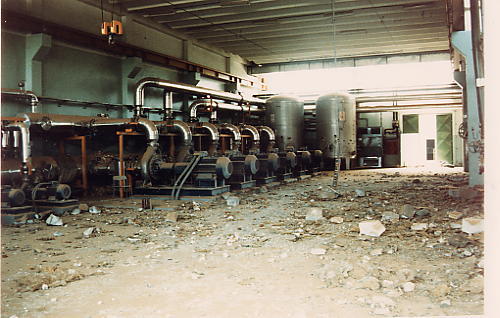
Tarmiya, – July 24, 1991
Centrifuges
Iraq also attempted to enrich uranium with high-speed centrifuges. This effort had lower priority than the EMIS program. Centrifuge separation works by passing uranium molecules in gaseous form (UF6) through high-speed rotational machines called centrifuges. The different weights of the uranium isotopes cause them to separate, with the heavier U-238 being thrown to the outside of the centrifuge and the lighter U-235 staying nearer the inside. As with other enrichment techniques, centrifuges require several repetitions with the enriched product to reach a high enough concentration to serve as nuclear fuel.
Iraq planned an ambitious research and development effort for its centrifuges. From mid 1987 to late 1989, Iraqi scientists conducted trials on a “model 1” centrifuge. It was an early Beams-type gas centrifuge using oil bearings, which ran into difficulties with vibration. It also consumed large amounts of power. Then from mid-1988 to mid-1991, Iraq ran trials on a “model 2” centrifuge. This was a Zippe-type centrifuge using magnetic bearings and a maraging steel rotor spinning at sub-critical speeds, for which the design drawings were provided by an ex-employee of the German firm MAN Technologie AG. Also during this period, another German national, Karl-Heinz Schaab, provided the design of a sub-critical centrifuge featuring a carbon fiber composite rotor. Schaab also furnished a quantity of sample rotors, which Iraq exploited successfully by achieving an output of 1.9 kg SW/year in 1990. Iraq also obtained 25 pieces of maraging steel from an unidentified source, 19 of which it machined into centrifuge preforms at Nasser Engineering Establishment while six more were machined by an unidentified foreign company.
Iraq planned to construct (with the help of foreign companies) a centrifuge plant at Al Furat between late 1989 and mid-1991. Trial operation was scheduled for the second half of 1991. Iraq also planned to design and construct a 100-centrifuge cascade at Al Furat between 1991 and mid-1993, when Iraq hoped to begin active operation. In addition, Iraq planned to design and construct a 500-centrifuge cascade from mid 1992 to mid-1995. The centrifuges and pipework for this latter cascade would be installed in 1995, and operation would start in early 1996.
The fourth International Atomic Energy Agency inspection team estimated that 1,600 to 2,000 Iraqi-designed maraging steel centrifuges in cascade could produce about 25 kg/yr of HEU. The team also found that Iraqi plans for the program “would most probably have been achieved once the capability to flow-turn and weld maraging steel had been acquired.” This quantity of HEU would have been enough for about 1.5 bombs per year.
Laser Isotopic Separation (LIS)
Because isotopes of different masses absorb different wavelengths of light, uranium isotopes can be separated by lasers precisely tuned to excite or ionize only the U-235 atoms in a stream of atomic vapor (atomic vapor laser isotope separation, or AVLIS). The U-235 is then separated out using a chemical reaction or magnetic forces that attract the excited atoms and leave behind the neutral ones.
In May 1994 the IAEA received information indicating that Iraq had pursued laser uranium enrichment through both molecular and atomic vapor isotope separation. But the IAEA did not believe Iraq had made substantial progress in either. The IAEA had no evidence that these efforts achieved any isotopic separation, or that Iraq had developed even the most rudimentary capabilities. In September 1994, however, Iraq admitted that an exploratory laser program had indeed been established in 1981 and was assigned to the laser group within the Physics Department of the Iraqi Atomic Energy Commission. Iraq said that this program continued, without success, until 1987, when it was relegated to a “watching brief.” IAEA-26 found Iraq’s explanation of its laser activities plausible, but was surprised that Iraq said it had not undertaken the relatively simple step of vaporizing uranium metal. After August 1995, the IAEA learned that Iraq had in fact made two attempts to build a suitable vacuum chamber for AVLIS experiments, the second of which succeeded. Moreover, the chamber was equipped with an electron beam gun for vaporizing uranium metal. Iraq’s AVLIS experiments in 1986 and 1989 were inconclusive, however, and Iraq claimed that further work was abandoned due to these failures and the low priority given to the laser program.
Chemical and Ion-Exchange Separation
Although U-235 and U-238 are nearly identical in chemical composition, they vary enough to have different chemical reaction rates. Thus, chemical reactions which take advantage of this fact can be used to separate the isotopes.
Iraq made some progress in chemical (solvent extraction) and ion-exchange methods of uranium enrichment before the Gulf war. The effort was centered at the Nuclear Research Center, Tuwaitha, except for the production of tri-butyl phosphate which, together with some theoretical work on crown ethers, had been done at the Muthanna State Establishment. The reason for chemical enrichment was to provide feedstock for the EMIS separators, so they could begin with low enriched uranium instead of natural uranium, thereby boosting efficiency. Iraqi research in solvent extraction appears to have been limited to laboratory-scale, but Iraqi scientists expressed confidence that they could have overcome any practical problems during scaling-up, and had begun buying components for a pilot plant to produce four metric tons per year of 1 to 1.2 % enriched uranium. Iraq stated that ion exchange enrichment was also promising, but that experience with it was limited. Its laboratory scale experiments, using indigenously produced ion exchange resins, produced only modest results. A project for a pilot plant to produce four metric tons per year of up to 3% enriched uranium had not gone beyond a preliminary assessment of the equipment and material needed. According to Iraq, the most promising project, though still at the conceptual design stage in late 1990, combined both enrichment methods in a hybrid process having a solvent extraction first stage and an ion exchange output stage, in order to produce up to 5 metric tons per year of 4 to 8% enriched uranium.
Gaseous Diffusion
In gaseous diffusion enrichment, uranium is converted into gaseous form (UF6) and then sent through a porous barrier. Lighter, faster U-235 molecules diffuse through the tiny holes in the barrier faster than the U-238 molecules, and thus separation occurs. Again, multiple stages in a cascade are required to produce weapon-grade material.
Group I of PC-3 apparently began its effort to produce diffusion barriers and compressors at Tuwaitha. Iraq confirmed that this work continued after Group I was relocated at the Engineering Design Center (Rashdiya) and that some significant achievements had been attained in the development of anodized aluminum barriers. Iraqi scientists had demonstrated the corrosion resistance of barrier material to UF6 and had achieved measurable uranium isotopic separation. However, according to an Iraqi scientist, this activity, which was carried out in 1989, had not progressed beyond the qualification of a single barrier. In parallel to the barrier studies, Group I attempted to reverse-engineer compressors, in cooperation with Iraq’s Specialized Institute for Engineering Industries, but Iraq claimed that this attempt was not successful. According to Iraq, all activities related to gaseous diffusion ended in 1989 and priority was given instead to gas centrifuge enrichment. According to the former director of Iraq’s nuclear weapon program, Khidir Hamza, however, the Iraqis perfected the diffusion barrier in 1993, under the noses of the inspectors. Dr. Hamza believes that diffusion is the most likely path a reconstituted Iraqi nuclear program would take in order to enrich uranium for its bombs.
Diversion of Reactor Fuel
After its invasion of Kuwait in 1990, Iraq intended to illegally divert to bomb-making a quantity of highly enriched uranium that was being inspected by the IAEA. The HEU was contained in the fuel of Iraq’s two research reactors at Tuwaitha. Iraq had at its disposal some 41 kg of U-235 in its supply of research reactor fuel from Russia and France.The effort to divert that fuel, known as Project 601, started shortly after Iraq’s invasion of Kuwait in August 1990. By December 1990, a chemical processing plant had been installed in the LAMA building at Tuwaitha which Iraq hoped would make available 26 kg of HEU within 2-3 months. The building was severely damaged, however, in the Gulf war, and plans were made to move a scaled-down project to Tarmiya. The IAEA’s decision to remove the reactor fuel, starting in November 1991, meant the end of the crash program.
Plutonium Separation
Because the plutonium isotope 239, which is used to fuel fission bombs, exists naturally only in trace amounts, it is necessary to manufacture plutonium in a nuclear reactor. This is done by bombarding U-238 with slow neutrons. When the U-238 captures a neutron, the U-239 isotope is produced, which decays into plutonium 239.
Iraq used its Russian-supplied IRT-5000 research reactor to irradiate (noncontinuously – to avoid detection during IAEA inspections) three U-238 fuel elements manufactured from December 1988 to February 1989 at Iraq’s Experimental Fuel Fabrication Research Laboratory (known as ERFFL or EFFRL). Iraq also irradiated one element for 22 days between February and April 1989, and two additional elements for 50 days between September 1989 and January 1990.3
II. Weaponization
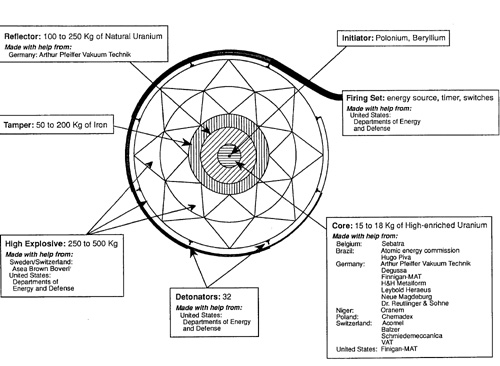
In 1995, Iraq admitted to the IAEA that it had considered several implosion-type bomb designs. Iraq claimed that it gave no serious consideration to the simpler, gun-type uranium bomb that the United States dropped on Hiroshima. Iraq ran the computer codes pertinent to these designs on a Japanese NEC 750 computer located at Tuwaitha, which was moved to the National Computer Center after the Gulf war. Iraq also experimented with high explosives to produce implosive shock waves and developed a 32-point electronic firing system using detonators developed at Al Qaqaa. The firing system was tested and gave satisfactory results. For research purposes, Iraq also used flash X-ray systems (180, 600 and 1200 kV), and two gas guns (light gas and high-explosive-driven gas). Iraq used fiber optics with fast response electronic equipment, and high speed electronic streak cameras – all to diagnose and perfect a workable bomb design.
Iraq also admitted studying several approaches to building a neutron initiator, which supplies the neutrons necessary to set off a nuclear chain reaction. Iraq produced and recovered tritium by irradiating lithium, and produced and recovered polonium by irradiating bismuth.
A special unit in Al Qaqaa was created to help Group Four develop and manufacture the high-explosive lenses and detonators needed for the implosion device. This group developed manufacturing processes such as rigid die-pressing of mixed explosives and plastic-bonded explosives, atmospheric and vacuum casting of melt-cast explosives, and casting of explosive/polymer composites. By the end of 1990, Iraq could perform computer numerical controlled (CNC) machining of high explosives.
The Al Qaqaa team was also responsible for developing and producing plane wave lenses During 1990, the team produced lenses with various diameters (up to 120 mm) and lengths. These lenses were tested or used as plane wave generators for shock-wave experiments. Iraq also started working on spherical lenses as early as 1988, and experimented with various kinds of explosives, including Baratol, PETN, COM-B, TNT, RDX and HMX. Iraq revealed to IAEA-4 that hundreds of tons of HMX had been imported, and that Iraq had gained “considerable experience in casting such material.” The HMX was used to make improved explosive lenses for the Iraqi bomb. The Al Qaqaa team also mastered the design of dedicated exploding bridge wire (EBW) detonators, after experimenting with several types. In fact, the U.S. Departments of Defense and Energy helped train three Iraqi scientists from Al Qaqaa at a quadrennial international detonation conference in Portland, Oregon, where nuclear weapon detonation technology and flyer plate technology were presented. The latter is used to control the force and shape of implosive shock waves.
The Iraqi Bomb
UN inspectors learned that Iraq’s first bomb design, which weighed a ton and was a full meter in diameter, was replaced by a smaller, more efficient model. From discussions with the Iraqis, the inspectors deduced that the smaller design weighed only about 600 kilograms and measured only 600 to 650 millimeters in diameter. That made it small enough to fit on Iraq’s Scud-type missiles, which were never completely accounted for. Iraq mastered the key technique of creating an implosive shock wave, which squeezes a bomb’s nuclear material enough to trigger a chain reaction. The smaller Iraqi design also used a “flying tamper,” a refinement that “hammers” the nuclear material to squeeze it even harder, so that bombs can be made smaller without diminishing their explosive force. The inspectors determined that Iraq had managed to develop a successful bomb design and lacked only the fissile material to fuel it.
In July 1998, Iran took a giant step forward in its missile program by flight-testing the Shahab-3, an 800-mile nuclear-capable missile that will be able to reach Israel, Saudi Arabia, and Turkey. Iran is also developing a 1240-mile missile called Shahab-4, and within five years, according to a recent U.S. Congressional study, Iran might develop an intercontinental ballistic missile (ICBM) with outside help.
The Iranian missile program and the speed of its development would not have been possible without extensive assistance from North Korea, Russia and China.
Iranian missile program
U.S. intelligence had been watching the progress of the Shahab-3 for some time before the launch. In December 1997, U.S. reconnaissance satellites observed a ground test of the Shahab’s rocket engine. The test occurred at Iran’s Shahid Hemmat Industrial Group (SHIG) and was the sixth or eighth of the year, according to intelligence estimates.
On July 22, 1998, Iran conducted Shahab-3’s first test-flight. U.S. intelligence observed what appeared to be an extended-range version of the 1000 km-range North Korean Nodong missile. The Shahab-3 is reportedly not simply a Nodong with new paint, however, but an Iranian-developed missile based on Nodong technology imported from North Korea. The Shahab-3 is liquid-fueled, carried on a road-mobile launcher, and could be deployed within one to two years, depending on the level of outside assistance.
The missile exploded in the later stages of its test-flight, leading to the question whether the launch was a complete success. Martin Indyk, U.S. Assistant Secretary of State for Near Eastern Affairs, was quoted as saying, “We can’t declare it a failure because they got the missile up and it traveled a very considerable distance, for the requisite amount of time, [then] something went wrong.” It is possible that the Iranians blew up the missile on purpose after having deemed the test flight successful.
Although Iran is not yet capable of building nuclear warheads, the Shahab test appears to show that Iran is bent on acquiring them. Countries do not build an 800-mile missile simply to deliver conventional explosives. In addition, the missile could be used to carry chemical or biological weapons, another likely alternative due to its limited accuracy.
Judging from the current level of its missile programs, Iran will probably be capable of developing longer-range, more advanced missiles within two to five years. The Shahab-4 currently under development is a liquid-fueled missile which matches the Soviet SS-4 missile in range and may be derived from it. Iran reportedly acquired designs for the engines that powered the SS-4, plus some guidance components, sales that were protested by U.S. Vice President Al Gore. According to a press report, Pentagon officials expect the Shahab-4 to have a range of up to 1240 miles (the same range as the SS-4) and the ability to carry a 2200 pound warhead.
The Commission to Assess the Ballistic Missile Threat to the United States, chaired by the Hon. Donald Rumsfeld, (Rumsfeld Commission) judges Iran also to be capable of “demonstrating” an ICBM-range missile, based on scaled-up Scud technology, within five years. In addition, Iran “has acquired and is seeking” advanced missile components that could be combined to produce ballistic missiles with a range sufficient to reach the United States.
Iran also has an indigenous infrastructure for building solid-fueled rockets and is seeking long-range missile technology imported from foreign sources.
Foreign partners
North Korea has been central to the development of the most recent Iranian ballistic missiles. In May 1996, the U.S. State Department imposed sanctions against entities in both North Korea and Iran for missile proliferation. The Changgwang Sinyong Corporation in North Korea and the Ministry of Defense Armed Forces Logistics in Iran were both cited. However, the sanctions did not prevent North Korea from declaring its intention to keep selling missiles and technology for hard currency.
Russia has also been an important contributor. In July 1998, the State Department imposed sanctions on seven Russian entities for “proliferation activities related to Iran’s missile programs.” The Russian entities sanctioned were the INOR Scientific Center, Grafit Research Insititute, Polyus Scientific Production Association, Glavkosmos, MOSO Company, Baltic State Technical University, and Europalace 2000. Two additional Russian entities – Tikhomirov Institute and the Komintern plant in Novosibirsk – were under investigation by the Russian Commission on Export Control at the time the sanctions were imposed, but were not named by the United States as sanctioned entities.
Reportedly, INOR contracted in September 1997 to supply special alloys for Iran’s long-range missile program, including steel for missile casings and alloy foil to shield missile guidance components. In addition, Russia’s arms exporting agency, Rosvoorouzhenie, and Russia’s space agency head, Yuri Koptev, have allegedly been directly involved in Iran’s Shahab program. Rosvoorouzhenie is also reportedly helping to construct a wind tunnel, which can be used for the testing and design of missile components. Russian assistance to Iran’s SHIG is said to include development of solid rocket fuel technology and the design of guidance and propulsion systems. Europalas 2000 reportedly was caught shipping Iran 22 tons of stainless steel that could have been used to make fuel tanks for Scuds, while Polyus is suspected of supplying navigation and guidance technology. Grafit is said to make material used to coat missile warheads, and U.S. officials reportedly suspect Iranians are being trained in missile guidance and propulsion at Baltic State Technical University and through a joint missile education center called Persepolis. These suspicions culminated in the Russian investigations and the U.S. sanctions.
The July sanctions were imposed only under pressure from Congress. The preceding month, President Clinton had vetoed overwhelming House and Senate votes in favor of a bill sanctioning the Russian companies. When Congress threatened to override the veto, the President imposed the sanctions.
Iran’s third source of missile technology has been China. According to the Rumsfeld Commission, China “has carried out extensive transfers to Iran’s solid-fueled ballistic missile program.” One press report has linked China Great Wall Industries to the supply of missile testing technology, and another has linked China Great Wall to an agreement to supply Iran telemetry equipment. The press has also reported an agreement by China Precision Engineering Institute to supply gyroscopes, accelerometers, and test equipment, and has reported joint work by China and Iran on short-range ballistic missiles.
As Iran’s missile capability increases, Iran will probably begin to export missile technology to states such as Syria or Libya, becoming a missile seller as well as a buyer.
Well before Operation Desert Storm or the U.N. inspections that followed it, Iraq had already begun to build chemical weapons. After launching a research effort in the 1970s, Iraq was able to use chemical weapons in its war against Iran and to kill large numbers of its own Kurdish population in the 1980s. During the first Gulf War, there were fears that Iraq would launch chemical-tipped missiles at its neighbors, particularly Israel, but Iraq refrained for fear of U.S. retaliation. During Operation Iraqi Freedom, coalition troops again feared they might be hit with chemical weapons, though this did not come to pass.
By 1991, the United Nations had established its Special Commission (UNSCOM) and charged it with the task of destroying, removing, or rendering harmless “all chemical and biological weapons and all stocks of agents and all related subsystems and components and all research, development, support and manufacturing facilities.”
By the time UNSCOM left Iraq in December 1998, it had eliminated a large portion of Iraq’s chemical weapon potential. UNSCOM had overseen the destruction or incapacitation of more than 88,000 filled or unfilled chemical munitions, over 600 tons of weaponized or bulk chemical agents, some 4,000 tons of precursor chemicals, some 980 pieces of key production equipment, and some 300 pieces of analytical equipment. Notwithstanding these extraordinary achievements, there remained important uncertainties regarding Iraq’s holdings of chemical weapons, their precursors, and munitions.
I. Chemical Agents
CS and Mustard Gases
After a successful research effort in the 1970s, Iraq began producing tear gas and mustard gas in the early 1980s. Tear gas is not lethal; its chief use is riot control. It causes pain to the eyes and nose, and uncontrollable coughing. Iraq first produced several tons of CS tear gas at its Salman Pak site, and by the early 1980s began military-scale production at the al-Muthanna State Establishment.
Iraq also began to produce sulphur mustard blister gas (HD) in the early 1980s, and by 1983 was able to employ it in chemical munitions against Iran. The primary effect of mustard gas is skin and eye blistering and lung irritation. Heavy exposure to an aerosol of mustard gas causes the lungs to fill with fluid and “drown” the victim. Mustard gas has a low death rate; generally only 2 to 3 percent of its victims perish.
Iraq initially told UNSCOM that 3,080 tons of mustard gas had been produced, but in 1995 Iraq reduced this amount to 2,850 tons. UNSCOM found Iraq’s mustard gas to be at least 80% pure and determined that it could be stored for long periods of time, both in bulk and in weaponized form. In its distilled form, mustard gas has a long life, and can be stockpiled for decades. It is relatively easy to produce and load into munitions. Iraq admits filling some 550 artillery shells with mustard gas but says it misplaced them shortly after the first Gulf War.
Nerve Gas: Sarin and Tabun
Iraq moved up to producing the nerve gases sarin (GB) and tabun (GA) in 1984. These gases are highly toxic compounds that can penetrate the body either through contact with skin or eyes, or by inhalation. Just a few droplets will kill within minutes if inhaled or within hours if absorbed through the skin. The initial effects depend on the amount of contact with the agent and are almost immediate. Chemical nerve agents tend to have little or no incubation or latent period in the body. These agents act by attacking the central nervous system, causing rapid paralysis, respiratory failure and death by asphyxiation.
According to Iraq, the sarin and tabun it first produced was of poor quality. It was unstable, and the effectiveness of the agents diminished quickly after production. Iraq claimed that its production methods were later changed to eliminate the stabilization problem. Iraq argued that the tabun it produced was of such poor quality that Iraq turned its research, development and production effort to prolonging the viability of sarin instead.
Iraq adopted the “binary” method of weaponization, in which the components of sarin gas are stored separately until use, when they are mixed. The components of sarin are DF 2 and the alcohols cyclohexanol and isoproponal. Iraq manufactured DF 2 with a purity of 95%, and imported alcohols of 100% purity, so the detonation of its munitions could be expected to yield relatively pure sarin.
At first, Iraq told UNSCOM that it had produced an estimated 250 tons of tabun and 812 tons of sarin. In 1995, Iraq changed its estimates and reported it had produced only 210 tons of tabun and 790 tons of sarin. Thus, it is still uncertain how much tabun and sarin Iraq actually manufactured.
Nerve Gas: VX
Iraq appears to have turned its research efforts toward VX nerve gas in 1985. VX is the most toxic of all known chemical warfare agents. Its effects on the body are similar to those of sarin and tabun, paralyzing the nervous system and causing convulsions and rapid death when contact occurs. A very small amount on the skin (10 milligrams) is enough to kill a man. VX is an oily liquid that may persist in the environment for weeks or longer, thereby posing a major skin absorption risk.
Iraq admitted that it had six or seven research teams working on VX, and production is known to have taken place in 1987-88 and possibly until 1990. A team of U.N. experts concluded that there was clear evidence that Iraq had the capability to produce the agent because the Muthanna State Establishment, as early as 1984, had done industrial scale organophosphorous synthesis, a process much more difficult than that required to produce VX. One plant, in Dhia’a, was reconfigured to produce necessary components for VX by 1988. Iraq also admitted producing and procuring vast amounts of precursor agents for VX, including 58 tons of the chemical choline, a key VX ingredient. Iraq claimed that nearly all of its precursors had been destroyed by aerial bombing during the first Gulf War, and that what remained was secretly destroyed in the summer of 1991.
UNSCOM estimated that by 1991, Iraq could have produced between 50 and 100 tons of VX gas. By 1998, UNSCOM estimated that Iraq was capable of producing 200 tons. Iraq at first told UNSCOM that it had only produced 240 kilograms of VX, but in 1996 admitted that it had produced 3.9 tons. Iraq provided documents stating that 2.4 tons of VX were produced in 1988 and the remainder in 1990. Iraq explained this low volume by claiming that it had scaled-up all its chemical weapons processes at al-Muthanna except VX, a claim UNSCOM rejected as incompatible with Iraq’s massive R&D efforts. Iraq also claimed that it later abandoned the VX project because the gas was of poor quality and was unstable. Iraq never backed up its claims with verifiable evidence, so the total quantity of VX that Iraq produced is not known.
Total Chemical Agent Produced
Iraq claimed that its chemical weapons program yielded a total of 3,859 tons of useable agents. Iraq insisted that it only weaponized 3,315 tons and consumed 80% of those weaponized agents during the war with Iran. The true extent of Iraq’s production and holdings of chemical agents has never been fully verified.
II. Precursors
Chemicals that serve as ingredients for making chemical weapon agents are known as “precursors.” In the early stages of its chemical weapon program Iraq imported the necessary precursors. However, from 1986 to 1990, Iraq constructed and operated numerous plants and facilities (such as Fallujah 1, 2 and 3) for producing precursors on its own. Iraq told UNSCOM that during Iraq’s entire chemical weapon program, which lasted from the mid-1970s through at least 1991, it produced and procured 20,150 tons of key precursor chemicals. Of that amount, Iraq claimed to have used 14,500 tons to produce chemical agents or other key precursor chemicals, leaving 5,650 tons of precursors unaccounted for. However, Iraq also claimed that only 3,915 tons of precursor agents remained inside the country as of January 1991, a noticeable discrepancy. Of that 3,915 tons, a total of 2,850 tons were destroyed under UNSCOM supervision and the rest was said by Iraq to have been destroyed during the first Gulf War or destroyed by Iraq unilaterally.
III. Weaponization
After a chemical warfare agent is produced, it is loaded into a munition so that it can be fired at an adversary. This step is called weaponization.
Tear Gas and Mustard Gas
Iraq admitted that it deployed CS tear gas in both RPG-7 rocket propelled grenades and in 82mm and 120mm mortar shells. CS was also used to fill 250- and 500-gauge aerial bombs. In addition, Iraq admitted that it used both 250- and 500-gauge aerial bombs for mustard gas deployment, as well as 155mm artillery shells. Documentary evidence was found showing that Iraq also filled DB-2 aerial bombs with mustard gas, although Iraq claims that it filled only a few bombs for testing purposes. UNSCOM managed to destroy 12,792 of the 13,000 155mm artillery shells filled with mustard gas that Iraq had declared as remaining after the first Gulf War ended; however, Iraq also declared that it had lost 550 of these shells. UNSCOM was never provided with any substantial evidence to corroborate this claim. A few such shells were destroyed by subsequent inspectors in 2002-2003, but many were still unaccounted for after the second Gulf War.
Sarin
Iraq filled thousands of munitions with sarin or its binary components. These included 122mm rockets, DB-2 and R-400 aerial bombs, and thirty special warheads for the domestically produced Al-Hussein missile (a SCUD variant). The Al-Hussein warheads were discovered and subsequently destroyed under UNSCOM supervision. Iraq also claimed that it unilaterally destroyed 45 additional special warheads that were filled with chemical agents, including binary sarin components.
VX
Iraq denied ever having weaponized VX. In June 1998, however, UNSCOM found evidence of VX contamination on fragments of missile warheads. Iraq never provided an adequate explanation for this evidence, insisting instead that weaponization never occurred. Iraq did admit filling three aerial bombs and one 122mm rocket warhead with VX, but claimed that this was only for storage and corrosion tests. Iraq said that the tests were failures due to the low purity and poor stability of the gas. U.N. experts concluded, however, that weaponization of VX presented no technical difficulty for Iraq and may have been done.
Total Munitions
Iraq declared to UNSCOM that at one time it held over 200,000 special munitions, either filled or unfilled, specifically designed for chemical or biological weapons. These included grenades, mortar shells, aerial bombs, artillery shells, rockets and missile warheads. Of those, Iraq claimed that it used or disposed of approximately 100,000 munitions filled with chemical weapons during the period of its war with Iran, which ended in 1988. With regard to its holdings as of January 1991, Iraq asserted that 127,941 filled and unfilled special munitions remained in the country. During the first Gulf War — according to Iraq — 41,998 munitions were destroyed by Allied bombing, and Iraq also said that it unilaterally destroyed 29,662 munitions after the first Gulf War. The remaining 56,281 special munitions were either destroyed or accounted for under UNSCOM supervision.
Iraq gained the ability to manufacture R-400 and DB-2 aerial bombs, chemical containers for 122mm rockets, and Al-Hussein missile warheads. Iraq had to import all other munition shells, but UNSCOM believed that Iraq also had the ability to empty conventional artillery shells and aerial bombs and refill them with chemical agents. Iraq had a wide array of munitions specially designed for chemical use, and some of them were used for more than one chemical agent.
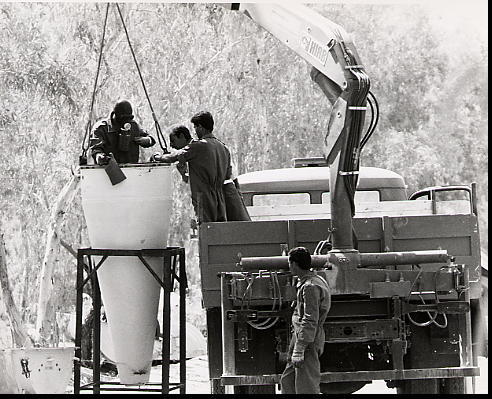
An Iraqi worker climbs into a chemical agent missile nose cone to open it for sample-taking.
Deployment
The role of the military in Iraq’s chemical weapons program remained a secret. Iraq never disclosed any information to UNSCOM concerning deployment, military requirements, firing or bombing tables, field manuals on the use of chemical weapons, or the chain of command for chemical weapons. According to Iraq, there were never any field manuals specifically for chemical weapons, nor were any specific military units trained to use them. Iraq said responsibility for the planning of combat use for chemical weapons was handled at the Muthanna State Establishment by a special tactical group, but refused to provide any further information.
IV. Manufacturing Plants and Equipment
Although Iraq developed and produced chemical weapons at several secret locations, the main work was done at the Al-Muthanna State Establishment (MSE). It was the principal manufacturing site for both agents and munitions. It also served as a storehouse for precursor chemicals, filled chemical munitions and warfare agents in bulk. The MSE consisted of the Al Muthanna production facility, three precursor production sites at Al Fallujah, and munition stores at Muhammediyat. The Samarra site, also part of the MSE, was the prime production facility for Iraqi mustard gas and nerve agents.
Iraq also produced chemical munitions at a large complex known as Al Taji. UNSCOM found at Taji 6,000 empty canisters designed to be filled with chemical weapons for use in 122mm rockets.
In addition to its work on chemical agents and munitions, UNSCOM attempted to find and destroy hundreds of pieces of production equipment. Iraq admitted that 553 pieces of equipment located at 15 production plants had either made chemical precursors, agents or munitions or had been bought for that purpose. Nearly all of the equipment came from foreign companies. Most of it was at the MSE, including the facilities at Al-Fallujah. UNSCOM, in accounting for this equipment, reported that it was destroyed either as a result of the first Gulf War or under UNSCOM supervision. UNSCOM also destroyed an additional 197 pieces of glass production equipment that MSE had procured.
V. The Situation Prior to the Second Gulf War
After UNSCOM inspectors left Iraq in December 1998, U.S.-led forces bombed many sites believed to be chemical weapon plants. After the bombing, reports emerged that Iraq had rebuilt many of those sites, and that the sites appeared to be operating. It was inferred that Iraq had resumed its production of chemical weapons, and was adding new elements to the portion of its previous stockpile that had never been accounted for. No evidence confirming these inferences has emerged to date.
The New York Times The Week in Review December 20, 1998
Arms inspectors have been trying for seven years to verify that Iraq has kept its promise to destroy its chemical, nuclear, and biological warfare capacity, but say many pieces of the puzzle are still unaccounted for. This table was compiled by the Wisconsin Project on Nuclear Arms Control, a research group based in Washington that tracks the spread of weapons of mass destruction. The authors, Gary Milhollin and Kelly Nugent, based their work principally on reports from the United Nations Special Commission and the International Atomic Energy Agency, and statements by Richard Butler, the commission’s chief inspector.
The Department of Energy has issued a new warning about the nuclear weapon efforts of China, India and Pakistan. In June, the department found that for these countries to improve their bomb designs, they will need supercomputers able to perform about 4 billion operations per second. Computers in this range, unfortunately, are the ones that the Clinton administration decided to free for export to these countries in 1996.
The Energy Department concluded that access to supercomputers “would have the greatest potential impact on the Chinese nuclear program.” The result has been what you would expect. China has imported more than 100 U.S. supercomputers since 1996, many of which have gone to nuclear and military sites. The Chinese Academy of Sciences, which helps develop China’s nuclear weapons and long-range missiles, got a machine from Silicon Graphics that performs about 6 billion operations per second. It is now the most powerful parallel processing computer in China. India also has imported DEC and IBM supercomputers for the Indian Institute of Science, a leading missile research site.
None of this should be happening. The General Accounting Office concluded in September that the administration had no basis for decontrolling supercomputers in 1996. The GAO found that the decision to decontrol was based on a faulty study in 1995 that “lacked empirical evidence or analysis” and failed to “assess the capabilities of countries . . . to use high-performance computers for military and other national security applications.”
To make matters worse, the author of the 1995 study refuted his own work in a study this year. The 1995 study predicted that computers operating at 7 billion operations per second would become so common by 1997 that it would no longer be feasible to control them for export. On the strength of that prediction, the administration decontrolled computers operating at less than 7 billion operations per second to most countries in 1996. In fact, such computers are not commonly available even now. The 1998 study finds that machines operating at much lower speeds still can be controlled effectively today.
The administration therefore should tighten controls immediately. Why should the United States help Third World countries make better bombs and missiles when we can avoid it?
A big improvement would be to set controls according to a computer’s potential speed rather than the speed at which it is sold. Why? Because foreign buyers may soon be able to obtain American supercomputers operating at relatively low speeds and then scale them up to much higher speeds by adding chips, which are not controlled for export. The risk arises because new computer designs accommodate a varying number of processors in a single box. Someone can buy a computer with one or two processors, which allows the machine to operate below the export control level, and then add more later to boost the performance above the control level.
If the administration tightened controls in this way — which the GAO recommends — it would be possible to control supercomputers performing about 3 billion operations per second. And machines operating below 7 billion operations per second could be controlled at least until 2000. Keeping such machines out of the hands of Chinese, Indian and Pakistani bomb makers would be worth the effort.
U.S. industry would not suffer, because it has no foreign competition. Compared with American machines, foreign-built computers have “modest performance” and are available only in small numbers, the 1998 study says. Except for those made in Japan, which coordinates its computer controls with the United States, foreign machines do not compete seriously in the world market. The GAO agrees with this assessment.
Nor are American jobs at risk. According to Commerce Department records, 202 American supercomputers were exported to countries in the high-risk category during the 20 months following Jan. 25, 1996. By contrast, the rest of the world imported 3,759. Sales to risky countries are thus 5 percent of the world supercomputer market. No company will prosper or fail because of sales to such a small percentage of its market.
Jobs are not the issue. National security is the issue. But the White House isn’t listening. The administration slashed supercomputer controls in 1996 to reward Silicon Valley for its campaign support. It was a payoff pure and simple.
It is time to stop trading U.S. security for political favors. American cities should not be targeted by weapons designed with American help.
On August 31, 1998, North Korea launched what was initially believed to be a two-stage Taepodong 1 (TD1) missile eastward over Japan. The first stage of the missile fell into international waters roughly 400 miles east of the launch site, and the second stage flew over Japanese territory, splashing down in the Pacific Ocean approximately 930 miles from the launch site.
North Korea soon announced that it had tested a three-stage space launcher which included the release of a satellite that the DPRK claimed orbited the Earth over 100 times. Subsequent analysis confirmed that the launch did indeed feature three stages, but the third stage was not successful and did not result in the launch of a satellite.
The launch of a two-stage TD1 missile had been anticipated by U.S. intelligence, which has been tracking North Korea’s progress toward an ICBM capability since the early 1990s. The TD1 is liquid fueled, reported to be roughly 25 meters tall, and has an estimated warhead capability of 3000 pounds. The two-stage missile is a significant step forward for North Korea’s missile program, which had not previously moved beyond single-stage rockets.
The Taepo-dong program, encompassing both the TD1 and the untested TD2 ballistic missile, was initiated in the early 1990s. Its intent was to improve the range of North Korea’s existing rockets, primarily the Scud C missile, and the Nodong, both of which are single-stage missiles. The TD1 appears to be constructed of a Nodong as a first stage and a Scud C as a second stage, whereas the TD2 is expected to couple a newly designed first stage with a Nodong as a second stage.
Evaluated as a test of a two-stage rocket, the August 31 launch appears to have been successful – both stages ignited and successfully separated. The range of the first stage could be greater than the splash-down point of the missile used in the test, with the North Koreans presumably restricting the distance the rocket flew in that instance to assure that it did not land in Japan. The second stage landed roughly 930 miles from the launch site. The missile’s total range is estimated to be 1500 km to 2000 km. The Nodong missile class which preceded the TD missiles had a range of approximately 1000 km.
While the third stage of the TD1 missile launched on August 31 failed, the attempt to launch a satellite into orbit is a substantial leap forward for North Korea’s missile program not anticipated by American intelligence analysts. The ability to launch a satellite into orbit brings a country close to ICBM capability. Should North Korea succeed in developing the TD2, it would have the ability to fly 4000-6000 km, which would make strikes at mainland Alaska and the Hawaiian isles a possibility. Intelligence sources estimate North Korea could flight-test the missile in 1998 and deploy it in a few years.
The launch of a three-stage North Korean rocket demonstrates two significant developments. First is the ability to implement stage separation procedures. North Korea had not previously tested two-stage rockets. American intelligence sources did not expect the North Koreans to attempt a test of a three-stage missile. Second was the use of solid fuel in the third stage, a technology North Korea was not known to possess. The appearance of solid fuel raises the question whether it was imported, and from whom.
New missile developments in North Korea are likely to spread elsewhere. The DPRK is a known missile and missile technology exporter to Iran, Syria and Pakistan. The Scud and Nodong programs have been partially funded by Iran in exchange for the delivery of missiles and the infrastructure to produce them. Iran tested a missile derived from North Korean technology in July. Pakistan, too, has been a recipient of North Korean exports, with North Korean technology and material having played a crucial role in the development of the Ghauri medium-range missile, a development of special concern in light of Pakistan’s recent nuclear weapon tests. Pakistan is also believed to have received production technology for the Ghauri. North Korea bluntly announced in June that it would continue to export its missiles, so any improvement in the DPRK’s missile technology is likely to filter into other weapons programs worldwide.
India’s and Pakistan’s recent nuclear weapons tests have demonstrated to the world that both have bombs. The Prime Minister’s Office stated: “These tests have established that India has a proven capability for a weaponised nuclear programme.” J. N. Dixit, formerly India’s Foreign Secretary, added that “by conducting these tests, which included a thermo-nuclear device, India has affirmed to itself and confirmed to the world its status as a full-fledged nuclear weapon state.”
It is also clear that the bombs are deliverable. Arguments about preventing India and Pakistan from weaponizing or deploying their weapons appear to be off the mark – the bombs could be dropped tomorrow. According to Mr. Dixit, “India has already weaponised itself in terms of various warhead manufacturing capacities and delivery systems. The question to be asked is whether we should move on to deployment of these capacities. I make a distinction between actual deployment and deployability.” Furthermore, an Indian official from Prime Minister’s office said, “if you’re asking me if we have a delivery system, the answer is yes we do.”
Data from the recent tests will be key to India’s future nuclear weapon efforts. According to the Prime Minister’s office, the data will be “useful in the design of nuclear weapons of different delivery systems.” Further, “they are expected to carry Indian scientists towards a sound computer simulation capability which may be supported by subcritical experiments, if considered necessary.” In other words, they will aid the development of different types of nuclear weapons.
In this vein, it is noteworthy that India is ready to begin serial production of its Agni intermediate-range ballistic missile, which can be deployed with nuclear warheads. Pakistan is also readying nuclear-capable missiles. An official Pakistani statement after the tests declared: “the long-range Ghauri missile is already being capped with nuclear warheads to give befitting reply to any misadventure by the enemy.” Pakistan also has Chinese M-11 surface-to-surface missiles which could carry nuclear warheads.
Foreshadowing
In December 1995, U.S. satellites detected activity at Pokhran, India’s nuclear testing range, suggesting a test was being readied, but under U.S. pressure, no such test occurred. The next warning occurred in September 1996, when India became one among only three states to vote against the Comprehensive Test Ban Treaty (CTBT) in the U.N. General Assembly. Then in October 1996, preparations for a nuclear test at Pokhran were once again revealed by reconnaissance photos, but India decided again not to test and the site was cleared by mid-December. Finally, upon its election in March 1998, India’s new coalition government, led by the BJP under Prime Minister Atal Bihari Vajpayee, announced that it would “reevaluate India’s nuclear policy ‘and exercise the option to induct nuclear weapons.'”
The tests
On May 11 and 13, 1998, India conducted five underground nuclear tests, code-named “Shakti ’98.” After the first set of tests, India’s Prime Minister A. B. Vajpayee immediately announced that India had detonated three underground nuclear devices at Pokhran: “the tests conducted were a fission device, a low-yield device and a thermonuclear device.” Indian scientists, Dr. A. P. J. Abdul Kalam, “father” of the Indian nuclear bomb, Dr. Rajagopal Chidambaram, head of the Indian Atomic Energy Commission, and Dr. Krishnamurthi Santhanam, chief technical adviser in the Defense Ministry, said that the two-stage thermonuclear device consisted of a fission trigger and a fusion second stage that produced most of the bomb’s yield of 43 kilotons of TNT. The significance of the staged design is that the yield of the bomb can be increased to much greater levels than the level tested. However, US government sources and independent scientific organizations placed the so-called thermonuclear yield in the range of 15-25 kilotons and said while the device could be thermonuclear, it could also have been a boosted fission device. The Indian scientists said they had also developed a design for a boosted fission bomb but did not test one. The scientists said the other four devices tested consisted of one that yielded 12 kilotons, two that yielded 200 tons, and one that yielded 600 tons.
On May 28 and 30, 1998, Pakistan followed suit, with an alleged six tests of its own. While official details about the tests were not forthcoming, Dr. Qadeer Khan, the “father of the Pakistani bomb,” said one of the original tests was a 30-35 kiloton fission bomb, plus four small tactical nuclear weapons. There was no thermonuclear test, but he claimed that one could be conducted if necessary. The claim that so many devices were tested appears to be at odds with outside estimates of Pakistan’s available nuclear weapon fuel. Pakistan agreed in 1991 to end production of high-enriched uranium, but Dr. Khan denied that Pakistan abided by this agreement. If this is true, Western officials estimate that Pakistan’s inventory of HEU could be as high as 500 kg (even after the tests) which would be enough for approximately 30 warheads for the Ghauri missile. Dr. Khan also indicated that one bomb remained capped in a hole at the test site, raising the question whether this device will be detonated in future. In summarizing the tests, Prime Minister Sharif said, “we have evened the account with India.”
Since the tests, both states have indicated some willingness to defuse the situation. One day after Pakistan’s declaration that it was willing to sign the Comprehensive Test Ban Treaty (CTBT), India announced that it might be willing to sign within the next year as well. However, both have attached conditions to this step that are likely to preclude final adherence.
Global reactions
In the wake of the tests, the U.N. Security Council demanded in an unanimous vote on June 5 that India and Pakistan refrain from further nuclear tests, halt their weapon programs, and sign nuclear arms control agreements unconditionally. And the Clinton Administration implemented economic sanctions to punish the two states for testing nuclear devices, but avoided cutting ties completely. The sanctions terminated economic aid, loans and military sales to both governments, but did not ban loans to privately-owned companies or investment by U.S. companies. Exports of most dual-use items would also be cut off, and banks were prohibited from lending money to either government. Most other states, including Britain, France and Russia, refused to impose any sanctions.
More recently, the US denied a visa to the chairman of the Indian Atomic Energy Commission and told seven Indian scientists to leave the United States by the end of August. The scientists had been working the at National Institutes of Standards and Technology (NIST) on two semiconductor manufacturing projects and a ceramics processing project. The seven scientists are from the Bhabha Atomic Research Center (BARC), the Tata Institute for Fundamental Research (TIFR) and the Indian Institute of Technology.
Despite these steps, the US Government is still delaying the release of a list of some 200 Indian and Pakistani bomb- and missile-making companies, which by law may be banned from receiving U.S.-origin products.
Foreign Affairs: It’s crazy to help countries build their bombs then ask them not to test them.
Although 4 1/2 months have passed since India and Pakistan tested nuclear weapons, American technology is still flowing into those countries’ A-bomb and missile efforts. In a series of closed meetings, U.S experts have identified nearly 200 Indian and Pakistani organizations that are key to bomb and missile making, but after announcing in June that U.S. sales to such firms would be cut off–a step required by U.S. law–the Clinton administration is still dithering. The delay is due to the fear that if sanctions are imposed on these countries, it will make it harder to cajole them into curbing their bomb programs.
The administration should stop dreaming and apply the law, which severs U.S. trade with any U.S. firm publicly named as a bomb or missile maker. Neither Pakistan nor India seems likely to restrict its nuclear effort in any significant way. Pakistan says it will sign the Comprehensive Test Ban Treaty only if it first gets financial aid and America lifts its sanctions–conditions that will never be met–and India has agreed only to “discuss” signing the ban within the coming year. Even if both countries signed, they would still be free to build an unlimited number of nuclear warheads and the missiles to deliver them. It is nonsensical to help a country build the bomb in exchange for a pledge not to test it.
The 200 bomb-making firms are terrible places to send U.S. technology. In India, they include Godrej & Boyce, which manufactures heat shields, nose cones and liquid-fueled motors for India’s biggest rockets; Hindustan Aeronautics, which makes rocket guidance systems and motors for India’s nuclear-capable missiles; Larsen and Toubro, which builds plutonium-producing nuclear reactors, and Walchandnagar Industries, which makes both large rocket motors and major reactor components. In Pakistan, the firms include Heavy Mechanical Complex and People’s Steel Mills, both of which are considered to be mass destruction weapon sites.
Unless these companies are excluded from U.S. trade, it will be impossible to keep American equipment from helping to build better bombs and missiles in South Asia.
It also is important to make the names of these organizations public. To see why, consider the Indian Institute of Science. It develops India’s most advanced rocket propellants, guidance systems and nose cones. It also tests rocket performance in its wind tunnels. Because it has never been named as a dangerous destination for U.S. goods, however, it managed to buy a supercomputer from the Digital Equipment Corp. in 1996 and to upgrade an IBM machine to supercomputer status in 1997. With this American equipment, the institute is able to design India’s next generation of nuclear missiles. The institute is on the list of 200 firms and, once the list is published, such sales must stop.
The U.S. Dept. of Commerce is primarily to blame for the institute’s dangerous American imports. The department is supposed to warn U.S. exporters about dangerous buyers, and it should have named the institute years ago. But it has consistently fought attempts to list such companies for fear of reducing exports, the promotion of which is its main goal.
When, for example, the Arms Control and Disarmament Agency proposed approximately three dozen private sector companies in India for inclusion on the list of 200, the department objected to virtually all of them on grounds that proved to be insubstantial. Under pressure from the rest of the government, Commerce finally agreed to roughly 10. Because of the department’s delaying tactics, U.S. exports have continued to flow to South Asian nuclear and missile programs long after they should have been cut off.
The second culprit is the CIA. Its Nonproliferation Center has been part of the interagency meetings at which individual companies were discussed but, mysteriously, it has provided virtually no intelligence information about them. Luckily, the experts who compiled the list had access to information provided by U.S. embassies and also to the Risk Report, which is published by the Wisconsin Project on Nuclear Arms Control, an independent group that tracks the spread of nuclear weapons. Had it not been for the project’s data, the no-trade list would be far shorter.
The cutoff of U.S. technology will produce howls of pain from India and Pakistan and intense lobbying by U.S. companies who will lose some export dollars. But Congress and the president should ignore that. Nor, once in place, should Congress allow the technology denial to be waived, as it did last week for the economic sanctions against India and Pakistan. The no-trade ban should stay in place as long as these two countries remain on the nuclear weapon path.
It is time to put teeth into the administration’s nonproliferation policy and force foreign firms to choose between building bombs and buying U.S. technology.