News

Pakistan Missile Update – 2003

Missile tests

Pakistan continues to develop its ballistic missile capability with foreign assistance and has pursued an ambitious testing program. In May 2002, Pakistan flight-tested its solid-fueled Abdali (Hatf 2) and Ghaznavi (Hatf 3) missiles, as well as its liquid-fueled Ghauri (Hatf 5) missile. The Shaheen I (Hatf 4) solid-fueled missile was flown in October 2002 and the Abdali missile again in March 2003. The Bush administration expressed its “disappointment” after both the May and October 2002 missile tests. In October 2003, Pakistan launched another series of tests in which it flight-tested the Ghaznavi and Shaheen I missiles.

Missile deployment

The Ghauri, or Hatf 5, which was bought from North Korea and is a version of the North Korean No Dong, was handed over to the Pakistani army by the Khan Research Laboratories (KRL) in January 2003. It has a 1000-1100 kilometer range and can carry a 700 kilogram payload. In March 2003, the Shaheen I, or Hatf-4, solid-fueled missile was turned over to the Pakistani Army’s Strategic Force Command. The Shaheen I is reportedly based on the Chinese M-9 missile, which according to one report, has a range of 200-600 km and a payload capacity of 950 kg.

Foreign assistance

In its most recent world-wide assessment of missile proliferation, the CIA reports that Chinese companies are continuing to assist Pakistan’s ballistic missile effort. China has helped Pakistan move toward the serial production of solid-propellant SRBMs, such as the Shaheen I, Abdali and Ghaznavi, and Pakistan will be looking for continued Chinese assistance in the development of the solid-propellant Shaheen II MRBM, according to the CIA.

In September 2001, the United States sanctioned the China Metallurgical Equipment Corporation (CMEC) for proliferating missile technology to Pakistan’s National Development Complex (NDC). In transferring Category II items under the Missile Technology Control Regime, the CMEC acted in violation of China’s November 2000 nonproliferation commitment, which according to the U.S. State Department was a pledge “not to assist in any way other countries to develop ballistic missiles that can be used to deliver nuclear weapons…” Pakistan’s NDC was also sanctioned.

In March 2003, the United States imposed sanctions against one Pakistani and one North Korean entity “for specific missile-related transfers.” Pakistan’s Khan Research Laboratories (KRL) was sanctioned under U.S. executive order 12938, and North Korea’s Changgwang Sinyong Corporation was sanctioned under the U.S. missile sanctions law. A report in The Washington Times said the sanctions involved the transfer of fully-assembled, nuclear-capable No Dong missiles from North Korea to Pakistan. According to press reports citing American intelligence officials, Pakistan obtained the ballistic missile hardware in exchange for supplying North Korea the gas centrifuge technology needed to make highly enriched uranium, and American spy satellites tracked a Pakistani aircraft (an American-built C-130) as it was loaded with ballistic missile parts in a North Korean airfield in July 2002.

Pakistan’s ballistic missiles

Hatf 1

  • single-stage, solid fuel, according to reports
  • 80 km range, according to Pakistani sources
  • payload of 500 kg, according to reports
  • deployed with the army

Hatf 1A

  • 100 km range, according to one report
  • tested in February 2000

Abdali (Hatf 2)

  • single-stage, solid fuel, according to reports
  • 300 km range, according to Pakistani sources
  • payload of 450-500 kg, according to reports
  • last tested in March 2003
  • in service, according to one report

Ghaznavi (Hatf 3)

  • two-stage (according to reports), solid fuel
  • more than 300 km range
  • payload of 500 kg
  • bought from China, Chinese M-11
  • last tested in October 2003
  • overseen by the National Development Complex (NDC)

Shaheen I (Hatf 4)

  • single-stage, solid fuel
  • 200-600 km, according to one report
  • payload of 950 kg, according to one report
  • based on the Chinese M-9, according to reports
  • last tested in October 2003
  • handed over to Pakistan Army’s Strategic Force Command in March 2003
  • overseen by the National Development Complex (NDC)

Shaheen II

  • two-stage, solid fuel
  • 2500 km range claimed by Pakistan
  • 1000 kg payload claimed by Pakistan
  • unveiled in March 2000, but not yet tested
  • development requires continued Chinese or other foreign assistance

Ghauri (Hatf 5)

  • single-stage, liquid fuel
  • 1000-1100 km range
  • payload of 700 kg
  • bought from North Korea, North Korean Nodong MRBM
  • last tested in May 2002
  • it is “fully operational,”according to Dr. A. Q. Khan, accredited as being the father of Pakistan’s nuclear program
  • turned over to the Pakistani Army in January 2003
  • overseen by the A.Q. Khan Research Laboratories (KRL)
  • Pakistan claims to be making improved versions of the Ghauri, called the Ghauri II and III. Reports citing the development and capabilities of these missiles are unconfirmed.

The Mullahs and the Bomb

The New York Times
October 23, 2003, p. A27

WASHINGTON – With much fanfare, and the reluctant endorsement of the Bush administration, Iran has vowed to suspend its controversial effort to produce enriched uranium – which can be used as fuel in nuclear weapons – and to clear up a host of suspicions about its nuclear program. In exchange, the foreign ministers of Britain, France and Germany promised new “cooperation” – meaning trade – in high technology with Tehran. While perhaps getting any concessions out of the mullahs should be seen as a step forward, this particular deal won’t prevent Iran from making the bomb. It also risks having the same outcome as the deal North Korea made in 1994 and later violated, and threatens to drive a wedge between the United States and its European allies on Iran policy.

The suspicions about Iran’s nuclear aims are well founded. Leaving aside the question whether such an oil-rich country even needs nuclear power plants, America has long questioned why Iran is building a factory to enrich uranium, material for which there is no reasonable need in Iran’s civilian power program.

Iran also plans to produce plutonium, another fuel for nuclear weapons, by building a 40-megawatt heavy water reactor at Arak. This type of reactor, too small for electricity and larger than needed for research, is now providing the fuel for atomic weapons programs in India, Israel and Pakistan. And Iran is developing a fleet of long-range missiles, which don’t make sense as a way to deliver conventional warheads. The only logical purpose of such missiles is to carry nuclear ones.

International suspicions about these programs led to the current crisis: the International Atomic Energy Agency has given Iran until Oct. 31 to explain how mysterious traces of bomb-grade uranium got into two Iranian nuclear sites. Iran says the traces arrived on contaminated imports; the other explanation is that Iran has been secretly enriching uranium in violation of its inspection agreement with the agency. The agency also wants to know how Iran developed such a high level of enrichment technology without secretly testing it with nuclear material, which is also forbidden. The agency’s experts are convinced that the testing occurred.

Under the new deal, Iran is supposed to explain all this. If it doesn’t, it risks being condemned as a pariah by the Security Council and the European Union may have to shelve its trade agreement with Iran, which would cost all concerned a lot of money. Thus Britain, France and Germany, as well as Iran, have an interest in seeing Iran comply.

But the problem is, even if Iran does so, there will be little assurance that the deal will really dampen Iran’s nuclear hopes. Consider what happened with the pact hammered out by the Clinton administration with North Korea in 1994, which had much in common with the present situation.

North Korea faced worldwide condemnation and a possible war with the United States after violating its inspection agreement with the International Atomic Energy Agency. By agreeing to suspend its effort to produce plutonium, North Korea avoided censure and got economic benefits from the West, and yet it preserved its nuclear potential intact. North Korea’s 8,000 fuel rods – containing five bombs’ worth of plutonium – never left the country. Like a sword poised over the world’s head, they remained only months away from being converted into bomb fuel – something that the North Koreans say was finally done this summer. The North Korean bomb program only shifted into neutral; now it is back in gear.

Under Tuesday’s deal Iran, too, will shift into neutral, while keeping its nuclear potential intact. It won’t – for the time being – operate its newly constructed centrifuges, which are needed to enrich uranium to weapon grade. But the deal won’t stop Iran from building more centrifuges to augment the limited number it now has, thus adding to its future ability to enrich uranium. Nor does the agreement bar Iran from completing the factory that produces the uranium gas that goes into the centrifuges. Nor does it prevent the building of the heavy water reactor or, indeed, the resumption of enrichment in the future. Thus the agreement could insulate Iran from international censure without hampering its nuclear progress in any way.

These defects won’t be cured by Iran’s acceptance of more rigorous inspections by the International Atomic Energy Agency. The inspectors’ new rights are still weaker than those that were enjoyed by their counterparts in Iraq – and we all know that the Iraqis repeatedly foiled those efforts with delays and obfuscation.

The only real solution is to convince Iran to dismantle all the plants that can make fuel for nuclear weapons. This would remove the threat that Iran could go back into the bomb business on a moment’s notice, and the country could still benefit from the electricity generated by its Russian-supplied reactor at Bushehr, which should be sufficient if Iran truly wants only civilian nuclear power.

This goal is what the Europeans hope to achieve in the long run. It would probably satisfy the United States as well. But the current agreement won’t take us there, and it may lead to the same sort of bickering between the United States and its vital allies that fractured international action on North Korea and Iraq.

The only chance for a solution to the Iran nuclear problem, short of war, is for a united West to apply relentless economic pressure. That means quickly closing any gap between Europe and the United States. It may be possible to convince Iran that the costs of building nuclear weapons exceed the benefit of having them. Unlike North Korea, Iran has large trade interests that really matter. However, unless the rest of the world is willing to put those interests at risk, it will probably soon have to live with a new nuclear power in the Middle East.

Gary Milhollin is director of the Wisconsin Project on Nuclear Arms Control.

Remarks on Iran’s Nuclear Program

Remarks to the Democratic Study Group on National Security

by Gary Milhollin
October 16, 2003

I am pleased to be able to address this distinguished group on an important question: what should be done about Iran’s nuclear program? I had occasion to make a presentation on this subject last month to the US-Israeli Joint Parliamentary Committee. The presentation can be found on my organization’s web site: www.wisconsinproject.org. Today, I will try to tackle this subject by emphasizing what is supposed to happen at the end of this month.

In mid-September, the International Atomic Energy Agency gave Iran a deadline. By October 31, Iran is supposed to come clean about its nuclear program. Iran is supposed to explain the traces of highly enriched uranium found at the Natanz site, where Iran is building a plant to enrich uranium with centrifuges, and explain the traces of highly enriched uranium found at the Kalaye site, where Iran developed the centrifuges. Iran says that the traces came from material that was already on components that Iran had imported. By the deadline, Iran is supposed to explain where those components came from, so that Iran’s story can be checked. The suspicion is that they came from Pakistan.

Iran is also supposed to answer the Agency’s questions about how it was possible to achieve the level of enrichment technology at Natanz without prohibited testing with nuclear material. The Agency has decided that it was impossible to develop the level of enrichment technology shown at the Natanz site without testing the centrifuges with uranium hexafluoride feed, which Iran denies doing. If Iran did that, it would be a violation of its inspection agreement with the Agency. The agreement requires Iran to allow the Agency’s inspectors to observe any activity using nuclear materials and to keep track of the materials.

There are other questions about Iran’s nuclear program. One concerns heavy water. Iran is building a plant at Arak to produce heavy water and has plans to build a 40 megawatt research reactor that will use the heavy water to produce plutonium, a nuclear weapon fuel. Construction of this reactor is expected to begin next year. History has shown that most states with this type of reactor – too small to make electricity and larger than necessary for research purposes – use it to produce bombs. The precedents are Israel’s Dimona reactor, supplied by France and Norway, and India’s Cirus reactor, supplied jointly by Canada and the United States. More recently, Pakistan commissioned a heavy water reactor of about the same size with help from China, and is using it to make bombs. We can expect Iran’s reactor to do the same. Why? Because heavy water reactors have nothing to do with Iran’s civilian nuclear program, which is based on light water technology. Thus, Iran must have something else in mind.

Iran has decided to build all the things necessary to give it nuclear independence: a uranium mine, a plant to convert the uranium to gaseous form for processing by centrifuges, and the centrifuges to enrich the uranium to reactor- or weapon-grade. Once Iran’s nuclear program matures, Iran will have what it needs to fabricate a bomb, perhaps without being discovered. Or, Iran could cite the treaty’s escape clause, declare its “supreme interests” to be in jeopardy, and cancel its treaty obligations. Three months later, Iran could use all the nuclear material it accumulated while a member and convert it to bomb-making without breaking any rules.

The question this poses is evident: why does Iran want such a nuclear capability?

Iran says it only wants to make electricity. But this does not make sense. Iran is paying Russia some $800 million for a reactor at Bushehr that Iran doesn’t really need for making electricity. Given Iran’s copious oil and gas reserves, it will cost Iran many times more to produce a kilowatt of electricity from uranium than from petroleum. According to the U.S. State Department, Iran now flares enough gas to generate electricity equal to the output of four Bushehr reactors. So why would Iran pay so much money for something it does not need? The answer is that this payment is probably financing a lot more than just the reactor. There is evidence of Russian help in laser enrichment and heavy water, and there are probably other information exchanges going on that we don’t know about.

One more piece of evidence bearing on Iran’s nuclear intentions is its effort to develop long-range missiles. Countries seldom develop such missiles to carry anything but nuclear warheads. Iran has developed a 1,300 kilometer missile called the Shahab-3 that can already reach Israel, Iraq, Turkey, Saudi Arabia and U.S. forces in the region. It is widely assumed that the Shahab-3 will be followed by the 2,000 kilometer Shahab-4, based on the Soviet SS-4 “Sandel” missile. Although the status of the Shahab-4 is unclear, its design would allow it to fly far enough to reach Eastern Europe.

If Iran fails to comply with the Agency’s deadline, the credibility of the Non Proliferation Treaty and its inspection regime will be at stake. Under the treaty, the issue should be referred to the United Nations Security Council. The Security Council’s first step might be to reiterate the demand that Iran come into compliance with its NPT obligations, which would mean explaining to the IAEA’s satisfaction the history of Iran’s enrichment efforts and the genesis of the samples. If Iran comes clean by providing all necessary records and allows for unfettered inspections and sampling, then a crisis probably will be averted. However, if Iran balks, or provides only partial or misleading information, then the Security Council may move towards imposing economic sanctions or mandating the cessation of all nuclear cooperation with Iran.

The sanctions would have to be severe and they would have to be enforced. They would have to convince Iran that the option of having nuclear weapons is not worth the cost. The question is whether the world is ready to impose such a burden on Iran rather than see another nuclear weapon state emerge in the Middle East. The answer will come over the next several months.

The Missile Threat: Who Has What and Where Did They Get It?

Remarks at the Conference on Transatlantic Cooperation on Missile Defense

Aspen Institute Berlin
Rome, Italy

It is a pleasure and an honor to discuss missile defense before this expert and distinguished audience. I know that many of you, from knowledgeable posts in industry, government and academia, have given this subject careful thought for a long time.

I have been asked to describe the world wide missile threat. The first point I would like to make is historical: long range missiles have been developed to carry nuclear weapons. They don’t make sense for use with conventional weapons. A country is not going to spend the money to develop a 5,000-mile or 5,000-kilometer missile to knock down a building with high explosives. A long-range missile has to be considered a nuclear weapon. Look at the countries that have developed or are developing such missiles – they are the seven declared nuclear weapons states, which include the permanent five members of the U.N. Security Council, together with India and Pakistan. They also include Israel, North Korea, and Iran. Iran’s efforts to build a long-range missile should tell us something about its nuclear program. The point, for missile defense, is that when we are talking about long-range missiles, missile defense is nuclear defense.

My second point has to do with the difference between nuclear defense and nuclear deterrence, when looked at in terms of capability. First, how confident can we be in deterrence? If Russia or China or North Korea should attack the United States with a nuclear missile, how confident can we be that such a country would be destroyed in retaliation? While there may be a question about whether we would have the will to retaliate, there is not much question about our ability. It would be close to 100%.

How confident can we be in defense? It is never going to be anything like it is for deterrence. Stopping fifty percent of the “incomings” would be a big success. Now, one could say that it would not matter, because by definition, in the event of an attack, deterrence will have failed, and a 50% capability to defend is better than nothing. But the fact remains that we are never going to be as confident in our ability to defend as in our ability to retaliate. We’ll never be able to say: “Fire away, we will defend against all your missiles.” But we can say: “If you launch against us, you will be destroyed.” This means that we are going to have to continue to rely on deterrence to protect us from missile attack. Any missile defense initiative must accept this basic fact.

Third, what about 9/11? The attacks on that day were a demonstration model of what happens when deterrence and defense both fail. If you can put together a 19-person team capable of flying an airliner into an office building, you can put together a team capable of smuggling a nuclear weapon into the United States. Say North Korea has two nuclear weapons made from plutonium acquired in past years, plus five more from plutonium separated in 2003 while America was busy invading Iraq. If North Korea wanted to strike the United Sates, would it load the plutonium on a missile and fire it at the West Coast, or would it send it in with a team? A launch would invite retaliation, while a team might not if there were uncertainty regarding its origins. The team would also have higher targeting accuracy.

However we may feel about these “scenarios,” the point remains that 9/11 demonstrates a vulnerability that may not be covered by either deterrence or defense, and certainly is not covered by missile defense. Low-tech delivery is a viable alternative to long-range missiles. Moreover, long-range missiles need to be tested, and testing would be watched. This is a real restraint on both North Korea and Iran.

Leaving aside a 9/11 type attack and just looking at missiles, what is the nuclear threat today? South Asia is perhaps the most likely place in the world for nuclear war. India and Pakistan can both target each other with nuclear missiles. Pakistan has a series of solid-fuel missiles imported from China, plus a liquid-fuel missile imported from North Korea. It has a compact nuclear warhead design that will fit on either. India has a series of liquid-fuel missiles based on a Soviet surface-to-air missile and a solid-fuel missile developed by copying the U.S. “Scout” space launcher and by receiving help in guidance technology from the German Space Agency.

The United States, by the way, was instrumental in starting up both the Indian and Pakistani rocket programs in the 1960’s. NASA hosted teams from both countries at the Wallops Island launch site, near Washington, D.C. India’s leading rocket scientist saw the U.S. “Scout” rocket launched and, after getting the blueprints from NASA, proceeded to build an exact copy in India. This rocket became the basis for India’s present “Agni” nuclear missile. NASA officials told me that they even planned for Indian and Pakistani teams to bunk together in the same barracks. NASA was surprised when that did not work out.

Both India’s and Pakistan’s missile programs have been built entirely with imports, and the same is true of the nuclear programs that have furnished their payloads. Without imports, neither country would be a nuclear or missile threat today.

North Korea has developed a series of liquid-fuel rockets, which were reverse-engineered from the Soviet SCUD series. It flight-tested a missile in 1998 known as the Taepo Dong-I, which had two stages that operated successfully. The Taepo-Dong-I probably has twice the range of its predecessor, the 1,000 kilometer No Dong. North Korea is also developing larger rocket engines, which may one day be capable of reaching the United States. However, it is unlikely that they would be able to hit any particular target in the United States without further testing of the missile’s guidance system. And testing could of course be observed by the whole world.

North Korea has been serving as an off-shore development and production site for countries that want missiles. Buyers get the missile production technology and sometimes the first production run of missiles. The buyers have included Iran, Syria, Egypt, Pakistan and Libya. North Korea’s imports are not as well known as its exports. Japan appears to be a significant helper. Its firms supplied steel for rocket bodies and – according to press reports and a defector – guidance components.

Iran is building long-range missiles at the same time that it is building nuclear plants. Its missile effort shows the intention to furnish nuclear warheads as payload. Iran already has the medium-range North Korean No Dong and may be developing a 2,000-km range missile based on the Soviet SS-4. In addition to North Korea, Iran’s biggest helpers have been Russian companies. Russians have supplied Iran with materials, components, designs, expertise and training. China has also sold Iran missile components and ingredients for missile fuel.

Iran’s missile program has been entirely imported, and to stop it or slow it down, the remedy must be found in Russia and China. Like all the other missile programs I’ve mentioned, it is an international export control problem.

China has a fleet of about 20 liquid-fuel ICBMs that can reach the United States. China is also a proliferator of missile technology. Last year, CIA director George Tenet testified to Congress that Chinese firms “remain key suppliers of missile-related technologies to Pakistan, Iran and several other countries.” Despite the fact that Chinese missiles threaten the United States and despite the fact that China continues to be a missile proliferator, China can still import missile- and nuclear-related items from the United States. Several Chinese companies that have been sanctioned by the United States for missile proliferation are still free to buy U.S. goods, either for themselves or through an affiliate.

For example, CATIC (China Aero-Technology Import and Export Corporation) was sanctioned last year by the U.S. government for helping Iran, and in 1999 it was indicted for diverting American machine tools to a Chinese cruise missile and military aircraft plant. The machine tools had helped produce the B-1 bomber and the MX missile. Despite these violations, the U.S. Commerce Department sponsored an export license for CATIC’s sister company in 2000 for the same kind of machine tool that CATIC was indicted for diverting. The point is that the parent organization, Aviation Industries of China, was not really burdened by the earlier indictment. It could just order the same tools through another subsidiary.

Similarly, China Precision Machinery Import-Export Corporation was sanctioned last year for helping Iran and in the 1990’s for helping Pakistan. Neither it nor CATIC is on the Commerce Department’s watch list of dangerous companies in China, nor are a number of other repeat offenders. These companies can buy high-performance computers, machine tools and other sensitive items from U.S. companies, so long as the equipment performs just below the level controlled for export. This level has now become very high as a result of the fact that export controls have been greatly relaxed since the end of the cold war. It would be a simple matter to put these companies on the watch list so they could not import anything of significance without a license. But that has not happened because the United States is interested in trade.

So, the missile threat today did not come about all by itself. It had lots of help from lots of places, including the United States. One way to slow it down is better export control. I hope that when the distinguished participants in this conference next have occasion to deal with export control issues, they will push hard to incorporate stronger controls and not weaker ones.

Testimony: Iran’s Nuclear Program and Imports of Sensitive Technology

Testimony of Gary Milhollin

Professor Emeritus, University of Wisconsin Law School and
Director, Wisconsin Project on Nuclear Arms Control

Before the US-Israeli Joint Parliamentary Committee

September 17, 2003

I am pleased to appear before this joint committee to discuss Iran’s nuclear program and Iran’s imports of sensitive technology. I direct the Wisconsin Project on Nuclear Arms Control, a research organization here in Washington that is devoted to stopping the spread of mass destruction weapons.

I will begin by describing the challenge posed by Iran to the nuclear non-proliferation regime, and then I will comment on some important Iranian procurement attempts. I will conclude with a discussion of Iran’s possible noncompliance with its international obligations.

I would like to submit one item for the record. It is a recent op-ed and table authored by myself and Valerie Lincy for the Week in Review section of the New York Times. The article discusses the possibility that Iran could gain nuclear weapon capability while claiming to be a member in good standing of the nuclear non-proliferation treaty.

To read the complete testimony, click here:  Iran’s Nuclear Program and Imports of Sensitive Technology

India Nuclear Update – 2003

Nuclear weapon overview

Since its nuclear weapon tests in May 1998, India has been gradually working to improve its nuclear weapon stockpile and its missile delivery systems. In the years immediately after the tests, it was estimated that India had roughly 300 kilograms of weapon-grade plutonium. This amount is enough to make approximately 60 nuclear bombs. By July 2003, the Congressional Research Service estimated that India “is believed to have enough fissile material for 75-100 nuclear weapons.”

Rajagopala Chidambaram, former chairman of the Indian Atomic Energy Commission, claimed in August 1999 that Indian scientists can make nuclear weapons of “any type of size,” including a neutron bomb, based on information obtained from the 1998 tests. He also reiterated the claim that India detonated a thermonuclear device during the tests. However, in February 2000, P.K. Iyengar, retired chief of the Indian Department of Atomic Energy, stated that the thermonuclear test was a failure.

In addition to accumulating nuclear material, India is taking steps to formalize control of its nuclear weapons. In January 2003, the country announced a formal nuclear command structure while reiterating elements (such as an air, land and sea-based “triad” of forces) established in its draft nuclear doctrine of 1999. That document included the goals of maintaining a “credible minimum deterrent” and policy of “no first use.”

India is also working on the means to deliver its arsenal. India has deployed the 150 km-range Prithvi I short range ballistic missile and successfully flight-tested the medium-range Agni II in April 1999. It also continues to develop sea-launched ballistic missiles and the Brahmos cruise missile.

After the tests

In the wake of the May 1998 nuclear tests, U.S. diplomatic efforts focused on obtaining India’s commitment to the Comprehensive Test Ban Treaty (CTBT), but India has still not become a member. In his speech to the UN General Assembly in September 1998, Indian Prime Minister Atal Behari Vajpayee said, “[the May 1998 tests]…do not signal a dilution of India’s commitment to the pursuit of global nuclear disarmament…In announcing a moratorium [on further tests], India has already accepted the basic obligation of the CTBT.” Earlier that month, Vajpayee spelled out India’s position on the Nuclear Non-Proliferation Treaty: “It is a discriminatory treaty…[that] has given the right to five countries to proliferate vertically in disregard of universal opinion against the very existence of nuclear weapons.”

Of the three weapon tests conducted by India on May 11, 1998, the so-called thermonuclear explosion and its subsequent yield remain a subject of debate. In a joint statement released shortly after the tests, the Indian Department of Atomic Energy and the Defense Research and Development Organization claimed that India tested “a thermonuclear device with a yield of about 43 kilotons.” India also claimed that a fission device yielding 12 kilotons and a sub-kiloton device were tested. According to news reports, U.S. analysts for the Department of Energy said the thermonuclear test had not fully succeeded, based on geophysical data and other classified information. They believed the blast’s actual yield was much lower than 43 kT and may have taken place in a boosted fission device or, more likely, in a two-stage thermonuclear weapon, where the fusion energy stage did not completely ignite. Officially, the U.S. Departments of State and Energy and nuclear weapon laboratories have neither confirmed nor denied this position, perhaps because a public disparagement of India’s data may encourage the country to test again.

In August 1999, Rajagopala Chidambaram, then chairman of India’s Atomic Energy Commission, insisted that rock samples from the test site established that the thermonuclear device did explode per design. But in February 2000, P.K. Iyengar, retired chief of the Department of Atomic Energy, said the test was a failure, saying “the secondary (fusion) device [of the two-stage thermonuclear weapon] burnt only partially, perhaps less than 10 percent.” He characterized India as being “at the beginning of a weaponization program” and opposed the signing of the CTBT. He also argued for further testing, which he said could not be replaced by computer simulations.

In 2002, all three organizations responsible for India’s nuclear weapons program-the Department of Atomic Energy, the Bhabha Atomic Research Center and the Defense Research and Development Organization-reportedly asked the Indian government to carry out another round of nuclear tests. According to a report in Nuclear Fuel, Indian sources claimed the request was spurred by the organizations’ desire to confirm the reliability of their thermonuclear bomb design.

U.S. response

By late 1998, the Clinton administration waived most of the sanctions that it put in place after India’s nuclear tests, and President George W. Bush removed the remaining sanctions in September 2001. In October 2001, the U.S. Department of Commerce pared down the “Entity List,” a list of approximately 200 institutions to which U.S. companies were prohibited from exporting after the nuclear tests, to only 16 Indian entities. All private and public sector companies except Bharat Dynamics Limited were removed, and only entities associated with the Defense Research and Development Organization (4 entities), Department of Atomic Energy (3 entities, plus those related to reactors) and Indian Space Research Organization (8 entities) remain on the list.

In addition, in July 2003, Indian Foreign Secretary Kanwal Sibal told reporters that “the US is no longer asking India to join the Nuclear Non-Proliferation Treaty or Fullscope Safeguards.” He expects the United States to liberalize its exports of high-tech, dual-use goods by the next meeting of the Indo-U.S. High Technology Cooperation Group, probably in November 2003. But India’s refusal later in July to join the U.S. led coalition in Iraq may impede high-tech sales from the United States and Israel.

Nuclear facilities

In October 2002, India completed the refurbishment of the 40-year-old Cirus 40 MW heavy water reactor. This step appears to have been taken instead of going forward with a plan, announced in June 1999, to build a new research reactor inside the BARC campus in Mumbai to increase India’s annual production of weapon-grade plutonium. Acccording to a March 2003 report in Nuclear Fuel, Anil Kakodkar, Chairman of the Atomic Energy Commission, said that India chose to refurbish the Cirus reactor between 2000 and 2002 because “that cost less than building a new reactor to replace it.”

India has also continued to develop its civilian nuclear energy program. India’s Atomic Energy Commission now overseas 14 nuclear reactor units at 6 sites with a combined generating capacity of 2,720 MWe. The government-owned Nuclear Power Corporation of India Ltd. (NPCIL) would like to boost output to 20,000 MWe, achieving 7-10% of India’s total electricity generating capacity, by 2020. India plans to have eight new reactors in operation by 2008, including two Russian-designed 1,000 MWe VVER units.

In a 2002 statement, Kakodkar spoke of the development of advanced heavy water reactors as part of India’s efforts to “evolve an innovative reactor system” as well as exploit “thorium for energy production,” given India’s resources of thorium. He also described a new facility that has been designed by BARC to separate and purify Uranium-233 from irradiated thorium.

Nuclear weapon policy

In January 2003, India announced a formal command structure for its nuclear arsenal, placing ultimate authority with the Prime Minister. The announcement included elements established in India’s draft nuclear doctrine of 1999, including its goals of maintaining a “credible minimum deterrent” and “no first use,” but added a new caveat that India “will retain the option” of using nuclear weapons in retaliation for a major attack by biological or chemical weapons.

India’s nuclear deterrent as laid out in its August 1999 draft nuclear doctrine is based on a strategic triad of “aircraft, mobile land-based missiles and sea-based assets.” India’s most likely delivery platforms are still fighter-bomber aircraft, although the country is developing a range of ballistic missiles and is negotiating to obtain a nuclear submarine from Russia.

Outside contributions

In May 2000, Russian President Vladimir Putin amended Russia’s presidential decree on nuclear exports to allow Russia in “exceptional cases” to export nuclear materials, technology and equipment to countries that do not have full-scope IAEA safeguards. This cleared the way for Russia to provide material for India’s civilian nuclear program and to agree to sell India two 1000 MWe VVER reactors. Russia has also become a main source of arms for the country. Russia is working with India to develop the Brahmos cruise missile and is negotiating the transfer to India of nuclear submarines and an aircraft carrier. Russia has also supplied India with advanced conventional weapons, such as AWACS aircraft, SU-30 fighters and MiG-21-93 aircraft, and has agreed to provide India with 310 T-90S main battle tanks as well as KA-31 helicopters.

Israel has sold India the Barak-I missile defense system and Green Pine radar. Negotiations are underway for the sale of three Israeli Phalcon early warning aircraft to India, but in July 2003, Indian Defense Minister George Fernandes was reported to have told the Rajya Sabha (Upper House) that India and Israel had not finalized the Phalcon deal. He also announced plans to revitalize the Trishul surface-to-air missile program to develop India’s first anti-missile system.

U.S. officials continue to block India’s purchase of the Israeli Arrow missile defense system, the only operational anti-ballistic missile system, built jointly by Israel and the Boeing Co. Because the United States was at the fore of the system’s development, it has veto power over Israeli exports of the Arrow. Although several Defense Department officials are believed to support the sale, State Department officials reportedly oppose the deal because it sends out the wrong message at a time when the United States is seeking to discourage proliferation.

Iran Nuclear Update – 2003

Since 2002, Iran has made rapid progress in its nuclear program. The Iranian government has continued work on a 1,000 megawatt nuclear reactor at Bushehr and a uranium conversion plant at Isfahan, developed a uranium mine at Saghand, and constructed a pilot uranium enrichment plant at Natanz. However, there are no indications that the government has constructed a facility to extract plutonium from spent reactor fuel. Although Iran claims that its nuclear program is strictly for civilian purposes, there is growing concern that Iran’s true intention is to develop nuclear weapons. Such a move would violate its obligations under the Treaty on the Nonproliferation of Nuclear Weapons, to which Iran adhered in 1970.

Uranium Mining

On February 9th, 2003, Iranian President Mohammad Khatami declared that his government intended to extract uranium from a mine at Saghand, in the province of Yazd. The Atomic Energy Organization of Iran (AEOI) has projected that approximately 1.5 million tons of uranium ore will be available at the site, which it expects to open by the end of 2004.

Gholamreza Aghazadeh, head of the AEOI, described the Saghand mine at a speech to the International Atomic Energy Agency (IAEA) in May 2003. He explained how the Saghand mine fits into Iran’s plans to produce nuclear fuel indigenously. The Iranian government projects that at full capacity, the mine could produce 120,000 tons of uranium ore annually for 17 years.

Foreign Suppliers

The source of the Saghand mining technology remains unknown, although the National Council of Resistance in Iran (NCRI), a coalition of Iranian opposition groups, claims that the Chinese are involved. The NCRI claims to have witnessed about fifty Chinese experts and, more recently, two Chinese officials at the Saghand site. Experts from China’s Beijing Research Institute of Uranium Geology have conducted scientific exchanges with Iranian nuclear scientists and have explored in Iran in the past.

Uranium Conversion

In 2000, the Iranian government informed the IAEA Secretariat that a plant for uranium conversion was being constructed at Isfahan. In a speech to the IAEA in May 2003, Mr. Aghazadeh said that uranium ore from the Saghand mine would be turned into yellowcake, a processed form of uranium, at a plant in Ardakan, and that the Isfahan plant would convert the yellowcake into uranium hexafluoride gas. This gaseous form of uranium serves as the feedstock for centrifuges, which enrich uranium to a form suitable for either reactor fuel or nuclear weapons.

Whether the hexafluoride plant at Isfahan is currently operational is uncertain. Though one press report cited Mr. Aghazadeh as predicting in late February that the plant would begin producing uranium gas within “two to three months,” all other reports indicate that the plant is still under construction.

Foreign Suppliers

The source of Iran’s hexafluoride plant technology is unclear. As part of a 1997 agreement with the United States to prevent new cooperation and to halt all existing projects with Iran in the nuclear field, China pledged to cancel a project to help Iran build a hexafluoride plant. Despite this promise, however, China appears to have provided Iran with a blueprint for the plant. Furthermore, the CIA has reported its “concern” that Chinese firms violated the 1997 agreement.

China is also widely acknowledged to have provided Iran with 400 kg. of uranium dioxide (UO2) in 1991. Iran informed the IAEA in February, 2003 that some of this material had already been processed, including at the Jabr Ibn Hayan Multipurpose Laboratories to test uranium conversion and purification processes envisioned for the uranium conversion plant under construction.

Uranium Enrichment

Iran is developing both a pilot centrifuge plant and a commercial scale centrifuge facility at Natanz, southeast of Kashan. As of February 2003, over 100 of the approximately 1000 planned centrifuge casings had been installed at the pilot plant, with the remaining centrifuges expected by the end of the year. Iran informed the IAEA that the pilot plant would begin operating on a limited basis in June 2003, initially with single machine tests and later with increasing numbers of centrifuges. The commercial facility, which is expected to house over 50,000 centrifuges, is scheduled to begin receiving centrifuges in early 2005.

The Natanz site was first revealed in August 2002 by the NCRI. Mr. Alireza Jafarzadeh, an NCRI representative, claimed that it was camouflaged as an anti-desertification project and was managed by way of a front company called Kala (Kalaye) Electric. The Iranian government officially informed the IAEA Secretariat of the facility in September 2002.

IAEA Director General Mohamed ElBaradei visited the Natanz centrifuge site in February 2003. In his report to the IAEA Board of Governors in March, Dr. ElBaradei stated that the site included a pilot plant that was “nearly ready for operation, and a much larger enrichment facility still under construction.” According to a media report, during this visit the IAEA also discovered that the centrifuges at Natanz could be twice as efficient as Iranian data had indicated. Rather than the Iranian estimate of about six or seven separative work units (SWU) per centrifuge per year, the IAEA estimated that the throughput of Iran’s centrifuges could be as high as 12 to 14 SWU per machine per year, according to the media report.

Whether Iran has enriched any uranium in the Natanz pilot centrifuge program remains unclear. However, according to recent media reports, IAEA inspectors collecting environmental samples at the Natanz site in mid-July found traces of enriched uranium. This report may not be conclusive. The enriched uranium was apparently found only in a single sample, and “inadvertent contamination” was offered as another possible explanation for the finding.

In a press release dated May 27, 2003, the NCRI claimed that the Iranian government had also developed two additional enrichment facilities, both smaller than the Natanz facility. According to the NCRI, the first facility is located at Lashkar-Abad, near Hashtgerd, and the second is located five kilometers away, at Ramandeh village. The group claims that the Iranian regime intends to use the facilities as enrichment sub-stations or, alternatively, as back-up stations in the event of a military attack on the Natanz facility. The group also alleged that several front companies were being used to manage these and other AEOI facilities. The companies included: Hasteh Farayed Company, Kavoshyar Company, Energy Novin Company, Novin Puneh Company, Mesbah Energy Company, Kala Electric Company, Tavan Gostar Company, and Noor-Afza-Gostar Company.

Foreign Suppliers

The source of Iran’s centrifuge technology remains unknown. During a meeting in January 1995, Iran and Russia agreed to conduct future negotiations for the construction of a centrifuge plant in Iran. Reacting to this report, then Secretary of State Warren Christopher said that the United States planned to make clear to Russia that such cooperation should be halted. In May 1995, Russia denied the existence of any construction contract or agreement to provide Iran with centrifuges.

The IAEA recently revealed that Iran secretly imported 1000 kg of UF6 in 1991, reportedly from China. This material could be used to test centrifuges, though Iran maintains that no material was processed. However, when the IAEA examined the two cylinders holding the UF6 in March, one was found to be lighter than declared. Iran claimed that a small amount of UF6, about 1.9 kg, was lost due to leaking valves.

Plutonium Production

Bushehr Reactor

Russia’s Atomic Energy Minister Aleksandr Rumyantsev has predicted that the Bushehr reactor, a 1,000 megawatt Russian-supplied pressurized-light-water reactor (PWR), will formally start-up as early as 2005. Russia took over the project in 1995 after West Germany halted its construction of the plant following Iran’s 1979 revolution. The facility is capable of providing Iran with enough weapon-grade plutonium in spent reactor fuel to construct approximately 35 nuclear weapons annually. This assessment is based on an estimate of plutonium output from a typical pressurized light water power reactor.

To use the plutonium in a nuclear weapon, however, Iran would have to construct a plant to extract plutonium from the spent reactor fuel. There have been no reports that Iran is building such a facility. Furthermore, Russia appears to have an agreement with Iran requiring the spent fuel to be returned to Russia through the first decade of the Bushehr plant’s operation. In a June 2003 interview with Western correspondents, Russian Atomic Energy Minister Alexander Rumyantsev stated that Russia will not provide any fresh fuel to Iran until such an agreement is signed. However, it does not appear that Russia will tie its supply of nuclear fuel to a demand that Iran sign the IAEA’s “additional protocol.” This protocol would grant the IAEA increased authority to inspect Iran’s facilities for undeclared nuclear activity. Russia’s Foreign Ministry spokesman Alexander Yakovenko said that although Russia was “actively pushing” for Iran to sign the protocol, Russia would not halt its construction of the Bushehr plant because of Iran’s failure to do so.

Graphite and Heavy Water Technology

In a letter dated May 5, Mr. Aghazadeh informed the IAEA of Iran’s intention to build a heavy water power reactor using Canadian CANDU reactor technology. The announcement complemented Iran’s numerous statements of its intention to build additional reactors in order to generate about 6,000 megawatts of electricity. Immediately following this announcement, Canadian officials vigorously denied any intention of selling CANDU technology to Iran.

Iran is also constructing a heavy water production plant in Arak. First revealed by the NCRI in August 2002, the existence of a heavy water production plant at Arak was verified by commercial satellite imagery in December 2002. Mr. Aghazadeh described the site to the IAEA Board of Governors in May 2003 at the same time that he described the centrifuge facility in Natanz and the uranium mine at Saghand. He did not, however, disclose the expected date of completion, nor did he disclose who supplied the plant’s technology.

Iran is suspected of having received assistance from Russia in its pursuit of heavy water-related technology, including know-how for a heavy water research reactor and help with technology for heavy water production.

Iran could also be pursuing graphite reactor technology. Russia is believed to have helped Iran with technology for nuclear-grade graphite production.

International Regimes and Obligations

Trade in nuclear equipment and material, such as centrifuges, uranium conversion technology, heavy water and graphite, together with their related production equipment, is controlled by international regimes to which many of Iran’s supplier states are party. A number of questions have emerged as to whether Iran’s suppliers violated their commitments under these regimes.

The regimes include the Nuclear Suppliers Group (NSG) guidelines and the Zangger Committee guidelines under Article III (2) of the Treaty on the Nonproliferation of Nuclear Weapons. The guidelines require that the export of each item on a “trigger-list” be declared to the IAEA by the exporting country, so that the agency can inspect it. The “trigger-list” is so called because the export of an item on the list triggers inspections. In 1992, the NSG list was expanded to include nuclear-related dual-use materials and technology as well as guidelines for the transfer of those items.

Russia, China and Pakistan are suspected or known to have supplied Iran with nuclear material or technology. Of the three, only Russia is party to both the NSG and Zangger Committee. China adheres to Zangger Committee guidelines and is party to the NPT, but is not a member of the NSG. Pakistan does not participate in any of these regimes.

Iran’s membership in the NPT requires that it submit all of its nuclear-related facilities and material to IAEA inspections. This includes all source or special fissionable material and all facilities where such materials are being used, processed or produced anywhere on its territory or anywhere under its control. Iran does not appear to have met these obligations. In 1991, Iran imported 1000 kg of uranium hexafluoride, 400 kg of uranium tetrafluoride and 400 kg of uranium dioxide, reportedly from China. However, because China did not accede to the NPT until 1992, this export does not appear to have violated its treaty obligation.

In a report to the IAEA Board of Governors on June 6, 2003, IAEA Director General Mohamed ElBaradei concluded that Iran had failed to satisfy its obligations under its inspection agreement. Iran had failed to report its purchase of natural uranium in 1991, failed to report the further processing of the uranium, failed to declare the facilities where the uranium was received, stored and processed, and failed to provide in a timely manner design information for its MIX (Molybdenum, Iodine and Xenon Radioisotope Production Facility) and TRR (Tehran Research Reactor) facilities, and information on waste storage at two other facilities.

Dr. ElBaradei stated that the IAEA would also look into a number of “open questions,” such as the history of Iran’s effort to enrich uranium, allegations about undeclared enrichment at the Kalaye (Kala) Electric Company, the role of uranium metal in Iran’s nuclear fuel cycle, and Iran’s plans for the use of heavy water.

Iranian Nuclear Facilities

FacilityPurposeLocationStatusSupplier
Uranium Mineextracting uranium oreSaghandpossibly operational by the end of 2004China helped with prospecting; allegedly helped with mining
Uranium Hexafluoride Conversion Planturanium conversionIsfahan and Kashanunder constructionChina supplied blueprints
Gas Centrifuge Pilot Planturanium enrichmentNatanzpilot plant scheduled for completion by the end of 2003unknown
Gas Centrifuge Commercial Planturanium enrichmentNatanzunder constructionunknown
Gas Centrifuge Auxiliary Planturanium enrichmentLashkar-Abad, near Hashtgerdsite alleged but unconfirmedunknown
Gas Centrifuge Auxiliary Planturanium enrichmentRamandehsite alleged but unconfirmedunknown
Heavy Water Production Plantproduces heavy water, used as a moderator in nuclear reactorsArakunder constructionRussia helped with know-how
Light Water Power Reactor (1,000 MWe)electricity productionBushehrprojected completion in 2005Russia
Tehran Research Reactor (5,000 kWt)radioisotope productionTehrancompleteUnited States
Miniature Neutron Source Reactor (30 kWt)reportedly for isotope productionIsfahancompleteChina
Heavy Water Zero Power ReactorresearchIsfahancompleteChina
Graphite Sub-Critical ReactorresearchIsfahandecommissionedChina
Light Water Sub-critical ReactorresearchIsfahancompleteChina

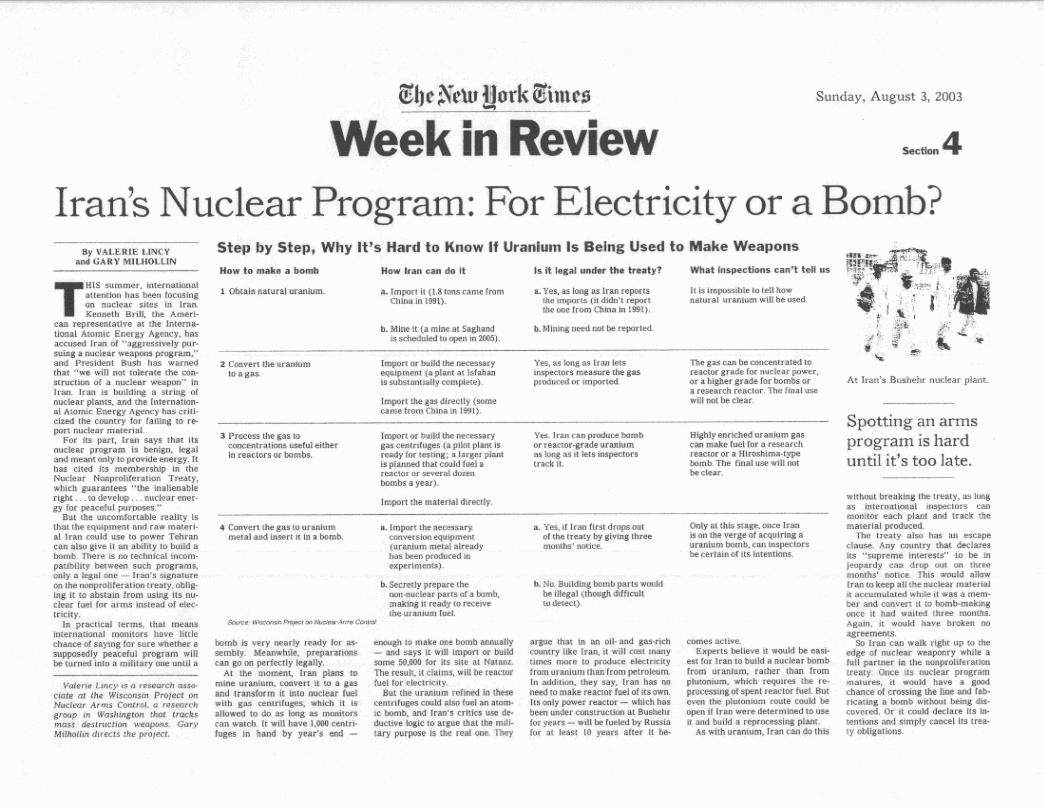
Iran’s Nuclear Program: For Electricity or a Bomb?

The New York Times
Week in Review
August 3, 2003

This summer, international attention has been focusing on nuclear sites in Iran.  Kenneth Brill, the American representative at the International Atomic Energy Agency, has accused Iran of “aggressively pursuing a nuclear weapons program,” and President Bush has warned that “we will not tolerate the construction of a nuclear weapon” in Iran. Iran is building a string of nuclear plants, and the International Atomic Energy Agency has criticized the country for failing to report nuclear material.

To view the below image larger, click here.


We Still Face the Menace of Iraq’s Hidden Horrors

The Los Angeles Times
May 22, 2003, p. A13

Saddam Hussein’s regime has been deposed, and the world is slowly losing interest in Iraq’s weapons of mass destruction. There are even some who suggest the weapons don’t exist. But this is dangerous. If they still exist –as much evidence indicates– those weapons could make their way into the wrong hands. And the time to prevent this is growing short.

Before the Iraq war, chief U.N. weapons inspector Hans Blix said Iraq might still possess 10,000 liters of anthrax and 15 times the amount of gaseous gangrene-causing agent that it had declared to the inspectors. Both these deadly items would still be viable today if properly stored. Blix also pointed to new evidence that Iraq could have 6,500 more chemical weapon warheads than previously thought.

And let’s not forget that when U.N. inspectors left Iraq in 1998, they had compiled a frightening catalog of Iraq’s undeclared poison gas, including almost four tons of missing VX, the deadliest form of nerve gas, and at least 600 tons of ingredients to make more of it. Also unaccounted for were up to 3,000 tons of other agents like tabun, sarin and mustard gas, about 550 artillery shells filled with mustard gas and about 31,000 chemical munitions, both filled and empty.

There’s more. A classified CIA report prepared last spring and leaked to the press in November reported for the first time that the agency had “high” confidence that Iraq possessed smallpox. Add to this the mobile biological weapons labs described by U.S. Secretary of State Colin Powell before the U.N. Security Council in February. Two or three such trailers side by side could produce enough dried anthrax and botulinum toxin in a month to kill thousands of people. The United States has found only two trailers out of the total of 18 that Powell claims Iraq has. Those two are still being tested to verify what they were used for.

And there is Saddam Hussein’s pursuit of nuclear weapons. Iraq never turned over drawings showing its latest nuclear weapons design to the first inspection teams. In 1998, Iraq tried to buy 120 high-precision electronic switches, ostensibly for medical purposes, which are also used to trigger atomic bombs. And though suppliers claim to have provided only eight, sources at the United Nations and in the U.S. government believe that the number supplied was higher.

Not to worry, says Undersecretary of Defense Douglas Feith. In congressional testimony last week he predicted that the process of finding this vast catalog of banned weapons could take “months and perhaps years.” Time, the administration claims, will provide a clear picture of Iraq’s programs for weapons of mass destruction. Yet time is exactly what we don’t have.

Each day brings new stories of looting at sensitive weapons sites in Iraq, disappearing documents and under-resourced search teams, incapable of protecting even the sites we know about. Consider the sprawling Tuwaitha nuclear complex south of Baghdad, the main repository of Iraq’s known nuclear material and equipment. Coalition troops have been neither willing nor able to keep looters out. As a result, documents and equipment that could have provided evidence of Iraq’s nuclear ambitions have disappeared.

Tuwaitha houses at least 13 metric tons of natural uranium and 1.8 metric tons of low- enriched uranium, as well as significant quantities of cesium, strontium and cobalt. These last three nuclear isotopes would be ideal for use in a “dirty bomb.” And further processing of Iraq’s partially enriched uranium, in neighboring Iran for example, could produce enough weapons-grade uranium to fuel up to three nuclear weapons.

In April, the New York Times reported that U.S. weapons experts searching an ammunition complex near Karbala found manuals and packaging for two drying ovens imported from Germany, but no ovens. These ovens, said the Times, could be used to process viruses and bacteria for germ weapons. The Times also reported that the team found 11 buried containers with sophisticated lab equipment and seven canisters of cesium in a warehouse. Taken together, these items sketch a suspicious picture that will remain forever incomplete because of looting.

And what of the sites we don’t know about? Think back to the period after the 1991 Gulf War when U.N. inspectors discovered the extent of Iraq’s hidden nuclear activities. The Iraqis were running a secret program at Tarmiya configured to produce weapons-grade uranium; they were turning out uranium oxide at Al Jesira; and they had a vast nuclear weapon production facility at Al Atheer. Similar unknowns could exist in Iraq today. Our odds of finding them intact are falling by the hour.

To solve the Iraqi weapons puzzle, we need to throw everything we have at the problem, which means more troops for better site security and more inspectors who know what they’re looking for. We should also use the experience of the United Nations, which has the best lists of what Iraq had and where it was. In particular, the nuclear inspectors need to get back in as quickly as possible.

As long as uncertainty remains as to the location and quantity of Hussein’s mass- destruction arsenal, the threat to our security has not disappeared; it has only shifted. Until these weapons are accounted for, the war to disarm Iraq will not be won.

Valerie Lincy is a research associate at the Wisconsin Project on Nuclear Arms Control in Washington D.C.,and Kelly Motz is the Associate Director. They edit the Project’s IraqWatch.org web site.

The Means to Make the Poisons Came From the West

The New York Times
Week in Review
April 13, 2003, pp. wk 5

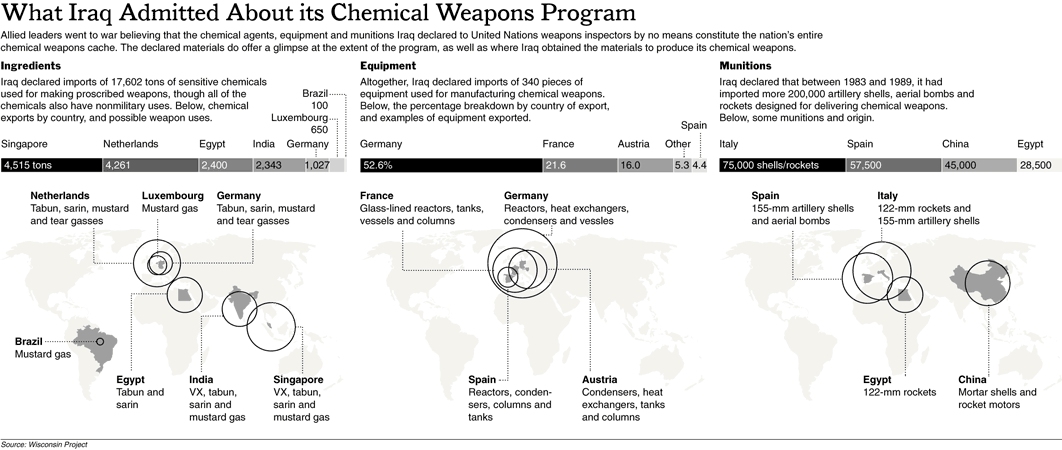
As allied troops interview Iraqi scientists, the chances grow of finding the chemical weaponry that Western governments believe Saddam Hussein was hiding since the gulf war of 1991. If the troops do find it, they will also find something else: that the means for making it came primarily from Western companies years ago.

Below is a picture of the origins of what Iraq said it imported for its chemical weapon effort. The data was given to United Nations inspectors in the late 1990’s, and was reconfirmed in Iraq’s 12,000-page declaration last fall. But the statistical material on which it is based remained confidential until recently.

The data reveals that firms in Germany and France outstripped all others in selling the most important thing – specialized chemical-industry equipment that is particularly useful for producing poison gas. Without this equipment, none of the other imports would have been of much use.

Iraq didn’t declare everything it bought, so the data is incomplete. But they can be presumed to be reliable as far as they go. In general, the pattern of Iraqi behavior with United Nations inspectors was to admit buying something only after learning that the inspectors already knew about it. Thus, it seems logical to assume that the admitted imports actually occurred.

Iraq sometimes lied about the quantities of ingredients or munitions to protect suppliers or to conceal stocks remaining on hand. Equipment, on the other hand, was listed in discrete units, so those quantities seem to be reliable.

The countries of origin are compiled based on the exporter, not the manufacturer, because it was the exporter who decided to sell a sensitive item to Iraq. Most of the equipment described in the report is restricted for export today, even though it also has civilian uses, but it was probably not restricted when it was sold in the 1980’s.

While individual items may have had innocuous uses, the usefulness of a combination of items on an order for making poison gas could have tipped off a seller. A former United Nations inspector, citing one case, said: “anyone looking at the order could see that all the chemicals were for sarin.”

The absence of American firms from this picture does not mean that none supplied Mr. Hussein’s mass-destruction weapons programs.

American firms show up on lists of suppliers of anthrax strains to Iraq, and of advanced electronics for nuclear and missile sites.


Gary Milhollin directs the Wisconsin Project, a research group in Washington that tracks mass destruction weapons. Kelly Motz is associate director, and Arthur Shulman, is a research associate, contributed to this project.