

News

Dateline New Delhi: India’s Nuclear Cover-Up

Foreign Policy
Fall, 1986, p. 161-175

In 1974, India became the first and only country in the world to explode an atomic bomb made from materials imported for peaceful nuclear purposes. India made the bomb with plutonium extracted from spent reactor fuel. Canada supplied the reactor and the United States provided the heavy water needed to run the reactor. India had promised to use the reactor and the heavy water for peaceful purposes only; thus it insisted on calling its bomb a peaceful nuclear device.

Heavy water was essential to the Indian bomb then; it is just as essential now. It is an ingredient that most of the country’s reactors—and all of its newest reactors—need to operate. India’s chances of becoming a genuine nuclear weapons state and of operating a successful nuclear power program depend upon an adequate and steady supply of heavy water.

A close study of India’s heavy water inventories reveals a large gap between this supply and India’s demand. This gap leads to one of two conclusions. Either India is illegally diverting heavy water from international safe-guards, or India has received a secret import—probably from China. New Delhi could also be pursuing both courses. India is using this illegally or secretly acquired water to run three new reactors outside international inspection.

These three new nuclear reactors will in-crease dramatically India’s nuclear-weaponsbuilding capability. Up to now, India has accumulated only small amounts of plutonium—enough for between 5 and 10 bombs but this material is restricted to peaceful use by Indian pledges to nuclear supplier countries. The new reactors, however, may pro-duce enough plutonium for 15 bombs per year, and the plutonium will not be restricted to peaceful use.

India has either secretly imported heavy water from China or diverted it illegally from international inspection to run its new nuclear facilities.

Both India and China have denied the contention that India covertly imported unsafeguarded heavy water from China, and India has denied any diversion from safe-guards. Yet despite invitations to do so, neither country has provided any information to support its denial. Neither country has signed the 1968 Treaty on the Non-Proliferation of Nuclear Weapons or agreed to adhere to the export control guidelines of the Nuclear Sup-pliers Group. Thus neither was breaking any international obligations by secretly trafficking in heavy water. Both, however, are members of the International Atomic Energy Agency (IAEA). The agency’s central purpose is the safeguarding of all important nuclear exports. China, moreover, has now specifically pledged to the United States that it will not use its nuclear exports to help other countries develop nuclear weapons. Both India and China will continue to need nuclear imports for their civilian programs, and both wish to import other high technology from the West. Until these large discrepancies in India’s heavy water balances are explained, nuclear supplier states should reconsider not only nuclear trade with India and China, but also any sensitive high-technology commerce with these countries.

India has manufactured its own heavy water since 1962, and though it can do what it pleases with the domestic product, India has never come close to meeting its needs. The country has been forced to import heavy water and to promise that all plutonium made by reactors using this water will be restricted to peaceful purposes.

Heavy water, scientifically known as deuterium oxide, is found in minute concentrations in ordinary water. To produce it, one must separate it physically from ordinary water in an expensive process that uses large amounts of energy. Its main advantage is that it allows a country to run reactors on natural uranium, which is widely available, rather than .on enriched uranium fuel, and thereby avoids the peaceful-use and safeguard restrictions that suppliers of enriched uranium require.

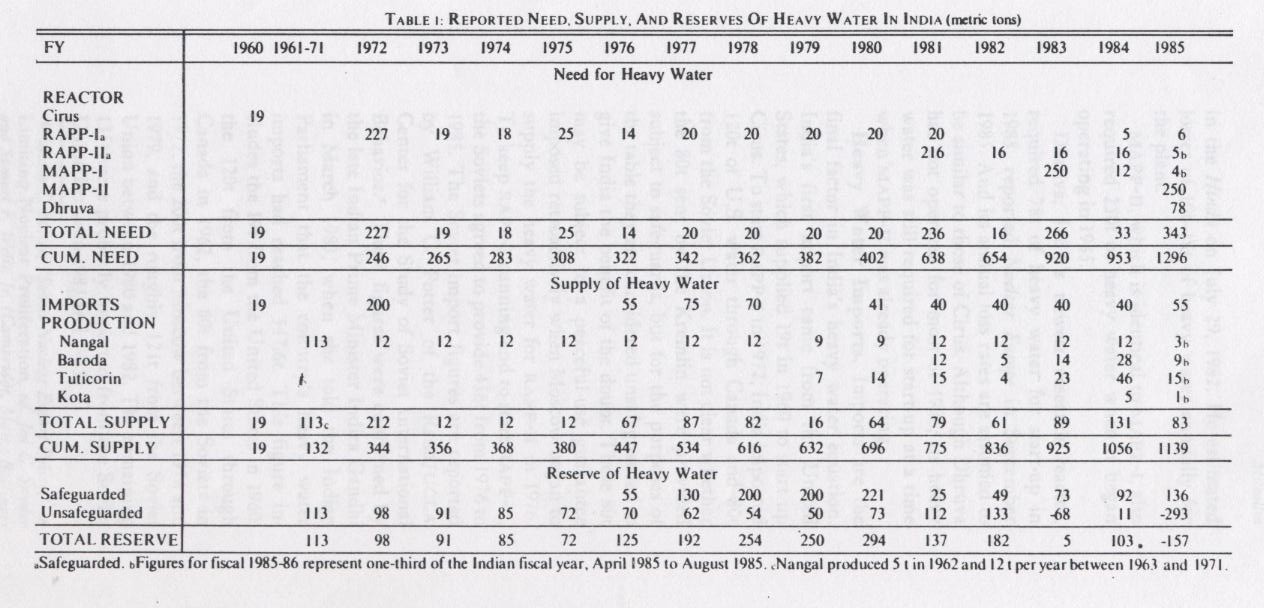
India’s disturbing shortages exist because domestic production has been very low, need has been high, and publicly acknowledged imports have been inadequate to make up the difference. In fact, an examination of India’s production, need, and imports reveals a gap of 68 metric tons (t) of unsafeguarded heavy water in 1983 and 293t in 1985. India in effect has been running reactors on water it does not admit having.

Domestic Production. India’s domestic production is the first factor in the heavy water equation. India produces heavy water at four principal facilities: Nangal, Baroda, Tuticorin, and Kota. Minute quantities may have been produced at a fifth plant called Talcher. Overwhelming operating problems and de-sign flaws have prevented these plants from producing more than a small part of their capacities. In testimony to the Indian Parliament in spring 1986, Shri Srinivasan, chief executive of Heavy Water Projects of India’s Department of Atomic Energy, reported that all domestic heavy water facilities have operated far below capacity and expectations. Despite a total annual production capacity of more than 300 metric tons (a unit of weight roughly 10 per cent more than a U.S. short ton of 2,000 pounds), the public record reveals that India never produced more than 50t of heavy water annually until fiscal year 1984–85, the last year for which figures are available. (India’s fiscal year runs from April to April.)

The Nangal plant has been India’s best producer. The Times of India science reporter Praful Bidwai reported on May 9, 1984, that Nangal has steadily produced between 10t and 12t of heavy water annually. However, according to the February 18, 1982, issue of Nucleonics Week, Nangal produced only 9t in fiscal year 1979—80. Production must have been at about this rate in fiscal year 1980—81 as well, because the plant was closed for at least 3 months.[1]

A wide range of authoritative sources con-firms low output for the three other plants. The biweekly Nuclear Fuel, on June 3, 1985, quoted Raja Ramanna, the chairman of the Indian atomic energy commission, as saying that a combined production of 80t at the Baroda and Tuticorin plants would be “approaching the maximum feasible capacity.”[2] This issue of Nuclear Fuel also cites the Indian government as acknowledging production of 7t at Tuticorin in 1979. Bidwai pegs Tuticorin’s annual production at 14t and 15t in fiscal years 1980—81 and 1981—82, respectively. For fiscal year 1983—84 he reports production at about 30 per cent of capacity, which would yield roughly 23t. In January 1983, the Hindu, a Madras daily, claimed that total production at Tuticorin for 1980 through mid-1982 was even lower. And Chemical Weekly’s August 9, 1983, issue cited a fiscal year 1982—83 figure of only 4t.

Baroda began producing heavy water in 1981, and the private Nuclear Assurance Corporation, which collects production data from nuclear facility operators around the world, reported an output of 12t for that year. Chemical Weekly, in the aforementioned issue, reported Baroda’s fiscal year 1982—83 output at 5t, and the Times of India, on May 8, 1984, reported a 13.6t figure for fiscal year 1983-84.

Precise production figures for fiscal year 1984—85 are not available for either Tuticorin or Baroda. Those in Table 1 are generous estimates that double production at both facilities from the previous year, to a total of 74t in both 1984 and 1985. As previously noted, Ramanna has stated that such levels for both plants would be “approaching the maximum feasible capacity.” Finally, Bidwai reports heavy water production of 5.2t at Kota in fiscal year 1983–84, according to the Times of India of May 7, 1984.

Heavy Water Demand. The second factor in the heavy water equation is demand. India’s demand for heavy water can be documented just as precisely as its production. The country currently operates two research reactors, Cirus and Dhruva, two nuclear power plants in the northwestern desert province of Rajasthan (RAPP-I and RAPP-II), and two near the southern port of Madras (MAPP-I and MAPP-II). All require heavy water, but only the two RAPP reactors are subject to IAEA inspection.

According to official U.S. export records, the Cirus research reactor required 19t of heavy water when it started up in 1960. Its annual losses are probably negligible: The Cirus design anticipates a loss rate of only .3 per cent annually, or t during its first 20 years of operation.[3]

RAPP-I started up in 1972 with an inventory of 216t of heavy water. Following pressurization in 1972, the reactor lost 11.4t of heavy water, raising the facility’s total need in that year to more than 227t. David Hart, then of Imperial College of London, reported in the 1983 book Nuclear Power in India: A Comparative Analysis that the heavy water losses at RAPP-I between 1977 and 1981 totaled 100t. The figures in Table 1 are based on the assumption that no losses took place in 1982 or 1983, when the reactor was shut down. The figures are. also based on the assumption that RAPP-I lost 5t of heavy water in fiscal year 1984–85, when the reactor operated for roughly one-fourth of the year, and 6t in fiscal year 1985–86, when the reactor operated for roughly 4 months. RAPP-II’s beginning inventory was probably the same as RAPP-I’s, but the figures in the table are based on the assumption of smaller loss rates—16t annually—because of likely improvements in design.

MAPP-I’s requirement of 250t of heavy water for its 1983 start-up comes from statements by Indian Minister of State for Science and Technology C. P. N. Singh that appeared in the Hindu on July 29, 1982. He estimated losses of 10t–15t of heavy water annually for the plant.

MAPP-II, which is identical to MAPP-I, also required 250t of heavy water when it began operating in 1985.

Dhruva, India’s newest research reactor, required 78t of heavy water for start-up in 1985, reported Nuclear Europe in September 1985. And its annual loss rates are assumed to be similar to those of Cirus. Although Dhruva has not operated for most of 1986, its heavy water was still required for start-up at a time when MAPP-II was already operating.

Heavy Water Imports. Imports are the final factor in India’s heavy water equation. India’s first import came from the United States, which supplied 19t in 1960 to start up Cirus. To start RAPP-I in 1972, India imported 120t of U.S. water through Canada and 80t from the Soviet Union. It is not clear whether the 80t sent by the Kremlin were provided subject to safeguards, but for the purposes of the table they are considered unsafeguarded to give India the benefit of the doubt. These 80t may be subject to a peaceful-use guarantee imposed retroactively when Moscow began to supply the heavy water for RAPP-II in 1976. To keep RAPP-I running and to start RAPP-II, the Soviets agreed to provide 456t from 1976 to 1985. The Soviet import figures are reported by William C. Potter of the Rand/UCLA Center for the Study of Soviet International Behavior.[4] These figures were confirmed by the late Indian Prime Minister Indira Gandhi in March 1983, when she told the Indian Parliament that the country’s heavy water imports had reached 547.6t. This figure includes the 19t from the United States in 1960, the 120t from the United States through Canada in 1962, the 80t from the Soviets in 1972, the 200t from Moscow between 1976 and 1979, and the roughly 12t from the Soviet Union between 1980 and 1982. The remaining 135t were probably imported from the Soviet Union between 1983 and 1985.

Uncertainties. These are the factors in the equation. They show that in 1985 India faced enormous heavy water shortfalls—157t in its overall supply and 293t in its unsafeguarded supply. Can the shortfalls be explained by errors in the table‘s estimates? How far off can the estimates be? First, the actual start-up inventories of MAPP-I and MAPP-II could each have been 240t instead of 250t. The number 240 has been mentioned occasionally. This figure would reduce the total need by 20t. Second, the loss rates could be slightly lower than those shown in the table. How-ever, the only loss figures not based upon Indian government or other actual published reports are the estimated annual 5t and 6t losses in fiscal year 1984-85 and fiscal year 1985-86 for RAPP-I and the estimated annual losses for RAPP-II and MAPP-I. The sum of these loss estimates is 80t. If, by extraordinary good fortune, India had reduced these losses by one-half—unlikely in view of the record—the figures in the table would overestimate the actual loss by 40t. Thus the maximum credible error in the table is roughly 60t, consisting of a possible overestimation of need by 20t and a possible overestimation of loss by 40t. This error cannot explain the 157t and 293t short-ages in 1985. Moreover, an overestimation of the heavy water loss by 40t would overestimate the unsafeguarded loss by only 8t, since the heavy water inventory from which the loss occurred was about 80 per cent safeguarded and 20 per cent unsafeguarded.

How Did India Do It?

India’s supply of heavy water kept up with its need until 1983. But in that year India decided to start MAPP-I without safeguards. Consequently, MAPP-I’s output of plutonium would not be monitored by international inspection and would be available for atomic bombs. This decision also required India to supply MAPP-I’s heavy water itself, presumably from unsafeguarded domestic production.

Yet India’s domestic production and re-serves in 1983 were insufficient to start MAPPI and still run the other operating reactors. In fact, India was 68t short. Its reserve—the heavy water remaining after meeting the needs of the on-line reactors—did contain 73t of heavy water. But that water was safeguarded and could not legally be put into unsafe-guarded MAPP-L So in 1983, India began for the first time to run more reactors than its supply of heavy water appeared to make legally possible.

In August 1985, India started MAPP-II and Dhruva without safeguards. By now, the country’s total public heavy water shortage stood at 157t. India was running four power reactors with only enough heavy water in the public records to run three. And because MAPP-II and Dhruva were started without safeguards, none of their heavy water could legally come from safeguarded imports. Therefore, the 136t of safeguarded reserve in 1985 were not legally available to MAPP-II and Dhruva, and the public shortage of unsafe-guarded heavy water was more than 290t—about one and one-half reactors’ worth.

These shortages mean that India cannot be running its nuclear power program honestly. The data show that India must be increasing its total supply of heavy water by some secret means, and must also be increasing its supply of unsafeguarded heavy water, probably by the same means. There are only two ways to do this: transfer heavy water from another Indian reactor or import the water secretly.

To bring MAPP-I to full power at the end of 1983, India needed 68t of unsafeguarded heavy water. Heavy water reactors need a full inventory of heavy water to operate, so heavy water could be shifted from another reactor only if that reactor were shut down. RAPP-II was operating in 1983, but RAPP-I was not.

RAPP-I had operated until March 1982, when it was shut down because of leaks. It did not start operating again until January 1985. RAPP-I, therefore, could have been drained to start MAPP-I in 1983. When RAPP-I closed, there was reactor-grade heavy water in its cooling and moderating systems and “degraded” heavy water collected from its leaks. Heavy water is called degraded when it leaks out of a reactor and mixes with ordinary water from the air. All of that heavy water was sitting idle and could have been shifted to MAPP-I. The portion that had leaked out could have been shifted after a process of upgrading, which means reconcentrating the heavy water by removing the ordinary water mixed with it, or the portion from the reactor could have been shifted directly at reactor grade.

India has done a great deal of upgrading. According to Hart, in Nuclear Power in India, from 1974 to 1976 the Indian government collected and upgraded at RAPP-I 60t to 70t of degraded heavy water each year. Bidwai re-ported in the Times of India on July 27, 1983, that India transferred about 100t of degraded heavy water from Rajasthan (RAPP-I) to Madras (MAPP-I) during the 2 years before MAPPI’s start-up. And according to Indira Gandhi, MAPP-I was started up by using 140t of upgraded heavy water.[5]

These statements all show that at least part of MAPP-I’s start-up inventory came from RAPP-I and that the shift occurred after upgrading. It is unclear how much heavy water was involved. If Gandhi’s figure of 140t is accurate, India would have had to remove about 60 per cent of RAPP-I’s inventory and all of RAPP-I’s unsafeguarded heavy water.

The amount of unsafeguarded heavy water in RAPP-I at any particular time depends upon how losses are replenished. Fifty-five per cent of RAPP-I’s original 216t inventory consisted of 120t of safeguarded water exported from the United States through Canada. Therefore, it is logical to assume that 55 per cent of RAPP-I’s yearly loss would be of safeguarded heavy water. As the table shows, RAPP-I lost a total of 176t during the 9 years from 1973 to 1982. Fifty-five per cent of this quantity equals about 100t. This 100t loss reduced the 120t under safeguards in the original inventory to 20t. Yet from 1980 through 1982, India added 46t of safeguarded Soviet heavy water to RAPP-I to make up for annual losses. This addition increased the safeguarded inventory to a total of 66t. Thus there were 66t of safeguarded heavy water and 150t of unsafeguarded heavy water in RAPP-I when it was shut down in 1982. India had to use the rest of the safeguarded Soviet imports received through 1982 in RAPP-II, the only other safeguarded reactor. Thus all the heavy water in RAPP-II is safeguarded.

The alternative to upgrading was simply to shift reactor-grade heavy water directly from RAPP-I to MAPP-I. Based on the previously cited requirement for MAPP-I, previously cited loss estimates for RAPP-II, and India’s domestic production, India needed 68t of unsafeguarded heavy water to start up MAPPI legally in 1983. RAPP-I contained 150t of unsafeguarded water, making that transfer both possible and legal.

Whether India shifted heavy water from RAPP-I to MAPP-I after upgrading, or transferred it directly, RAPP-I’s heavy water inventory would have been cut. If India had shifted only the 68t of unsafeguarded heavy water that MAPP-I needed, RAPP-I would have been left about 70 per cent full. If India had shifted 140t, as Gandhi said, the effect would have been to leave RAPP-I 65 per cent empty—unlikely in light of the fact that RAPP-I began operating again in January 1985.

At the beginning of 1985, India’s reserve surplus stood at some 103t. With this quantity India could have started MAPP-I in 1983 by draining RAPP-I, and operated MAPP-I through 1984 with the RAPP-I water. Then, in 1984, India could have shipped other water—produced in the interim—back to RAPP-I and restarted it with a full heavy water inventory in January 1985. This means that RAPP-I could have been the sole source of the extra heavy water needed to start MAPP-I in 1983.

In 1985, India started Dhruva and MAPP-II without safeguards. Its apparent shortage of heavy water was vast—some 157t. Its apparent unsafeguarded shortage was even larger — some 293t. Where did the heavy water to start Dhruva and MAPP-II come from? Could RAPP-I have been drained again?

After RAPP-I started up in January 1985, it stopped operating in early summer and remained shut down through the end of 1985. Therefore, its water was in theory available be drained out again—between its shut-down in early summer and the time Dhruva and MAPP-II went critical in August. Yet this means that India planned to bring to criticality two reactors for which it had no water until shortly before they were due to go critical; produced that water by taking off the country’s power grid another reactor that had just started up in another part of India; and transported large amounts of heavy water almost overnight. This scenario seems far-fetched.

In fact, MAPP-II and Dhruva could not have started solely on heavy water from RAPP-I. First, RAPP-I did not have enough heavy water. After RAPP-I shut down in early summer 1985, the residual decay heat from its core still had to be removed continuously by the heavy water in its cooling system. According to the reactor’s specifications, that system required about 70t. The rest of the inventory, about 145t, acted only to moderate the reaction and would have been available for transfer. But these 145t are still some 150t shy of covering India’s 293t shortage.

Second, by 1985, only 140t of RAPP-I’s heavy water were unsafeguarded and legally available for MAPP-II and Dhruva. This 140t is calculated by starting with the 66t of safeguarded heavy water RAPP-I contained when it shut down in 1983, and adding 11t of safeguarded make-up water for its operation during calendar year 1985. This makes a total of 77t under safeguards. The balance of the 216t inventory, which is roughly 140t, was unsafeguarded. Using those 140t would also still leave India some 150t shy of covering its 293t shortage. Thus there is no way India could have covered the shortage in 1985 solely with water from RAPP-I. India was 150t short even after draining all heavy water out of RAPP-I that was legally and physically available.

If RAPP-I’s water was insufficient, what were the other possible sources? RAPP-II, MAPP-II, and Cirus were all running in 1985, making their heavy water unavailable. The only heavy water left in India in 1985 was the 13t of safeguarded reserve. India either diverted it illegally or got a secret import.

Enter the mysterious shipment from Bombay. Bidwai reported in the Times of India on July 27, 1983, that 100t of reactor-grade heavy water were shipped from Bombay to MAPP-I several months before MAPP-I started up in 1983. Bidwai stated that only 70t of reactor grade water were available at MAPP-I in September 1982, in addition to 70t in accumulated domestic production in spring 1983—a total of 140t. This leaves a shortage of about 100t to start MAPP-I in summer 1983. These estimates are quite close to the amounts shown in the table. That total represents all the heavy-water in India, including all the water from upgrading, all the domestic production, and all the previous imports—which at the time were keeping reactors running. Nothing more could be in the system. Then, suddenly, 100t of absolutely pure reactor-grade water reportedly appeared in Bombay from unknown sources. And it arrived in the nick of time to start MAPP-I.

One must conclude that by August 1985 India had either diverted heavy water illegally from safeguards or received a clandestine import. No other explanation suffices. RAPP-i, still possible as the source of MAPP-I’s water in 1983, could not have provided heavy water for RAPP-II and Dhruva in 1985. Even had India used all of RAPP-I’s 140t, it would still have been short 150t of unsafeguarded heavy water. The mysterious shipment from Bombay shows that India probably received an import sometime before mid-1983—in time to use it in MAPP-I.

China is the only country in the world that could legally export this quantity of heavy water without safeguards. The world’s only other significant manufacturers of heavy water are Canada, the Soviet Union, and the United States. Canada cut off nuclear trade with India in response to India’s peaceful nuclear device in 1974. Canada’s decision was public, firm, and has been rigidly adhered to.

The Soviets are bound by the nonproliferation treaty and by their membership in the Nuclear Suppliers Group not to export heavy water without safeguards, and they have adhered strictly to those obligations. Indeed, the Soviet requirements on the heavy water for RAPP-II were the strictest ever imposed on heavy water—stricter than Canada’s requirements on the water for RAPP-I. Moscow presented New Delhi with a set of strict controls and demanded that India accept them. The Soviets have had one of the best export records of any major supplier. They have never been willing to sacrifice nonproliferation goals to gain a political advantage. In fact, the field of nonproliferation is the only one in which the superpowers have maintained a united front against other countries. Therefore, China is the only heavy water source remaining.

Yet China maintains close ties with India’s near-nuclear neighbor and rival, Pakistan. And China and India have long been regional rivals. Would China help a powerful neighbor build a nuclear arsenal?

That is precisely what may have happened. China needs foreign exchange. Beijing was forced recently to scale back its nuclear pro-gram for lack of it. And it has been willing to make just about any nuclear deal to get foreign exchange. China has even offered to take in, for a price, the high-level nuclear waste of other countries. Press reports and congressional statements based on U.S. intelligence information have stated that China has negotiated the transfer of sensitive nuclear technology to Iran, helped Pakistan operate its unsafe-guarded uranium enrichment plant, conducted a nuclear test in the presence of a high-level Pakistani official, provided nuclear weapons design data to Pakistan, sold enriched uranium without safeguards to South Africa, and provided heavy water to Argentina without safe-guards in 1985 and from 1980 to 1982.

Given China’s record and heavy water capabilities, India is obliged to provide some information on the source of the mysterious 293t of heavy water. To date, India has simply said that its heavy water production is adequate, and has refused to supply any figures to back this statement up.

India’s conduct has grave implications for the spread of nuclear weapons. Its unexplained shortages mean either that export controls are being ignored by an important supplier, which appears to be China, or that the IAEA cannot safeguard heavy water. Worse, India could be both circumventing safeguards and importing from China. Until the matter is cleared up, both China and the IAEA safeguards system are suspect.

The remedy—and there must be a remedy if controls mean anything—is to halt nuclear trade with India as long as the public short-ages of heavy water remain. Moscow should not provide New Delhi with any more heavy water. The United States should not sell India anything with a possible nuclear application, such as the supercomputer now being considered. These actions are the minimum necessary. In particular, a Soviet cutoff of heavy water probably would prevent India from operating one or more of the new reactors it is now constructing.

These remedies, however, could all be defeated by more nuclear shipments from China. Washington insists that in mid-1984, China pledged to stop unsafeguarded exports. Beijing must be encouraged in the strongest way possible to comply. China now wants to import nuclear reactors and other high-technology products, and to open its economy to the West. Rather than leaping into the new market, suppliers must first insist that China make internationally binding promises to change its export behavior.

If the United States and the Soviet Union take action, India’s program can be pulled back in the direction of accountability. If the suppliers as a group act against China, China can be pulled in the direction of a responsible export policy. If no one takes any action, India can continue officially to thumb its nose at the world, and the suppliers will have once again failed to get tough on nuclear arms proliferation.

Gary Milhollin is a professor of law at the University of Wisconsin. A consultant for the Nuclear Regulatory Commission from 1976 to 1986, he is currently working on a study of U.S. plutonium policy.  The author acknowledges the helpful comments of Professor Frank von Hippel of Princeton University on a previous version of this paper.


Footnotes

[1] The Patriot (New Delhi), 28 December 1981, 1,7.

[2] “Commissioning of Vitrification Facility Affirms India’s Self-Sufficiency Claims,” Nuclear Fuel, 3 June 1985, 10.

[3] “State Says ‘Substitute Clause’ Gets India off of Heavy Water Hook,” Nucleonics Week, 1 July 1976, 6-7.

[4] William C. Potter, “Soviet Nuclear Export Policy,” in Limiting Nuclear Proliferation, ed. Jed C. Snyder and Samuel F. Wells, Jr. (Cambridge, Mass.: Ballinger Publishing Company, 1985), 213-252.

[5] Unclassified telegram 13373, from the U.S. embassy, New Delhi, to the secretary of state, July 1982.

Is India Dodging Nuclear Controls?

The New York Times
September 8, 1986, p. A23

Do controls on nuclear exports really work? Or are they just a veil behind which nations buy and sell the means to make atomic bombs? India is now forcing these questions on the world. India has either diverted nuclear material from international inspection or imported it secretly from China and is using it to increase dramatically its ability to build a nuclear arsenal.

The material at issue is heavy water (deuterium oxide). It is needed to create a chain reaction in India’s reactors fueled by natural uranium.

India asserts that its three newest reactors – two at Madras and one at Trombay – are being operated exclusively with Indian-produced heavy water. Thus, India argues, it should not be subject to the same international controls on heavy water that India has imported from Canada, the United States and the Soviet Union.

Under controls of the International Atomic Energy Agency, plutonium made by a reactor using imported heavy water is restricted to peaceful uses and open to inspection. By asserting the water is not imported, India could use the plutonium from its reactors to make atomic bombs.

So far, India says it has accumulated only small amounts of plutonium and pledges to use it only for peaceful purposes. The new reactors, however, would not be subject to such a pledge and could produce enough plutonium for 15 bombs a year.

The problem is that India has never made enough heavy water to run these reactors without imports. An analysis of India’s heavy water needs, imports and production shows a staggering shortage unexplainable by possible error in data. In effect, India is now dishonestly running five reactors with barely enough heavy water to run three. It is either shifting safeguarded heavy water illegally to a reactor not covered by safeguards or getting secret imports.

India’s first reactor at Rajasthan – itself under international safeguards – is suspect. It has been closed each time India has started a new reactor outside such safeguards. At any of these times, the Rajasthan reactor’s safeguarded heavy water could have been diverted.

Secret imports could come from Canada, China, the United States or the Soviet Union. These are the only countries that export heavy water in the quantities India needed. But Canada cut off nuclear trade shortly after India detonated a ”peaceful nuclear device” in 1974. The Russians are bound by the Non-Proliferation Treaty and Nuclear Suppliers Group guidelines not to export heavy water without safeguards. It is inconceivable that these countries would illegally supply water.

China is the only source remaining and the only supplier that accepts no restrictions. According to published accounts, China has supplied heavy water to Argentina without safeguards and a nuclear weapons design to Pakistan. It is also desperate for foreign exchange and scaled back its nuclear program for lack of it.

China has denied making exports to India, and India has denied receiving any. But India has also denied any diversion from safeguards and refused to provide data to back up the denial.

Canada, the United States and the Soviet Union cannot be sure their heavy water exports are not being used to make bombs. The remedy is to halt nuclear trade with India until the shortages are explained.

The United States should not sell India anything with a possible nuclear application, such as a supercomputer now under consideration. A Soviet cutoff of heavy water probably would prevent India from operating one or more of the new reactors it is now constructing.

These remedies, however, could all be defeated by secret shipments from China. China wants to import reactor technology and open its economy to the West. Rather than leap into the new market, foreign suppliers must first insist that China make internationally binding promises to change its export behavior.

If the United States and the Soviet Union acted, India’s program could be made accountable. If the suppliers acted as a group against China, it could be forced to accept a responsible export policy. If no one does anything, India can officially thumb its nose at the world and show that nuclear export controls don’t work.

Gary Milhollin is professor of law at the University of Wisconsin. This was adapted from an article in the fall issue of Foreign Policy.

Testimony: Risks of Plutonium Use in World Commerce

Testimony of Gary Milhollin

Director, Wisconsin Project on Nuclear Arms Control

Before the House Committee on Foreign Affairs,
Subcommittee on International Security and Scientific Affairs
And on International Economic Policy and Trade

June 12, 1985

I am grateful for the opportunity to be here today, and to testify before these two Subcommittees on the question of plutonium use in the world.

Plutonium is the preferred material for making atomic bombs. It is in most of the warheads in the U.S. stockpile, and made the world’s first atomic explosion in 1945. Twelve pounds of it destroyed the city of Nagasaki. To make a bomb with plutonium, one places a sphere of it in the center of a sphere of high explosives. Once the high explosive is ready, it doesn’t take long to insert the plutonium — a few days will do. So very little time exists between the moment a competent weapons maker — or someone working with him — steals or diverts plutonium and the moment such a person has an atomic bomb. This fact — the quick convertibility of plutonium into atomic bombs — makes plutonium unique as a world commodity.

But is plutonium a world commodity? Should it be one? That is the broad issue before this hearing. The Ford and Carter administrations tried to discourage the use and availability of plutonium. However, some of the closest U.S. allies and trading partners wanted — and still want — to create plutonium in large quantities for commercial use. They wish to extract plutonium from spent nuclear reactor fuel, and then use it or sell it to others as new reactor fuel. If they do, it will mean that weapons-useable plutonium will be created in large quantities, shipped in large quantities, and stored in large quantities, and that all of this will happen in several foreign countries which do not now have nuclear weapons. Tons of plutonium will be involved. It will also mean that this type of commerce will become a precedent among the advanced countries, which the developing countries will want to follow.

Since the Ford and Carter days events have moved along, France made one shipment of plutonium to Japan in 1984. It now wants to begin shipments to Switzerland, and is considering the general sale of plutonium to fuel the present generation of power reactors. For the United States, these developments pose two questions. The first is simply one of security. The national security of the United States, and the individual security of each person who lives here, is placed at risk by the diversion of plutonium anywhere in the world. The second question is whether the United States should oppose this spread of plutonium, or simply go along with it. The United States still controls a large portion of the spent reactor fuel in the world — from which this plutonium is sought to be made — and has important influence over the very allies and trading partners which wish to market plutonium.If the United States wanted to, it could stop this spread of plutonium from happening.

I have been asked to comment today upon three specific questions. First, whether the United States would receive timely warning if U.S.-origin plutonium were stolen or diverted somewhere in the world. A corollary of that question is whether the Reagan administration’s interpretation of timely warning is consistent with the Nuclear Non-Proliferation Act of 1978. Second, I have been asked to comment upon the proposed transfer of U.S.-origin plutonium from France to Switzerland. The Department of State approves of this transfer; the Department of Defense opposes it. Third, I have been asked to comment upon the practice — which is now United States policy — of approving the use of plutonium in certain countries, which do not appear to be a proliferation risk, and of opposing its use in other countries, which do appear to be a proliferation risk. I will take these questions up in order.

The concept of “timely warning” is central to any use of U.S.-origin plutonium. When the United States exports fresh nuclear reactor fuel — in the form of low-enriched uranium, which is not useable in weapons — the recipient must promise not to retransfer the fuel beyond its jurisdiction or reprocess it without United States consent. Reprocessing consists of chopping up the spent fuel, dissolving it in acid, and extracting (separating) its plutonium in pure form. Plutonium in this form can be put directly into a weapon. Before reprocessing, a country having spent reactor fuel is still several months away from being able to make a nuclear weapon. If it has not built a facility in which to do the reprocessing, it is years away. After reprocessing, it is days or weeks away. The difference is crucial, and is the reason for requiring U.S. consent. When a recipient requests U.S. consent to either reprocess or retransfer, the request must be judged under the criteria in Section 131 of the Atomic Energy Act (Section 303 of the NNPA). To approve the request, the Secretaries of State and Energy must find that granting it “will not result in a significant increase of the risk of proliferation ….” When making this finding, the “foremost consideration” is whether the retransfer or reprocessing “will take place under conditions that will ensure timely warning to the United States of any diversion„..” To be timely, the warning must be “well in advance of the time at which the non-nuclear-weapon state could transform the diverted material into a nuclear explosive device….”

These words describe the basic goal of timely warning. It is simply this: that plutonium must be held and processed in such a way that, if a diversion of it occurs, the United States will be warned of the diversion well before the plutonium can be made into a weapon. The warning must be “well in advance” of the moment of possible fabrication. Why “well in advance”? Because it has always been assumed that the United States would, upon learning of a diversion, intervene diplomatically or by force to prevent the diverter from achieving a weapon. If the diverter achieves one or several weapons before the United States can react, the reaction becomes far more difficult. This “response time” has always been thought essential to national security.

With respect to plutonium, there can be timely warning in some cases, but not in others. When a foreign country holds spent fuel, the plutonium in it cannot be used in a weapon without reprocessing, which takes time. Months at least. That is time enough for a response, if a diversion is detected quickly. Spent fuel rods are visible in storage, can be counted easily, and are not simple to move. If spent fuel is diverted, one can reasonably hope for warning in time to react. Separated plutonium is quite different. First, it cannot be measured accurately when handled in bulk. The limit of accuracy in measuring the plutonium in a reprocessing plant is 1%. At Tarapur, where India hopes to reprocess two tons of U.S. plutonium, this measurement error means that 20 kilograms could be diverted without detection. Twenty kilograms can make up to 5 fission bombs with reflectors, depending upon the purity of the plutonium. The second problem with separated plutonium is its short conversion time. That time is from seven to ten days if the plutonium is finished metal, and from one to three weeks if the plutonium is an oxide. The International Atomic Energy Agency, which is responsible for safeguarding plutonium, will not give timely warning of its diversion. The IAEA cannot, and does not promise to give timely warning. In the words of its legal counsel, “it is a misconception.. .that it is the prescribed task of the agency to deliver timely warning. That is not the task under NPT safeguards.”

If the IAEA does not deliver timely warning, what does it deliver? It delivers “timely detection.” The IAEA promises only to detect a diversion within the conversion time of the material being safeguarded. That means, for separated plutonium, that the IAEA will inspect it every seven to ten days if it is in metallic form and every two to three weeks if it is in oxide form. The IAEA would not notify the United States, or anyone else, of a diversion within that time. Notice would come only after a report of material unaccounted for had made its way up through IAEA channels. At the IAEA, a report of material unaccounted for requires a period of time for evaluation, a period to report the diversion to the Director General, and a period for him to report it to the Board of Governors, who would then meet and decide: a) whether to ask the country concerned to remedy the discrepancy, b) whether to report the discrepancy to all members of the Agency, or c) whether to report it to the United Nations. It is obvious that this will take longer than one to three weeks.
So, for separated plutonium, IAEA safeguards will not provide timely warning. How then, did the retransfer of separated U.S. plutonium to Japan satisfy the Atomic Energy Act? The Japanese transfer was the first major shipment of separated plutonium to a non-weapons state since passage of the NNPA. The shipment was approved because the Act allows factors other than timely warning be considered in deciding whether the retransfer causes “a significant increase of the risk of proliferation…”

The other factors are listed in the Senate Report on the NNPA. They are whether the recipient is committed to non-proliferation, whether the recipient has a security agreement with the United States, whether it has a stable government, whether it is militarily secure, and whether it has a need for nuclear energy. The Senate Report also states that if it is not clear that timely warning will be provided, “a strong combination of other factors is necessary to compensate for this weakness in safeguards.”

The Japanese case has raised a dispute over what timely warning means. The Departments of State and Energy took the position that timely warning existed in that case. They said that timely warning could be based upon Japan’s governmental system, its non-proliferation policies, and its security relationship to the United States, rather than simply upon the scientific facts determining the conversion time of separated plutonium. The implication is that Japan’s stable government, its avowed policy against nuclear weapons, and its close relation to the United States Would all have to change in order for Japan to divert plutonium. These changes would be noticed by the United States, so that there would then be timely warning that a diversion might occur. This position was rejected by the Nuclear Regulatory Commission. The NRC pointed out that under State and Energy’s interpretation, “it would be necessary to consider the same non-technical factors both in connection with the timely warning analysis and in connection with the overall increase in the risk of proliferation’ finding.” The NRC said that Congress intended for timely warning to be “essentially a technical matter involving such factors as safeguards measures applied to the material and the technical ease of incorporating the material into a nuclear explosive device.”

It is pretty clear that the NRC is right. When the NNPA was adopted, all the Congressional discussions of timely warning — in committee reports, in markups, and floor debates — assumed that timely warning was purely a matter of scientific fact. That is, that the only factors in timely warning were whether a diversion would be detected, and whether it would be reported in time to intervene. A thorough study of the legislative history on this point has recently been done by Leonard Weiss, who is Minority Staff Director of the Senate Subcommittee on Energy, Nuclear Proliferation, and Governmental Processes. Mr. Weiss played a key role in framing the timely warning language. His study shows, beyond any doubt, that NRC’s view is the one Congress intended. The NRC view is also consistent with logic and common sense. Why would Congress provide that political factors could be considered in addition to timely warning, if Congress intended for those very same political factors to determine whether timely warning existed? ‘Congress could not have intended for the political factors to be considered twice. What Congress did intend was for the executive branch to make a separate finding on timely warning,
distinct from the political factors, to weigh the political factors along with timely warning to determine the risk of proliferation, and to give timely warning ” foremost consideration.” It is manifestly impossible to give it “foremost consideration” unless it is different from the other factors to which it is being compared. By not making a separate finding on timely warning, the executive branch has reduced the importance of timely warning, and made it impossible to give it foremost consideration. There is also another, less obvious reason why the executive branch cannot be right. If one follows the scenario which the executive branch poses, Japan could not, because of the stability and openness of government, divert plutonium without first changing its policy on non-proliferation, or its security alliance with the United States. Such changes, the argument goes, would be overt and the United States would learn of them. But suppose Japan did change one, or all of these factors. What would the United States do? Would the United States deem itself to be timely warned, and intervene at that point to get its plutonium back? The answer is that it would not, because it could not. There is absolutely no link between any of these political factors and the U.S. right to retrieve its plutonium. The only way the United States can legally demand the return of its plutonium from Japan is if Japan violates safeguards, or otherwise breaches the U.S.-Japan agreement for cooperation. In other words, if Japan diverts the plutonium. The U.S.-Japan nuclear trade agreement does not require Japan to have a particular form of government, be enthusiastic about non-proliferation, or maintain a security relation with the United States. Japan can change all of these without affecting in any way its right to keep the plutonium. It only gives up that right when it breaches safeguards by diverting. Because the right to intervene is triggered only by diversion, the previously-occurring political factors are irrelevant. The only important factors — those which affect intervention time and thus timely warning — are the rapidity of detection (safeguards adequacy) and the time it will take the diverter to make a weapon. Congress understood this very well when it enacted the NNPA. It is only the Departments of State and Energy which do not seem to understand it.

The remedy for this is to amend Section 131. Congress should do this: first, require the NRC to make the finding on timely warning, and to base its finding simply upon the factors Congress originally intended: that is, the adequacy of safeguards and the conversion time of the material in question. This is the definition now used by the NRC and the one Congress intended when it passed the NNPA. If the NRC is not able to find that timely warning would be provided, then the request would have to be denied under current law unless the absence of timely warning were outweighed by the political factors. When the case reaches this point, the question changes from science to politics. A non-weapons state will receive weapons-ready material by U.S. export, there will not be timely warning of a diversion, and the approval depends upon political factors. It could be that the approval should be granted. But, in a democracy, political questions such as this are important enough for public involvement and public debate. They should not simply be left to the experts.

Congress should require that in any retransfer or reprocessing case in which NRC finds that timely warning will not be given, Congressional approval is necessary before the retransfer or reprocessing is allowed to occur. Congressional approval will insure that the political factors are properly weighed, and that timely warning is given its true importance. It will take some time to do this, but that time will be more than justified by the importance of timely warning to national security. Once material is exported without provision for timely warning, it effectively goes beyond U.S. reach. It is worth taking some time to insure that such a risk is worthwhile.

This same analysis applies to the Swiss retransfer. About two hundred kilograms of U.S.-origin plutonium are involved. Because the plutonium is separated, the IAEA will not be able to give timely warning of its diversion. The approval depends upon political factors. What are they? Switzerland has a stable government. It has signed the Non-Proliferation Treaty. But it is not an ally of the United States and has no security relationship with the United States. It may or may not be militarily secure (is anyone militarily secure?); it may or may not need nuclear energy (the United States no longer needs it enough to order new reactors). One could argue over these factors for a long time.

The real importance of the Swiss case lies elsewhere. It resides in two facts. First, that Switzerland has one of the worst records on nuclear explorts of any country in the world. And second, that by exporting separated plutonium to Switzerland, the United States will be abandoning the line — which it has drawn for four years — beyond which U.S. separated plutonium was not supposed to go.

The record on Swiss exports is dismal. One need only look at the facilities in the world which now pose the greatest threat of proliferation. First, there is Pakistan’s unsafeguarded enrichment plant at Kahuta. Over United States objections, Switzerland supplied a giant, specially built gasification and solidification unit for that plant, together with high-vacuum values. Switzerland could have been under no illusions about that export. Second, there is the unsafeguarded enrichment plant in Argentina, built in secret for five years at Pilcaniyeu. There is strong evidence that Swiss equipment was used in that plant, and therefore that the Swiss knew the plant was being constructed. There could have been no illusions about that export either. In addition, the Swiss sold Argentina a heavy water plant in 1980 without requiring full-scope safeguards, again over U.S. protests. Third, there is the unsafeguarded enrichment plant in South Africa, at Valindaba. The Swiss sold compressors for that plant. Also, in 1984, the United States was forced to hold up action on the current retransfer request because of reports that Switzerland planned to sell a heavy water plant to South Africa. There would have been no peaceful use for such a plant in South Africa’s program. This is Switzerland’s export record, or at least the part of it which is public. Because of it, there is Swiss equipment in most of the dangerous facilities now operating in the world. Also because of it, Switzerland does not have “good non-proliferation credentials.” I wish to emphasize that these examples are the ones which are public. There are others which are not public. Before any U.S.-origin plutonium goes to Switzerland, these subcommittees should ask for a presentation of the classified part of these exports. The Subcommittees are likely to find things which are even more revealing than the ones I have mentioned.

The second problem with the Swiss case is one of precedent. When the Reagan administration entered office, the U.S. policy on plutonium changed. The administration said it would not “…inhibit reprocessing.. .in nations with advanced nuclear power programs where it does not constitute a proliferation risk…” The policy is frankly discriminatory and assumes that discrimination among countries makes sense when countries are truly different in their relations to the United States, and in their commitment to nuclear non-proliferation. There is nothing wrong with the policy in theory; the question is whether it can work in practice. Before the Swiss case, the administration had drawn a line around Euratom and Japan for the purpose of deciding who got separated plutonium from the United States. In the Swiss case, we go over that line. Switzerland has signed the Non-Proliferation Treaty. But it is not a United States ally, as Japan and the Euratom countries are, and has no security relationship with the United States. Nor does it have “good non-proliferation credentials.” South Korea has signed the Non-Proliferation Treaty, is an ally of the United States, has a large nuclear program, and has been important enough for United States blood to be shed in its defense. Taiwan has signed the Non-Proliferation Treaty, has a larger nuclear program than Switzerland’s, and has long had a security relationship with the United States. Yet, the United States vigorously suppressed the efforts of both Korea and Taiwan to acquire separated plutonium. Moreover, it is still not the policy of the United States to allow these countries to get separated plutonium. Finally, there is Mexico, our close neighbor and good friend to the south. Mexico has great nuclear ambitions and a much better record on non-proliferation than Switzerland. Is the United States going to furnish Mexico with separated plutonium when Mexico reaches the point of requesting it? If not, why not? Are Mexico, South Korea, and Taiwan less trustworthy, or less valuable friends of the United States, than Switzerland? The problem with the Swiss case is that for four years we have had a clear line marking off the countries which could get separated plutonium from the United States and now that line is gone. So, where is the line? A policy of discrimination requires the ability to draw a line. A line which moves is not a line, and a line which no one can define is not a line either.

The solution to the Swiss case is suggested by the issue it poses. That issue is whether a policy of discrimination can really work in practice. A U.S. decision that Switzerland is more trustworthy, and should receive more favorable U.S. treatment, than South Korea, Taiwan and Mexico is basically insulting to South Korea, Taiwan and Mexico. It does not seem possible to formulate any convincing principle according to which Switzerland is on the “good” side of a line and these other countries are on the “bad” side.

The remedy is for Congress to put a hold on the retransfer until there is a clear, defensible, and operational line beyond Euratom and Japan. Ad hoc treatment of each country is not a policy. A Congressional hold would have a great many benefits. First, it would allow a review of Switzerland’s export record, both public and classified, to see what Switzerland’s “non-proliferation credentials” really are. Second, it would allow Congress to obtain a statement of where the administration now draws the line on separated plutonium. Such a line is essential if U.S. policy is to be taken seriously by other countries. Third, it would allow Congress to explore what Switzerland has promised in exchange for the favorable treatment,. Is there, for example, a promise by Switzerland to require full-scope safeguards on its exports? That is a promise worth striving for. It is also something which, if not promised, says a lot about a country’s commitment to non-proliferation.

My last point — and the third question I was asked to address — is whether one can really distinguish countries which are a proliferation risk from those which are not. U.S. policy now hinges upon the faith that this can be done. One looks at the stability and openness of a country’s government, whether it adheres to the Non-Proliferation Treaty, whether its nuclear program is highly developed enough to make its request reasonable, and so forth. One assumes that one can judge a country’s intentions by its outward behavior. The example of Sweden proves that is false.

This past April, a history of Sweden’s nuclear weapons program was published in a Swedish technical journal, My Teknik. The history is based upon numerous interviews with persons in charge of the program, and upon previously classified government documents. The Swedish government has not denied the history’s essential findings. The history reveals a number of interesting things. First, that Sweden’s civilian and military programs worked together from the beginning, and that their relation was kept a secret. Sweden insisted, for example, upon mining uranium, even though imported uranium was far cheaper, in order to avoid the peaceful use restrictions on imports. Also, Sweden acquired the land for and tried to build a reprocessing plant despite the fact that its civilian program could not justify it. When, in the mid-1960’s, Sweden became interested in switching to the light-water reactors marketed by the United States, Sweden began secretly to study the use of reactor-grade plutonium (the grade of plutonium which light-water reactors produce) in nuclear weapons. Sweden actually conducted weapons experiments using this plutonium. In the period 1968-1970, U.S. inspectors, looking for U.S.-origin plutonium, discovered that it had been transferred to the weapons research program. In 1968, 20 kilograms of weapons-grade plutonium in spent fuel from the Agesta reactor was sent to Belgium for reprocessing and on to the Federal Republic of Germany. This plutonium was sent on an unrestricted basis, but may have been subject to U.S. controls. Sweden manufactured numerous bomb parts, such as neutron initiators, electrical detonators, and explosive lenses. In 1972, two years after depositing its ratification of the Non-Proliferation Treaty, Sweden conducted ten secret nuclear explosive tests with plutonium in an underground laboratory.

What conclusions can one draw from this? First, that there is a great temptation to use a nuclear power program to boost a nuclear weapons program. Sweden was unable to resist the temptation. Second, that such a use can be kept secret, and can continue in the teeth of the most solemn assurances to the rest of the world. The NPT forbids a non-nuclear-weapons state to “manufacture…nuclear weapons or other nuclear explosive devices…” Sweden’s actions from 1970 to 1972 violate the spirit of this language, and probably the letter as well. According to the Ny Teknik, the 1972 tests were done with metallic plutonium “setups” weighing 5-10 grams. The plutonium and high explosives were placed in a special room and ignited by remote control. Instruments recorded what happened when the plutonium was compressed. Were these “nuclear explosive devices?” They were surely devices using nuclear material, which exploded. Their purpose was military, not civilian. It is unclear whether the plutonium itself exploded, but whether it exploded or not, Sweden was building “nuclear explosive devices” in a way which could not be squared with what one expects from a non-weapons member of the NPT. Sweden also made numerous bomb parts over the course of its secret program. Did it stop making them in 1970, or throw them all away in 1970? If it was still making detonators, explosive lenses, or neutron initiators, after 1970, it violated the letter of the Treaty. Weapons parts are weapons under Article II of the NPT. Finally, under Article III of the Treaty, Sweden promised to maintain IAEA safeguards on all plutonium within its jurisdiction. After 1970, did Sweden inform the IAEA of the whereabouts of the plutonium used in the tests?

The NRC has now asked the executive branch whether Sweden used U.S.-origin plutonium in the tests. The United States exported heavy water to Sweden from the 1950’s through the 1960’s, and may have exported the uranium core for the Agesta reactor. Also, the U.S. has supplied Sweden with separated plutonium for many years. In 1972, the year of the ten tests, the U.S. apparently sold Sweden eight kilograms of weapons grade plutonium.

The example of Sweden shows that a country simply cannot be judged from its outward behavior. From 1970 to 1972, after Sweden had ratified the NPT, its “non-proliferation credentials” were excellent. An open, stable government, an advancing nuclear program, a reputation as a neutral. Above all, a treaty commitment not to make “nuclear explosive devices.” These appearances were unreliable in the early 1970’s. Are the appearances in other countries more reliable in the early 1980’s? They are not more reliable and the reason is this: the promise not to make nuclear weapons goes to the heart of a country’s national security. Such a promise will be kep only so long as a country’s national security
is not jeopardized by it. When it is Jeopardized, the promise will be abandoned and probably abandoned in secret. That is simply how countries act on matters of national security. Sweden did not abandon its secret program until its national security no longer required it. It therefore seems wrong, or at least very risky, to rely upon these outward appearances, as the U.S. policy now does, rather than a practical assessment of what a country can in fact do with what it is being given.

Finally, there is one additional point on plutonium policy which I would like to add; it concerns India. There have been recent statements to the effect that India may have a “bomb in the basement.” Mr. Gandhi has said that India can make nuclear weapons on short notice if it wishes. I think it is important to realize that India does not now have any fissile material out of which it would be legal to make a weapon. India’s separated plutonium is safeguarded except for the plutonium from the CIRUS reactor, which is subject to a guarantee of peaceful use. That guarantee was given to Canada for its supply of the CIRUS reactor, and to the United States for its supply of the CIRUS heavy water. India has no high-enriched uranium, and has not yet begun to reprocess the unrestricted plutonium from the MAPP-1 reactor. India’s test in 1974 was billed as “peaceful, but a weapons deployment could not be. The point here is that if India were to declare next week, next month or in the next six months that it were deploying a weapon, that would mean it had violated its peaceful use guarantee to Canada and the United States. It is quite remarkable that no one in the executive branch, or apparently in Congress, finds this fact disturbing. An effective plutonium policy requires enforcement of peaceful use guarantees. It also requires monitoring of U.S. materials. The CIRUS plutonium is not safeguarded, so no IAEA inspectors are keeping track of it. But that does not mean that the United States should not itself demand an accounting adequate to show that the pledge of peaceful use is being kept. The need for this accounting will not go away. CIRUS plutonium has been used in the core of India’s experimental breeder reactor, which is designed to breed “supergraden plutonium in its blanket. That supergrade plutonium will have been made from U.S. material, and should be restricted to peaceful use. This apparent lack of interest in the CIRUS plutonium, and the apparent failure to appreciate its importance, shows that U.S. plutonium policy lacks thoroughness and perseverance. I recommend that before we launch an Indian astronaut into space, we make sure India is not using our plutonium in atomic bombs.

Tarapur: A Brief for the United States

Summary

India has received reactors and reactor fuel from the United States through an Agreement for Cooperation. Those reactors (at Tarapur, near Bombay) have produced spent fuel from which India wishes to extract plutonium, a nuclear explosive. India contends that it has the right to do so, and that nine years from now (in 1993), when the fuel supply under the Agreement ends, it will have the right to use that plutonium for any purposes it wishes, including weapons. Despite India’s contention, the United States has the right to prevent the plutonium from being extracted. Also, despite India’s contention, India will have no such right in 1993 as it asserts, and India’s repudiation of its obligation in 1993 is a present breach of the Agreement for Cooperation. Because of this breach, the United States can suspend, through France, its delegee, fuel deliveries under the Agreement until India assures the United States that India will perform its obligations. If India does not provide these assurances, the United States can terminate the Agreement, accelerate the AID loan on Tarapur, and if India does not pay the balance due, accelerate the principal of all past AID loans to India and suspend disbursements on all current AID loans to India. Because the United States will lose, by 1993, the remedy of suspending fuel deliveries, the United States should act now. If the United States does not act, plutonium made from fuel shipped to Tarapur in the late 1980s will, under India’s view, be free of all restrictions as soon as it leaves the Tarapur reactors.

To read the complete report, click here:  Tarapur : A Brief for the United States