

News

Testimony: U.S. Exports to Iraq

Testimony of Gary Milhollin

Professor, University of Wisconsin Law School and
Director, Wisconsin Project on Nuclear Arms Control

Before the Senate Committee on Banking, Housing and Urban Affairs

October 27, 1992

I am pleased to appear here today before this Committee to discuss United States exports to Iraq.

I am a member of the University of Wisconsin law faculty, and I direct a research project here in Washington that is devoted to tracking and inhibiting the spread of nuclear weapons to additional countries.

The Committee has asked me to answer the question whether American exports aided Iraq’s effort to build weapons of mass destruction.

The answer is “yes.” Saddam Hussein is the first monster with imported fangs. Although the West Germans supplied the canines, Americans supplied some of the lesser teeth. Both governments knew what was going on, but chose not to stop it.

I have been working on the problem of exports to Iraq for almost three years. In September 1990, in testimony before Congressman Barnard’s subcommittee, I recommended that the subcommittee obtain a list of the dual-use exports that the U.S. Commerce Department had approved for Iraq since 1985. The committee then did so with my continuing advice and assistance. After the list was released, I prepared a study analyzing it, which was completed in June 1991. I would like to offer the study today for inclusion in this committee’s hearing record.

In April 1992, I also published an article in the New York Times that listed over forty American companies that got more than one hundred licenses to supply sensitive, dual-use equipment to Iraq. All of these licenses were for Iraqi nuclear weapon and ballistic missile development sites. The April article followed an earlier one that I published in March 1992 in the New York Times Magazine. The March article showed which companies had contributed to developing the individual components of the first bomb Saddam was trying to build. I would also like to offer these two articles for inclusion in the hearing record. All of these publications are based squarely on official records kept by the U.S. Commerce Department.

The records show beyond any doubt that American equipment went directly into the Iraqi mass-destruction weapon programs. The records also show that our officials knew it was going there, but held their noses and waived it through.

Today I am going to talk about two categories of American exports: first, the ones that the UN inspectors actually found in Iraqi mass destruction weapon programs, and second, the ones that the Commerce Department licensed to these programs but that the UN has either not found or not included in its reports.

AMERICAN EXPORTS THAT THE UN HAS FOUND

The electron beam welder. The inspectors found a giant electron beam welder at an Iraqi nuclear weapon plant. It was an essential part of Saddam’s production line for making centrifuges, which Saddam was counting on to make his first critical mass of nuclear weapon material. The welder even had a special fixture for holding the centrifuges in place. The inspectors included it on a list of “the more important equipment” that they found.

This case sheds a lot of light on how the export licensing system worked. The exporter was the Connecticut branch of a German company called Leybold Vacuum Systems. In May 1987, Leybold had already made the newspapers. It was being investigated for trying to smuggle blueprints for uranium enrichment to Pakistan. And another German firm was suing it for stealing the blueprints. According to a German official, the evidence against the company was “very incriminating.” The newspaper stories appeared only six months before the company applied for its two U.S. export licenses in December 1987. Despite the applicant’s notoriety, Commerce approved both licenses in January and February 1988. Neither case was referred to the Pentagon or the State Department for review.

What were the Iraqis going to do with the welder? The application said, in plain English, that they wanted it for “general military repair applications such as jet engines, rocketcases, etc.” So Commerce explicitly approved military repairs, and work on rocketcases.

And who was buying the welder? Nassr State Enterprise for Mechanical Industries. One of Nassr’s main jobs was to buy equipment for Project 1728, devoted to increasing the range of Iraq’s SCUD missiles. The Iraqis did that by cutting up and rewelding the rocketcases to make them hold more fuel. Nassr also bought equipment for making centrifuges, which Saddam hoped would make his first atomic bomb.

So the Commerce Department allowed a known nuclear smuggler to send strategic U.S. equipment straight into the Iraqi bomb and missile program even after being told that the export was going to help make military rockets.

NBC News later discovered an internal Commerce memo showing that Commerce staffers had objected to the license. One employee wrote that “it is difficult to be a consenting party to a transaction such as this.”

The mass spectrometers. The UN found two U.S.-licensed mass spectrometers in the nuclear weapon program. These instruments are used to measure the quality of uranium as it is being enriched to nuclear weapon grade. The Commerce Department licensed one in December 1988 to the Ministry of Heavy Industries, a front company that bought equipment for the Iraqi nuclear weapon development sites, and another to Sa’ad 16 in 1985.

The vacuum pump oil. The UN also found vacuum pump oil made by Dupont in the nuclear program. Vacuum pumps move uranium gas through the enrichment process, while the uranium is raised to nuclear weapon grade. The gas is corrosive, so special pumps are needed to move it. The oil is a restricted item because it is used to lubricate these special pumps. The Commerce Department licensed the pump oil in February 1989.

In addition to this American equipment, which the UN listed as “important,” and which it said was actually being used in the atomic bomb program, there was also a transfer of know-how.

The detonation conference. In 1989, the Pentagon and the Department of Energy invited three Iraqis to attend a “detonation conference” in Portland, Oregon in August. Financed by American taxpayers, the meeting brought together experts from around the world to explain to the Iraqis how to produce shock waves in any desired configuration. There were even lectures on “H.M.X.,” the high explosive of choice for nuclear detonation, and on flyer plates, used to help produce the precise shock waves needed to ignite A-bombs. The UN found both H.M.X. and flyer plates at Iraq’s main nuclear weapon development site. The three Iraqis who attended the conference came from the laboratory that provided parts for Iraq’s first high explosive nuclear detonator.

Chemical and missile items. In February 1992 the UN sent the State Department a list of American equipment that had been found in Iraq’s chemical and missile programs. The list reveals a number of interesting things.

At the al-Muthanna State Establishment at Samarra, the largest Iraqi site for producing chemical weapons, the U.N. inspectors found American equipment during UNSCOM 17, the fifth chemical weapon inspection. They found air compressors, pressure and temperature regulators, power supply components, air filters for ensuring a clean and dry working environment, and buffer vessels, all made by a company in North Carolina. They also reported finding a filling system for projectiles–to fill the projectiles with chemical agents–made by a company in Connecticut and process control equipment made by a large American electronics manufacturer.

In addition, they reported finding a generator, some motors, and an ion exchange machine at al-Fallujah, another chemical weapon site. The UN said that all of these items were made by American companies. The UN also said in its letter that it had not determined how the equipment had found its way to Iraq, so it was possible that it had got there without the companies’ knowledge.

AMERICAN EXPORTS LICENSED BUT NOT YET FOUND

The second category I want to talk about is the equipment that the Commerce Department licensed, but that the UN has either not found or not mentioned in its reports.

It should be clear by now that U.S. export controls on Iraq suffered a massive breakdown in the period preceding the Gulf War. Front companies for every known nuclear, chemical and missile site in Iraq bought American high-speed computers and electronics. Computers exports alone exceeded $96 million. The Commerce Department also licensed equipment for making such things as military radar, and even told one company that it did not need a license for equipment that the Iraqis had specified as being able to operate 66 miles above the surface of the earth. I will mention here only a sample of the licenses that were approved.

The Iraqi Air Force. This is obviously a military institution, yet it was licensed to get $57 million worth of high-tech American exports, including navigational, radar, and air communication equipment and almost a million dollars worth of compasses, gyroscopes, and accelerometers. Compasses, gyroscopes and accelerometers are used in the guidance systems of missiles as well as aircraft. The Commerce Department approved them despite the fact that they were on the U.S. missile technology control list, which came into effect before the approvals were made. They fell under export control category 1485. All items under that category are controlled as missile items. Commerce also approved them without referral to the State Department, which was required for missile-tech items.

Iraqi Atomic Energy Commission. It was directly in charge of nuclear weapon research in Iraq, yet it was licensed to get several American computers that were fast enough to require licenses for export.

Ministry of Defense. Obviously another military organization. It got over $2 million worth of computers, over $1 million worth of guidance equipment, and almost $300,000 worth of navigation, radar, and airborne communication equipment. Many of these items were approved without referral to the Pentagon, even though the buyer was clearly a military enterprise.

Ministry of Industry and Military Industrialization (MIMI). This was another military organization, run by Saddam Hussein’s son-in-law Hussein Kamil al-Majid. It built Al Atheer, Iraq’s primary nuclear weapon development and testing site. It also ordered the now-celebrated furnaces from Consarc that the White House blocked in June 1990 because of Iraq’s plan to divert the furnaces to nuclear weapon production. MIMI was licensed to get roughly $8 million worth of computers and a half million worth of computer-controlled machine tools.

Al-Qaqaa. Part of MIMI and part of Iraq’s nuclear weapon program. It sent the three experts I mentioned above to the detonation conference, and was the buyer of the nuclear weapon triggers that the Iraqis got caught smuggling out of the United States in March 1990. It was licensed to get $200,000 worth of American computers.

Badr. This organization was jointly in charge of all the centrifuge production in Iraq. It was also one of the few places I know of that actually got a “pre-license check” by the U.S. embassy in Baghdad. After U.S. officials toured the plant, Ambassador Glaspie cabled in September 1989 that Badr was “a reliable recipient of sensitive U.S.-origin technology.” It was licensed to get $1.6 million worth of American computers.

Salah al Din (Saad 13). UN inspectors visited this plant and reported that it manufactured radar for the Iraqi army. It also supplied control panels for machines that enriched uranium for nuclear weapons. Commerce licensed it to get over $1 million worth of quartz crystals–essential for making radar–from Zeta Laboratories despite the fact that the crystals were on the missile technology control list and the license was granted in January 1988–after the list went into effect. The stated end use was “components for a radar system.” As late as November 1989, Commerce also licensed Hewlett Packard to sell frequency synthesizers used to develop radar, despite the clear statement on the application that they would be used for “calibrating, adjusting and testing of a surveillance radar.”

These are only some of the licenses. There were other dangerous exports that went out without licenses. This happened because the Commerce Department inexplicably told exporters that no license was required. One of the most mystifying is what I call the case of the “flying tractor.”

The flying tractor. In 1991 the Los Angeles Times discovered that a New Jersey company had contacted the same Commerce Department representative, Michael Manning, who had advised Consarc about the furnaces. Iraq wanted to buy “time-delay relays.” These have civilian uses but are also used to separate the stages of ballistic missiles in flight. Iraq wanted a special model, “tested for shock and vibration,” that would perform at 350,000 feet. That is 66 miles above the earth. An employee of the company told the Los Angeles Times that “when I heard 350,000 feet, I thought missile.”[1]

The employee also said that he told Manning about the high-altitude specifications, which were military grade. They contradicted the Iraqis’ claim that the relays were for “heavy industrial use.” The employee said he told Manning that “they’re not putting tractors 350,000 feet in the air.”[2] Nevertheless, U.S. officials told the company that if a civilian use were stated, there was no reason to bar the export.

I think these examples show an unmistakable pattern. Our government allowed a mountain of dangerous equipment to go to Iraq, and now the UN is finding it at mass-destruction weapon sites. Rather than deny the facts, the government should try to learn something from them.

WHAT DID OUR GOVERNMENT KNOW AND WHEN DID IT KNOW IT?

Did our government actually know what Saddam was up to? And did it know early enough to stop these dangerous exports? The answer is clearly “yes.”

Sa’ad 16. In November 1986, the Pentagon sent the Commerce Department a letter stating that the Pentagon had intelligence information linking a giant Iraqi site called “Sa’ad 16” to missile work.[3] The letter also said that Sa’ad 16 was working on other weapons of mass-destruction. As we now know, Saad 16 was the biggest missile development site in Iraq. U.S. pilots were sent to bomb it during the Gulf War.

We also know that Commerce had even more information about Saad 16 earlier. In May 1985, the general contractor for Sa’ad 16, a West German company called Gildemeister, filed an application for a $60,000 computer for the Sa’ad General Establishment, which Commerce approved six weeks later (case A897641). With the application was an Iraqi letter listing 78 laboratories at Sa’ad 16, including four for testing “starting material and fuel mixtures,” two for “calometric testing of fuels,” two for developing “control systems and navigation” equipment and one for “measuring aerodynamic quantities on models.” On May 3, 1986 a second letter from Sa’ad revealed that the Sa’ad General Establishment was a part of the “State Organization for Technical Industries (SOTI)” and that another name for Sa’ad 16 was the “Research and Development Center.”[4] Commerce undoubtedly received this second letter–an internal Commerce memo mentions it.[5] These two letters from Sa’ad, combined with the November 1986 message from the Pentagon, should have barred any of these organizations from receiving sensitive U.S. exports after November 6, 1986.

But the Sa’ad General Establishment got over half a million dollars’ worth of U.S. computers in eight cases, seven of which were approved after November 1986. Sa’ad also got $290,000 worth of precision electronic and photographic equipment, approved in February 1987, three months after Commerce received the Pentagon letter and more than a year after the receiving the letter describing Sa’ad 16’s laboratories.

The second Iraqi organization mentioned in the Sa’ad letter, SOTI, got high-speed U.S. oscilloscopes in March 1988, a year and a half after Commerce received the Pentagon’s letter (case B259524). SOTI is part of the Iraqi Ministry of Defense. It directed the construction and equipping of a solid rocket motor production plant called “DOT,” and it also procured equipment for at least two SCUD missile enhancement projects. High-speed oscilloscopes are essential to maintain radar, computers and missile guidance systems, all of which have internal electronics that operate in short time frames. Oscilloscopes are also used to capture the brief signals from a nuclear weapon test, which occur in a microsecond or less. Only high-speed oscilloscopes need a license for export.

The third organization mentioned in the Sa’ad letter was the “Research and Development Center,” which the letter said was another name for Sa’ad 16. The “Center” was allowed to buy $850,000 worth of high-performance measuring, calibrating, and testing equipment (cases B060729 and B075876), all approved in January 1987, three months after the Pentagon’s letter and more than a year after the Iraqi letter describing Sa’ad 16’s laboratories. The Defense Department apparently objected at the staff level but did not escalate its objections to a higher level before Commerce approved the exports. The Center also got communicating and tracking equipment valued at $3,000 in 1989 (case B382561).

In addition to the letters from Sa’ad and the Pentagon, there were other warnings. According to U.S. officials, American intelligence began to brief other U.S. agencies on the Iraqi end user network at least at early as 1987. The briefings continued throughout 1988.

In the open press, the earliest detailed accounts of Sa’ad 16 emerged in January 1989, when the German magazine Stern published a list of the Sa’ad 16 laboratories. Over the next several months, the German press published several stories linking Sa’ad 16 to Iraqi missile, nuclear and chemical weapon development. But even these press reports did not stop Commerce from approving the tracking equipment in June of 1989.

Thus the Commerce Department continued to let sensitive American equipment flow to Iraqi front companies even after it knew that the equipment was likely to be diverted.

Internal U.S. government memos. Due to the excellent investigative work done by Representative Henry Gonzales, we now have documents showing that U.S. intelligence knew about, and was reporting on, Iraq’s nuclear weapon effort well before many of the most dangerous exports went out.

As early as June 28, 1985, a Pentagon memo referred to a CIA report, attached to a letter from Secretary of State George Shultz, stating that “there is a body of evidence indicating that Iraq continues to actively pursue an interest in nuclear weapons,…[and] that Iraq has been somewhat less than honest in regard to the intended end-use of high-technology equipment.” Despite the CIA report, Shultz asked the Pentagon’s help in licensing exports to Iraq “without impractical conditions.”

On April 3, 1986, a State Department memo complained about the Pentagon’s effort to hold up licenses to Iraq. It said that the Pentagon’s evaluation of the Iraqi proliferation threat “differed radically from all other agencies,” and that “DOD has simply found a device for blocking legitimate high-tech sales to Iraq while appearing to take the high ground on nonproliferation.”

On February 22, 1989, Director of Naval Intelligence, Rear Admiral Thomas Brooks, explicitly told the House Armed Services Committee that Iraq was “actively pursuing” nuclear weapons.

On March 23, 1989, a State Department memo stated that Iraq was “working hard at chemical and biological weapons.”

Despite all this, on October 2, 1989, President Bush issued NSD 26, stating that “normal relations between the United States and Iraq would serve our longer-term interests and promote stability in both the Gulf and the Middle East. The United States Government should propose economic and political incentives for Iraq to moderate its behavior and increase our influence in Iraq.”

Only a month later, on November 6, 1989, the CIA reported that “Baghdad has created complex procurement networks … to acquire technology for its chemical, biological, nuclear and ballistic missile development programs.”


Footnotes:

[1] Henry Weinstein, “Despite Warning, U.S. Okd Sale of Missile Part to Iraq,” Los Angeles Times, April 9, 1991. p. A7.

[2] Id.

[3] United States Government Accounting Office, “Arms Control: U.S. Efforts to Control the Transfer of Nuclear-Capable Missile Technology” (Report to the Honorable Dennis DeConcini, U.S. Senate), GAO/NSIAD-90-176, p. 14.

[4] Sa’ad General Establishment, letter of May 3, 1986 from H. A. Al-Dahan to Gildemeister Projecta.

[5] U.S. Department of Commerce, Memorandum to John Knofala from Willard A. Workman, August 12, 1986.
Winking at Proliferation

The Washington Post
August 16, 1992, p. C2

Why Are U.S. Firms Still Able to Aid the Mideast Missile Race?

The Bush administration this summer has missed a major opportunity to slow the spread of missiles in the Third World. In June, it published a list that purports to name the world’s most dangerous rocket projects so that U.S. firms would not sell material of any sort to them. However, after political arm-twisting by several foreign governments, the administration has deleted the names of every dangerous project in the Mideast. The effect of this, bafflingly, is to let U.S. firms continue selling missile-related technology not only to Israel, but to its rivals.

Among the nations and projects listed in the original Commerce Department tally but dropped from the final list are: Egypt’s upgraded Scud and Condor II missiles; Iraq’s Scud-B, Al-Husayn, Al-Abbas, Condor II and Tammuz missiles, and Al-Abid rocket; Israel’s Jericho I and II missiles and Shavit space launcher; Libya’s upgraded Scud and Al-Fatah missiles; and Syria’s upgraded Scuds. Also dropped were Argentina’s Condor I and II missiles and Alacran rockets. President Carlos Menem pledged to end the Condor II program, but it remains an active component of his nation’s unneeded space-launch program.

To be sure, some of these deletions are theoretical — total embargoes are in effect in such countries as Iraq. But the deletions mean that U.S. firms can continue to fan missile proliferation, especially in the Middle East, by selling equipment and technology while claiming they do not know which projects are missile efforts.

U.S. law forbids U.S. firms from selling anything — even a pencil sharpener — to a project that they “know” is missile-related, unless they obtain an export license from the Commerce Department. The procedure is intended to give Commerce direct oversight of any exports to dangerous projects. But the only way for an exporter to “know” legally is through the newly published — and now deeply flawed — list.

The new list is an example of unsavory political favoritism. For example, by omitting the potent Jericho II missile, which has a range that allows it to reach every Mideast capital, the administration winks at Israel’s diversion of U.S. technology to the missile effort.

The list also winks at Israel’s agreement to develop the Jericho jointly with South Africa, and that is because the administration’s list is also nonsensical. Though it leaves out the Jericho, it names South Africa’s “Surface-to-Surface Missile Project” — which is Pretoria’s half of the Jericho project.

The list’s same lack of logic is at work in other international missile projects. While leaving out Syria’s short-range missiles, for example, the list names North Korea’s “Scud Development Project,” which is virtually identical. North Korea is selling short-range Scuds to Syria as fast as it can. The list also fails to mention Syria’s medium-range missiles, but names China’s medium-range “M Series Missiles,” even though the technology to make them is being sold to Damascus by Beijing.

The Israelis fought the administration’s 1991 version of the list because it did name the Jericho, their premier missile. After caving in to Israeli demands that the Jericho be excluded, the administration felt forced to exclude projects underway in Egypt, Libya and Syria because, administration officials told me privately, it would have been politically embarrassing to do otherwise.

The task of compiling the list divided the administration. On one side were officials whose job is to stop proliferation; on the other were the country desk officers at the State Department, whose job is to maintain good relations with the countries on the list. “We went back and forth for more than a year,” said one official close to the debate, “and ‘the desks’ finally won.”

The result did not please the exporters. “It shows that the president’s program lacks clear objectives,” asserts one exporter. “It doesn’t really achieve any foreign policy goals.” In fact, American exporters are the loudest proponents of a better list that would enable them to tell safe buyers from the risky ones.

To be truly useful, the list should name the various companies, institutes, “research” enterprises and other entities that are the actual buyers of equipment for missile programs.

Some examples would be: Israel’s Technion University, which has helped design the Jericho II’s re-entry vehicle, and Israel Military Industries, which makes the Jericho’s rocket motors; and the Indian Institute of Science and the Institute of Technology, which are studying such things as stresses on rocket bodies and computer modeling of solid rocket fuel performance.

In Brazil, the Embraer company, an arm of the Brazilian Air Force, and another firm, Orbita, are trying to turn Brazil’s Sonda IV space launcher into an intermediate-range, nuclear-capable missile.

The administration is now said to be considering adding such companies and institutes by name to the June list. But there is still a black hole in place of the rocket projects of Argentina and the Mideast.

A detailed list from the administration would be a message to the world. All exporters — foreign and domestic — would rely on it. Foreign governments would immediately feel the pressure to incorporate the list into their own laws. The result could be a lot less missile proliferation. If Saddam Hussein has taught us anything, it is that half-hearted export controls don’t work.

Missiles too Dangerous to Name

On June 16, 1992 the U.S. Department of Commerce published its long-awaited list of missile projects in the Third World. The list was supposed to plant a red flag on the heads of secret missile makers by naming them, and thus deny them U.S. exports. Instead, the administration came up short by bowing to special interests.

U.S. law forbids U.S. firms to sell anything–even a pencil sharpener–to a project that they “know” is missile-related, unless they first obtain an export license. But the only way for an exporter to “know” is to read the Commerce Department list. Thus, the whole exercise depends on a comprehensive list being published, which Commerce failed to do because of pressure from Israel and other missile-building countries.

The new list is only the truncated remains of a longer draft that Commerce was poised to publish in 1991. The original 1991 draft named 38 missile projects; the 1992 list but 21. Gone are the names of all of the projects in the Middle East, home to some of the most dangerous and destabilizing missile builders in the world. The deletions mean that U.S. firms can continue to fuel Mideast missile proliferation by claiming that they do not know which projects are involved.

Israel fought the 1991 draft because it named Israel’s premier missile, the “Jericho II.” The Jericho has already flown over 800 miles in tests–far enough to bring most Arab capitals within range. When fully developed, the Jericho will be able to send a nuclear payload to Moscow or Western Europe. Israel has at least a hundred nuclear warheads for the Jericho to carry, and is working on a missile nose cone that will allow the warheads to reenter the atmosphere accurately.

The new list, which does not name the Jericho, sends Israel the wrong signal. Israeli missile makers have already diverted U.S. technology to the Jericho in violation of promises not to. Yet firms such as Israeli Military Industries, which makes the big rocket motors that power the Jericho, will still be eligible for American goods and so will South Africa. In 1989, NBC News revealed that Israel was selling Pretoria the means to make Jericho rocket motors and that the two countries were developing the missile together. In return for the Israeli help, the Jericho was being tested off the South African coast. The new list pretends that neither the Jericho nor the diversions exist.

While leaving out the Jericho, the June list names South Africa’s “Surface-to-Surface Missile Project,” which is South Africa’s half of the Jericho. In effect, Commerce is telling U.S. exporters that there is a dangerous missile project in South Africa to which they must not sell anything, but they can sell all they want to the other half of the project, which happens to be in Israel.

The new list also sends the wrong signal to Egypt, Libya and Syria. After dropping the Jericho, the administration had to drop the project names in these three countries too–all of which were on the 1991 list. It would be blatantly discriminatory for the U.S. government to name Arab but not Israeli projects. All three of these Arab states are aggressively building short- and medium-range missiles and deserve to have their projects named. But the best the administration could do was put all four countries into a broad category called the “Middle East,” into which it also put such non-threatening, non-missile states as Bahrain, Oman and Qatar. The result was to allow Arab missiles to escape censure because Israeli missiles did.

And while leaving out Syria’s short-range missiles, the list names North Korea’s “Scud Development Project,” which amounts to the same thing. North Korea is selling short-range Scuds to Syria as fast as North Korea can develop them. And while not naming Syria’s medium-range missiles, it names China’s medium-range “M Series Missiles,” which are, again, the same thing because China is selling Syria the means to make the M Series. Commerce might as well try to control a river by building a dam half way across.

The new list also drops Argentina, whose medium-range Condor II missile was included on the 1991 draft. President Carlos Menem promised to cancel the Condor, but will only move it to the Argentine space program, where it can be nurtured until some future president may decide to consider it a missile again.

The 1992 list, in fact, is a better guide to Washington lobbying than to Third World missiles. The Commerce Department had no trouble naming India’s short-range “Prithvi” missile, medium-range “Agni” missile, and long-range space launchers. It also named Pakistan’s short-range “Hatf” missiles. Neither country had the clout to hide their projects under a “South Asia” label. Brazil, China, Iran, North Korea and South Africa also had their missile projects named. All these countries have the same problem: they lack Israel’s influence in Washington.

The list also divided the administration. On one side were the officials whose job it is to stop proliferation; on the other were the country desk officers at the State Department. The country desks, whose job it is to maintain good relations with the countries on the list, did not want to see their foreign friends embarrassed. “We went back and forth for more than a year,” said one official close to the debate, “before the desks finally won.”

The result did not please the exporters. “It shows,” says one exporter, “that the President’s program lacks clear objectives. It doesn’t really achieve any foreign policy goals.”

American exporters have in fact been the loudest proponents of a better list. They say that they need to be able to tell the safe buyers from the risky ones, and don’t want to waste their time negotiating with buyers on a secret blacklist. Nor do they want to read in the newspapers that their equipment has wound up making missiles somewhere.

To be truly useful, the list would have to name buyers–by company name. Exports go to companies, not to missile projects labeled as such. Some companies, of course, are fronts that can change their names quickly, but there are others–large and well-known–that cannot.

In 1987 a Pentagon-sponsored study revealed that Technion University, the Israeli M.I.T., was helping design the Jericho II’s re-entry vehicle. Cray–America’s supercomputer giant–tried for years to sell Technion a supercomputer that would be able to do in one month missile and nuclear weapon calculations that now take years. The computer was not licensed because of the risk that it would help design the re-entry vehicle. In the future, Cray could save time and money if the U.S. government had the courage to name Technion as part of Israel’s missile network.

Some buyers’ own publications reveal their link to missiles. The Indian Institute of Science and the Indian Institute of Technology are studying such things as stresses on rocket bodies and supersonic combustion. There is even a project to study the performance of solid rocket fuel through computer modeling. Both institutes freely admit this in their own publications. Nonetheless, during the last three years Cray has tried to sell supercomputers to both of them.

In Brazil the company Embraer–an arm of the Brazilian Air Force–is in the missile-for-export business. Through its ownership in another firm called Orbita, Embraer is trying to turn Brazil’s Sonda IV space launcher into an intermediate-range nuclear-capable missile. Embraer tried for years to buy an IBM supercomputer but couldn’t get a license.

There should be little harm in naming these foreign companies. Indeed, if the U.S. government cannot list such buyers, there seems to be little point in having a list at all.

The administration is now said to be moving toward a list of company names. They would be added to the projects listed in June. But because the June list named no projects in Argentina or the Middle East, there will still be a massive gap. Government sources also say that judging from its progress so far, the administration will not be any more courageous in naming companies than it was in naming projects.

To increase the government’s resolve, and to give the exporters some guidance, we present our own list here. It contains only the minimum amount of information that the government should provide. It names only those projects that are widely known, and only those companies that have been linked to missile development by their own publications or by reliable government or press reports.

The government should either endorse our list or provide a detailed one of its own. A comprehensive official list would be a beacon to the world. Foreign governments would immediately feel the pressure to incorporate it into their own laws. And all exporters–foreign and domestic–would rely on it.

A high German official told us that his government would welcome such a list. “The more countries that agree to name names,” he said, “the less risk and rage there is.”

The result could be a lot less missile proliferation. If Saddam Hussein has taught us anything, it is that half-hearted export controls do not work. Western troops, and later U.N. inspectors, had to risk their lives to destroy what their own countries’ industries sold. It is time for the government to get serious about export controls, and to declare that stopping missile proliferation is more important than keeping other countries happy.


THIRD WORLD MISSILE PROJECTS, INCLUDING SELECTED BUYERS


** Missile Projects deleted from the 1991 Commerce draft **
[No buyers were listed by the 1991 draft]
ARGENTINA: Condor I and II missiles, and Alacran rockets

Selected buyers: Aeronautics and Space Research Institute; National Space Research Commission; Air Force; Falda del Carmen base; Mar Chiquita, La Rioja Chamical, Mar del Plata and Matienzo test sites

EGYPT: Upgraded Scud and Condor II missiles

Selected buyers: Arab Organization for Industrialization; Arab-British Dynamics; Ballistic Missile Egypt; Factory 17; Sakr Factory for Developed Industries; Egyptian Armed Forces Technical Institute

IRAQ: Scud, Al-Husayn, Al-Abbas, Condor II and Tammuz missiles and Al-Abid rocket

Selected buyers: [All exports currently blocked by embargo] DOT; MIMI; Nassr State Establishment; Project 1728 (Taji); Project 395 (part of TECO); Saad 16/Al Kindi at University of Mosul (Research & Development Center); SOTI and SOTI Monsour; Ministry of Defense; TECO; Techcorps and Technical Corporation for Special Projects; ADG of Military Accounts Baghdad; Air Force; Al Anbar Space Center at Karbala; Augba Bin Nafi (composed of Al Radwan, Al Ameer and Al Amin); Badr (part of Iskandariyah); A.M. Daoud Research Center; Al Dujayl; Al Dawrah; Al Falluja (Project 073); Al Farouk; Al Habbaniyah; Al Hillal (possibly Project 96); Al Huteen; Iraqi Airways; Al Kadhesia State Equipment; Kerbala (Project 1157); Latifiyah; Mahmudiya (Project 096); Al Musayyib; Al Mutawakla Factory; Projects 124, 144/1, 144/5, 1720 and 1721; Al Qaqaa; Saddam State Establishment; Salah al Din; Saad State Establishment; Schuala (part of Fallujah); Scientific Research Council; Space and Astronomy Research Center; State Establishment for Electrical Industries; State Establishment for Oil Refining and Gas Processing; TDG Technology Development Group

ISRAEL: Jericho I and II missiles and Shavit space launcher

Selected buyers: Israel Aircraft Industries; Israel Military Industries; Israel Space Agency; Rafael; Technion University; Ashot Ashkelon Industries

LIBYA: Upgraded Scud and Al-Fatah missiles

Selected buyers: Ittisalat missile program; Military Procurement Authority; Military Industrial Organization; Technical Industrial Corporation; Technology for Oil Production; Tenowhia Air Force Training Center

SYRIA: Upgraded Scud missiles

Selected buyers: Syrian Scientific Research Center, Ministry of Defense

** Missile Projects retained on the 1992 Commerce list **
[No buyers were listed by the 1992 draft]
BRAZIL: SS-300. SS-1000 and MB/EE-series missiles, Sonda III and IV rockets and VLS space launcher

Selected buyers: Aerospace Technical Center; Institute for Space Activities; Institute for Space Research-INPE; Avibras; Aeronautics Ministry; Armed Forces Joint Command; Alcantara Launch Center; CLA Operations Control Center; Space Activities Commission; Embraer; Imbel; Orbita; Engemissil; Barreira do Inferno Launch Center; Automation and Control Systems Engineering

CHINA: M-Series and CSS-2 missiles

Selected buyers: New Era; Poly Technologies; Commission of Science, Technology and Industry for National Defense; Chinese International Trust and Investment; China Precision Machinery Import- Export; Great Wall Industry; China Electronic Import-Export; China Aviation Technology Import-Export; General Staff Equipment and Technology; China North Industries; China State Shipbuilding

INDIA: Prithvi and Agni missiles, and SLV-3, ASLV, PSLV and GSLV space launchers

Selected buyers: Integrated Guided Missile Development Program; Space Research Organization; Defense Research and Development Organization (or Laboratory); Department of Space; Vikram Sarabhai Space Center; Bharat Dynamics; Institute of Science; Institute of Technology; Atomic Energy Commission; Ministry of Defense; Mishra Dhatu Nigam; Sriharikota Space Center; Chandipur, Pakheran and Baliabal test ranges

IRAN: Upgraded Scud and Surface-to-Surface missiles

Selected buyers: Parchin complex; Sirjan complex, Ministries of Defense and Military Industrialization; Defense Industries Organization; Special Industry Group of the Republican Guards; Center for War Research of the Reconstruction Jihad; Rafsanjan test site

NO. KOREA: Upgraded Scud and Nodong I missiles

Selected buyers: Changgwang Credit; Lyongaksan Machineries and Equipment Export; Ministry of Defense

PAKISTAN: Hatf-Series missiles

Selected buyers: Space and Upper Atmosphere Research Commission; Space Applications Research Center; Remote Sensing Application Center; Karachi Computer Center; Mekran Coast and Sonmiana test ranges

SO. AFRICA: Arniston or Jericho II missiles and space launcher

Selected buyers: ARMSCOR; Council for Scientific and Industrial Research; Denel; Hotek; Kentron; Krantzkop; Missile and Rocket Technical Division (ARMSCOR); Somchem; Houwteg; Overberg and De Hoop test ranges

** Missile projects that should be added to the Commerce 1ist **
INDONESIA: Prima III and IV and RX-250 rockets

SO. KOREA: Surface-to-Surface missiles and space launcher

TAIWAN: Ching Feng and Tien Ma missiles

TURKEY: ASR-227 missile

Nuclear Needles in an Iraqi Haystack: Lies and Bugging Are Keeping Them Hidden

The Washington Post
June 28, 1992, p. C4

With little fanfare, the United Nations has dramatically increased its effort in Iraq to detect stockpiles and production sites of weapons of mass destruction still hidden by Saddam Hussein’s regime.

Late last week, the U.N. began unannounced helicopter flights to suspected sites for the first time in the effort to decapitate the mass-weapons complex. The intensified inspections were initiated because inspection teams are running out of intelligence leads and time and still have not found all Saddam’s nuclear, chemical, biological and missile sites.

The inspectors’ success has always depended on intelligence, such as a defector’s tip or a satellite photo that triggered a site visit. But as Iraqi concealment has intensified, such leads have dried up. “I’d send in a team [every] week if I could,” a U.N. official told me recently, “but I don’t know where to tell them to go.”

And as the visits yield ever more meager results, pressure is building within the U.N. to stop looking for new sites and simply monitor what’s already found.

The International Atomic Energy Agency (IAEA), which visits the sites the U.N. designates, is part of this pressure. “Practically the largest part of Iraq’s nuclear program has now been identified,” said Maurizio Zifferero, who leads the IAEA’s Iraq visits. “Probably what is missing is just details.”

But Rolf Ekeus, who heads the U.N. inspection effort, disagrees. He has repeatedly said that vital parts of Saddam’s nuclear program are still to be found.

U.N. inspectors think Iraq has built an undetected experimental array of centrifuges called a cascade to purify uranium to weapons grade level. The inspectors are also looking for missiles. They know that of the 819 Scud missiles Iraq bought from the Soviet Union, 487 were fired in battle, used in tests, or otherwise destroyed, including 93 fired in the Persian Gulf War. But Iraq refuses to reveal launch records, so the overall number of expended rockets cannot be verified. The CIA is known to believe 200 or more Iraqi Scuds are still hidden.

Part of the cause for concern is the recent belief in Washington that despite Pentagon claims of having destroyed numerous mobile Scud launchers and support vehicles, it is now thought that U.S. Air Force fighter-bombers failed to bomb any Scud missiles during Desert Storm’s air campaign. Neither U.N. inspectors nor Pentagon spokesmen can now confirm that a single operational Iraqi Scud was it by an American bomber. U.S. pilots did destroy some fixed Scud launchers in the desert, but no missiles were near them.

The U.N. inspectors are also looking for a second Iraqi missile, the Badr-2000, better known as the Condor II. It can fly 600 miles, three times farther than the Scud, and is big enough to carry nuclear warheads. U.N. inspectors report finding the factory where the first stage was built but have no information about second stage or guidance system production.

Egypt and Argentina, which joined with Iraq to develop the missile in the 1980s, could shed light on the program, but inspectors say they have received no help.

Chemical weapons are also a worry, but the inspectors found that Iraqi nerve gas was only 2 to 7 percent pure (by comparison, U.S. gas is over 90 percent pure) and degrades rapidly. But U.S. intelligence sources say manufacture of biological weapons, which unlike lethal chemical weapons can be produced in small spaces without elaborate apparatus, may already have resumed at sites the U.N. has not visited since last summer. There are also thousands of buildings and bunkers in Iraq that have never been inspected. The invasive new tactics attack this problem.

The plan’s advocates envision inspectors living in Baghdad semi-permanently instead of the customary periodic arrivals on two days’ notice. From there they can make daily helicopter flights to suspected weapons sites, making concealment and manufacture more difficult.

Only two or three inspectors have moved to Baghdad, with more likely to follow. U.N. officials worry about questions of control and logistic support. The U.N. now has secure telephones, so New York managers can talk to inspectors in the field. But the inspectors have complained that Iraq’s penchant for electronic bugging makes secure communications impossible, either among themselves in their hotels or with New York.

The Bush administration wants the U.N. to set up a secure office complex near an Iraqi airport, with support personnel for a score or more inspectors and rooms shielded from bugging. The U.N. has already moved 35 German airmen and their helicopters to Baghdad, enough to keep several inspectors flying every day. “The Iraqis,” said one inspector, “really hate the helicopters.”

U.S. officials say that a score of inspectors in Baghdad could saturate the few areas where there is enough industrial infrastructure for Iraq to mount a major missile or nuclear production. The theory is that continuous inspection would force Iraq to move equipment — and be detected.

Thus, Saddam could be convinced that continued resistance to the inspections will only prolong the embargo for nothing.

Iraq still rejects the U.N. Security Council resolutions requiring full disclosure and long-term monitoring of its mass-weapons programs. Baghdad recently filed what it called “full, final and complete” disclosure, but the inspectors found little new in it. They are certain there is a lot more to be found.

North Korea’s Bomb

The New York Times
June 4, 1992, p. A23

The North Koreans are on the verge of making the bomb, and seven international inspectors are in Pyongyang this week belatedly trying to stop them. If they fail, North Korea will go nuclear, South Korea will feel the pressure to follow and so will Japan. A nuclear-armed Asia will be the price the world pays.

North Korea now has enough nuclear weapon material for six to eight atomic bombs. This is the conclusion of U.S. intelligence analysts, who have watched a small reactor operate for four years at Yongbyon, 60 miles north of Pyongyang. Each year, the analysts say, the reactor has created about two bombs’ worth of plutonium.

But Hans Blix, the inspectors’ boss at the International Atomic Energy Agency, is loath to believe it. He seems to prefer North Korea’s line, which is that the reactor has virtually failed to operate. He also seems to believe that North Korea’s dictator, Kim Il Sung, only wants reactors for making electricity, not nuclear weapons.

But what do the inspectors think? If they believe what the U.S. analysts say, they must push North Korea until they find the plutonium, or prove that U.S. intelligence is wrong. If they believe the North Koreans, they may face another Iraq, where they totally missed Saddam Hussein’s bomb program by inspecting only what he declared.

The North Koreans, who in April bent to U.S. and Japanese pressure to let the inspectors in, have told incredible stories about their nuclear past. They say the small reactor didn’t work when they started it up in 1987, so they have run it only sporadically. This contradicts U.S. observations, which show continuous operation at high power. In addition, North Korea is busy building two larger reactors exactly like the small one.

The Government in Pyongyang says it wants the reactors to produce electric power, but no transmission lines are visible. The reactors also use a graphite design, which is inefficient for power and used almost exclusively to make bombs. In January, Robert Gates, the Director of Central Intelligence, said the reactors’ “sole purpose is to make plutonium.”

North Korea is also lying about plutonium extraction. To prepare plutonium for use in a bomb, it must first be extracted from discharged reactor fuel. The North Koreans have built an extraction plant the size of an aircraft carrier, big enough to handle all three reactors’ plutonium fuel. Calling this monster plant a “laboratory,” they assure Mr. Blix that it is not ready to operate. But North Korea probably wouldn’t have built it without a successful prototype, and U.S. analysts fear that the prototype, still hidden, could already have extracted enough plutonium for bombs.

The inspectors’ job is to penetrate the smoke screen. They have the means to do so. They can trace the small reactor’s operating history by analyzing its internal parts. They can do the same for the reactor’s fuel. They can then draw their own conclusions about how much plutonium the reactor has made. If their conclusions match the observations of U.S. intelligence, they can ask North Korea to hand over the plutonium.

Suppose North Korea refuses? It will then breach the Nuclear Nonproliferation Treaty and be subject to U.N. sanctions. Will the inspectors have the courage to push things this far? If they don’t, they will lose what credibility they have left. They cannot afford another inspection disaster.

Global security may ride on the outcome. The cash-strapped North Koreans sell everything they make. In 1987, their first batch of Scud missiles was shipped to Iran, which paid all the development costs. A subsequent batch went to Syria in 1991. Libya, too, has been a buyer and financer of North Korean Scuds. If foreign money is also behind the nuclear program — which seems likely — the world could soon see the first black-market sales of renegade-made atomic bombs, or the plutonium to fuel them. Libyan or Iranian bombs could then be smuggled into Washington or New York.

Pursuing the Bomb in North Korea

North Korea has produced enough nuclear weapon material for six to eight atomic bombs. This is the conclusion of U.S. intelligence, which has watched a small reactor operate for four years at a place called Yongbyon, 60 miles north of Pyongyang. Each year in its uranium fuel, U.S. intelligence analysts say, the reactor has created about two bombs’ worth of plutonium, the grey metal that destroyed Nagasaki in 1945.

These conclusions are based on overhead photographs and environmental sampling. From these observations, the reactor’s power level has been estimated at 30 thermal megawatts, a level quite close to that confirmed recently by the North Koreans, who have told the International Atomic Energy Agency that they designed the reactor to operate at 25 thermal megawatts. Either of these two thermal megawatt levels could easily provide the 5 electrical megawatt power level reported in the press.

The North Koreans have confirmed that the reactor is cooled by gas, fueled by natural uranium, moderated by graphite, and modeled on the United Kingdom’s reactor at Calder Hall.

The attached table shows the operating characteristics of three such reactors. All are well-known designs that have been used to produce plutonium. For all three, the amount of plutonium produced in the uranium fuel is directly proportional to the megawatt-days of operation. Also, the amount of fuel burn-up for all three reactors is optimized for plutonium production.

Applying the data in the table to North Korea leads to the following conclusions:

* The North Korean reactor appears to have produced six to eight bombs’ worth of plutonium.

The table shows that the reactor would have produced some  40 kilograms of plutonium in normal operation over four years, enough for 8 bombs at 5 kilograms per bomb. This size bomb would have the same power as the one dropped on Nagasaki. The table assumes off-line refueling for all types of graphite production reactors. In other words, the reactor would shut down for at least some time (probably a couple of months) each year. This would mean on-line operation about 80 percent of the time.

The actual quantity of plutonium produced depends upon how often the reactor is on line and its real power level. If it were on line only three-fourths as often as the table assumes, or if its power level were only three-fourths as great, 30 kilograms of plutonium would have been produced since 1987, enough for 6 bombs. If one assumes a real power level as high as 50 megawatts, which has been reported in the press, some 66 kilograms of plutonium would have been produced, enough for 13 bombs.

U.S. intelligence has observed nearly continuous operation since 1987 at high power levels. Thus, six to eight bombs’ worth of plutonium is a reasonable estimate.

* It is likely that plutonium-bearing fuel has been discharged in North Korea and is being hidden.

It is likely that one or more complete core discharges have been made from this reactor. The table shows that graphite production reactors are operated at low burn-up, meaning that the fuel is left in the reactor for only a short period of time. If the fuel is left in for a longer time, it builds up undesirable plutonium isotopes. Even intermittent operation for four years would require fuel discharge if the low burn-up levels in the table were not to be exceeded.

The reactor’s discharged fuel could easily be hidden. The table shows that a 30 megawatt reactor would discharge only 94 tons of uranium fuel per year, a total of less than 400 tons in four years. While this might sound like a large quantity, it would fit into a standard-size swimming pool. It could also be stored dry in one of the numerous deep tunnels the North Koreans are reported to have built.

The reactor has a pool designed to hold discharged fuel, but the International Atomic Energy Agency reports that the water in it is colored opaque green. On its first visit to the reactor in May, the Agency’s team was not able to see whether the pool contained any discharged fuel. This raises the possibility that discharged fuel has been moved elsewhere, and that its plutonium is being extracted for the production of nuclear weapons. One way around the visibility problem is to sample the water, which should indicate whether any discharged fuel has been stored in the pool.

* North Korea’s claims about its nuclear program are implausible.

North Korea claims that the small reactor did not work when operators tried to start it in 1987, and has been virtually inoperable since. As a result, North Korea also claims that all the uranium fuel originally loaded into the reactor is still there. This story directly contradicts U.S. observations, which show continuous operation at high power. In addition, Pyongyang is busy building two larger graphite-moderated reactors exactly like the small one. One doesn’t scale up a failed design.

The controversy over the small reactor’s operation can be put to rest by on-site inspections. Inspectors from the International Atomic Energy Agency, who are now inspecting the reactor, can trace its operating history by analyzing its internal parts. They can do the same for the reactor’s fuel. They can then draw their own conclusions about how much plutonium the reactor has made. If their conclusions match the observations of U.S. intelligence, they can ask the North Koreans to submit the undeclared plutonium to Agency inspection.

The North Koreans have also argued that the small reactor, as well as two larger 50 and 200 megawatt reactors that they are building, are limited to the peaceful production of electrical power. This is implausible. It is not economical to build 5, 50, or 200 megawatt reactors for power generation. They are too small to achieve the economies of scale that make nuclear reactors attractive. Nor is their graphite design the technology of choice for electrical power. The small, low-temperature graphite reactor has historically been used to produce plutonium for atomic bombs. Indeed, graphite reactors have been the hallmark of a nuclear weapon program. North Korea has also built these reactors without visible transmission lines. In January, CIA director Robert Gates told Congress that the reactors’ “sole purpose is to make plutonium.”

North Korea is planning to process the plutonium into weapon-ready form. To prepare plutonium for use in a bomb, it must first be extracted from discharged reactor fuel. This is a dangerous, expensive, messy process done behind heavy shielding. North Korea, a poor country, has built an extraction plant the size of an aircraft carrier, big enough to handle all three reactors’ discharged fuel and produce more than twenty bombs’ worth of plutonium per year.

North Korea says that it will use the plutonium to fuel future power reactors, but it is planning no reactors that could use plutonium fuel. Also, it calls the giant extraction plant a “laboratory,” which it obviously is not.

The concern is that North Korea probably would not have built such an expensive extraction plant without first building a successful prototype. U.S. analysts fear that the prototype, still hidden, could already have extracted enough plutonium for bombs.

* North Korea’s plutonium is a threat to world peace.

According to South Korea’s president, intelligence monitoring has picked up evidence of North Korean efforts to build the high-explosive parts for a nuclear warhead. Also, a North Korean defector is said to have reported on a secret nuclear weapon research site near Yongbyon. These reports support the claim that North Korea intends a military use of its plutonium.

North Korea has also developed nuclear-capable missiles at the same time it has developed its nuclear program. By upgrading the Soviet SCUD-type design, North Korea has produced a 350-mile missile that covers all of South Korea. More alarming is North Korea’s plan to field a 600-mile version this year that would reach Japan. This missile would make Japan vulnerable to long-range nuclear attack as soon as North Korea can put plutonium into compact warheads.

There is also the question of where North Korea’s plutonium might wind up. The cash-strapped North Koreans have sold everything they have produced. Their first batch of SCUD missiles was shipped in 1987 to Iran, which paid all the development costs. A subsequent batch went to Syria in 1991. Libya, too, has been a major buyer and funder of North Korean SCUDs. If foreign money is also behind the nuclear program–which seems likely–the world could soon see the first black market sales of renegade-made A-bombs, or the plutonium to fuel them. Libyan or Iranian bombs could then be smuggled into American cities.

* The public should be aware of the true risks presented by North Korea.

When inspectors from the International Atomic Energy return from a visit, they usually say little or nothing about what they found. They have a policy of holding their inspection results confidential.

This is ill-advised in this case. In order to build the international support needed to deal with North Korea, the inspectors should disclose what they have found.

If North Korea refuses to reveal the location of all of its plutonium, it will breach the Nuclear Nonproliferation Treaty and be subject to U.N. sanctions. If the inspectors are not satisfied with North Korean cooperation, they should publicly protest, and should bring North Korea before the United Nations Security Council. The world should then rally behind the inspectors and force North Korea to fulfill its obligations.

Representative Reactor Concepts
Thermal power, Mw 30 250 400
Coolant Air CO2 H2O
Number of fuel channels 1418 1892 2155
Moderator and reflector Graphite Graphite Graphite
Total graphite, mt 989 1550 2260
Fuel type Nat. U-metal Nat. U-metal Nat. U-metal
Cladding Mg or Al Mg Al
Base plants, previously constructed and operated Brookhaven, Marcoule G1 Calder Hall, Marcoule G2 Hanford, Soviet
Approximate Pu production 1 rate, kg/full-power yr 10 80 134
Uranium requirement, mt/full-power yr 1, 2 94 147 274
Fuel burnup, 1Mwd/mtU 115 620 520
Fissile Pu content, 1 % 99.2 95.5 96.2

1 Assuming annual fuel cycle.
2 Also equal to the total loading and to the quantity of uranium to be reprocessed in recovery of the plutonium.

Testimony: Nuclear Arms Proliferation

Testimony of Gary Milhollin

Professor, University of Wisconsin Law School and
Director, Wisconsin Project on Nuclear Arms Control

Before the House Committee on Banking, Finance and Urban Affairs

May 8, 1992

I am pleased to appear before this Committee to discuss the subject of nuclear arms proliferation.

I would like to begin by congratulating the Committee, and its chairman, on their excellent investigative work. The Committee has done a great public service by exposing the dangerous decisions, made by our government, that helped Saddam Hussein build weapons of mass destruction and become a threat to the Middle East. We will never truly understand the American experience with Iraq until the truth comes out about our government’s cooperation with Saddam. I hope the Committee continues its investigation until all of the important facts are known.

The Committee has asked for my views on why the bomb is spreading and what can be done about it.

In general, countries build the bomb because they perceive its benefits to be greater than its costs. Each country makes this appraisal from its own vantage point. To convince countries not to make the bomb, they must be persuaded that the costs are simply too high. We are now trying to convince Belarus, Kazakhstan and Ukraine of that proposition. They are being asked to move from nuclear weapon to non-nuclear weapon status, and to voluntarily give up what other countries have struggled and paid lots of money to pursue. The choice these former republics make will set an important precedent for the rest of the world.

We must convince them that any benefits of nuclear weapons are outweighed by cost of being deprived of Western aid and trade, which we must withhold unless the republics make the right decision. In effect, we must ask them to choose between bombs and breakfast.

Everybody knows that you can’t eat bombs for breakfast, but if somebody else is willing to buy your breakfast and let you keep making bombs, you never need to experience this reality.

The Russians also want our help. We haven’t asked them to give up nuclear weapons, but we can ask them not to help other countries develop long-range missiles. The Russians are now trying to sell India an powerful space rocket that would help India make an ICBM. In addition, India would get the rocket production technology, which would allow India to mass-produce the rocket and supply it to other countries. The Russians have also offered to supply the same technology to Brazil. Both India and Brazil convert their space rockets freely to ballistic missiles.

These Russian rocket sales would clearly violate the Missile Technology Control Regime, an international accord that limits the sale of dangerous missile technology. The Russians have not joined the regime although they have promised to abide by its provisions. If the sales go through, the regime would be severely, if not fatally, wounded. Before the West sends a giant aid package to Moscow, the Russians should be persuaded to join the regime and publicly renounce both of these deals. It is essential that the United States stand firm on this issue.

But does pressure like this really work? The evidence is growing that it does. Beacons of hope have begun to shine from several points. Argentina and Brazil have promised to stop short of nuclear weapon status, despite years of effort devoted to making both nuclear weapon material and long-range missiles. And even South Africa has promised to become a non-nuclear weapon state, although that country may have actually manufactured warheads. These three countries have apparently decided that the cost of having the bomb is simply too high. They concluded that whatever benefit they might derive from nuclear weapon status was smaller than the cost of being deprived of high-technology. They want to be viewed as reliable trading partners by the developed world, and are willing to give up the bomb to gain that status.

North Korea is now facing the same choice as Argentina, Brazil and South Africa did. The developed world is telling North Korea that it will remain isolated–diplomatically and economically– unless it gives up its bomb program. The isolation will push North Korea ever farther behind South Korea in real political and economic power, and hence influence. North Korea must decide whether the bomb is worth such a price.

In the Middle East, we are watching Saddam Hussein try to wriggle out of the embargo and still keep his nuclear secrets. It is unclear whether he will succeed. The U.N. does not seem to have found all of his nuclear equipment, and it is certain that his supplier network, which is perhaps his most dangerous asset, has not been exposed. The network is still willing and able to supply other would-be nuclear weapon states. To do a thorough inspection job in Iraq, the International Atomic Energy Agency needs to increase its effort dramatically. There must be several times more inspectors, they must move into Iraq, and they must engage the Iraqis aggressively until a complete picture of the Iraqi bomb program can be drawn. To help make this effort succeed, the countries that supplied Saddam must give the U.N. a list of the equipment their companies sold. And the members of the U.N., including the United States, must be willing to pay for more expensive inspections.

Israel’s nuclear arsenal also remains a problem. It is not easy to convince the Islamic countries that they don’t need nuclear weapons, chemical weapons or long-range missiles when Israel has all three, with our apparent blessing. Israel has passed along missile guidance technology to China and missile and nuclear technology to South Africa, making Israel an additional source of proliferation. Israel has also diverted U.S. missile technology–supplied to help Israel defend itself against missiles–to its own offensive long-range missile program.

Finally, we come to the subcontinent, where India and Pakistan can each deploy nuclear weapons and are embroiled in a long-standing border dispute. Neither country seems to have a clear military doctrine governing the use of nuclear weapons, so if fighting should suddenly break out over Kashmir, both countries would be stepping into the unknown.

The Indian and Pakistani bombs were built without jeopardizing anyone’s breakfast. American aid to Pakistan continued throughout the 1980s, even though it was clear that Pakistan was bent on making the bomb. Strangely enough, the aid flowed into Pakistan until Pakistan was actually able to assemble a nuclear device, at which point we cut them off. One can wonder at the effectiveness of such a policy.

India also enjoyed uninterrupted U.S. aid while it was developing its nuclear program. In fact, the bomb that India tested in 1974 was made with plutonium produced with U.S. heavy water, supplied to an Indian research reactor through Canada. Heavy water is used in reactors to make plutonium–a nuclear weapon material–from natural uranium. During the mid 1980s, India finally achieved the ability to make a nuclear arsenal by smuggling large quantities of heavy water from China, Norway and the Soviet Union. The United States detected the shipments and discovered that they were being made by a German broker. American diplomats complained about the broker to the German government, but Germany ignored the complaints, just as it ignored other U.S. complaints about the poison gas plants that German firms were supplying to Iraq and Libya at the same time. The State Department apparently decided not to embarrass Germany publicly, so all the deals went through.

The bill before this committee today, H.R. 4803, would cut into the free breakfast. India, for example, could not make bombs with one hand and still take money from the World Bank with the other. According to its Annual Report for 1991, the World Bank loaned India more than two billion dollars in 1991 and has loaned India more than $37 billion altogether. For Pakistan the figures are $677 million in 1991 and $8 billion altogether; for Argentina, $680 million in 1991 and $5.8 billion altogether; for Brazil $955 million in 1991 and $18.9 billion altogether. All of these countries also get help from the International Monetary Fund. The Fund loaned India over $2 billion in 1991 and loaned Pakistan $130 million.

It is also interesting to look at other types of aid. India got over four billion dollars’ worth of Export-Import Bank financing from the United States from 1970 to 1989, the period during which India was actively developing nuclear weapons. India also got another $20 billion in bilateral aid from Western countries other than the United States from 1980 to 1988.

When all these numbers are added up, we can see that the West was sending many billions of dollars in foreign exchange into India at the very same time that India was sending out billions to import its nuclear and missile infrastructure. In effect, the West was buying not only breakfast, but lunch, dinner and dessert for India’s nuclear and missile makers. India never had to decide between bombs and breakfast because it had an inexhaustible tab.

It is one thing for India to build nuclear weapons, nuclear missiles, and even nuclear submarines, which it is now doing, but it is quite another to ask U.S. taxpayers to finance it.

One final note on India. According to the standard references, India is now exporting only $17 billion in goods while importing $25 billion, thus running a trade deficit of $8 billion, which must be added to the interest payments on its $70 billion foreign debt. India is now in a financial vise. Yet, India is still spending over $9 billion per year on defense, and is ready to pay the Russians $200 million to import the missile regime-breaking rocket technology. Where will India get the money? From foreign aid.

H.R. 4803 would stop at least some of this. India would be cut off from multilateral aid unless it gives up its dangerous nuclear and missile programs. It is eminently fair to force India to make such a choice. If India has enough money to build nuclear weapons and long-range missiles, it does not need foreign aid. And if we continue to shovel foreign exchange into India while it is making bombs and missiles, we are simply bankrolling its drive to become a mini nuclear superpower.

Low-tech Delivery of Nuclear Weapons

Testimony of Gary Milhollin

Professor, University of Wisconsin Law School and
Director, Wisconsin Project on Nuclear Arms Control

Before the House Committee on Armed Services
Subcommittee on Research and Development

April 30, 1992

I am grateful for this opportunity to appear before the Armed Services Committee’s Subcommittee on Research and Development, and to discuss the subject of nuclear arms proliferation.

The Subcommittee has asked me to address the question of how a nuclear attack on the United States might be carried out by means other than a long-range ballistic missile.

Before considering a number of plausible delivery methods, we should first ask which countries have nuclear weapons now, and which countries are likely to have them in the years just ahead.

Britain, France, China and several of the former Soviet republics have nuclear weapons–these are the declared nuclear weapon states. India, Israel, Pakistan and South Africa also seem to have manufactured nuclear weapons but have not openly admitted deploying them. These are called the undeclared nuclear weapon states. Argentina, Brazil, Iraq and North Korea probably could make nuclear weapons within the next few years if they wanted to do so badly enough, but they have not yet done so. These are the threshold states. Iran and Libya would also like to make the bomb but do not yet possess the means, and South Korea and Taiwan have made attempts in the past but now seem in a period of quiescence. These I call the potential nuclear weapon states. The countries are listed in Figure I.

You will notice that none can now reach the United States with an ICBM, except China and the former Soviet Republics. However, a number could deliver a bomb to the United States by what I have called “low-technology delivery,” a term that I will take up in a moment.

If we look five years down the road, only one of these countries, Israel, seems likely to be able to build an ICBM capable of reaching the United States. A number of additional states, however, could become capable of low-tech delivery during this period. So, if one is concerned about additional countries getting the bomb, and one considers how a new nuclear weapon state might actually deliver a bomb to the United States, one sees that the threat of low-tech delivery is the one that is increasing. The threat of ICBM delivery seems to be constant or possibly even decreasing if Russia proceeds with deep cuts in its arsenal, and the other former Soviet republics get rid of their missiles as they have promised.

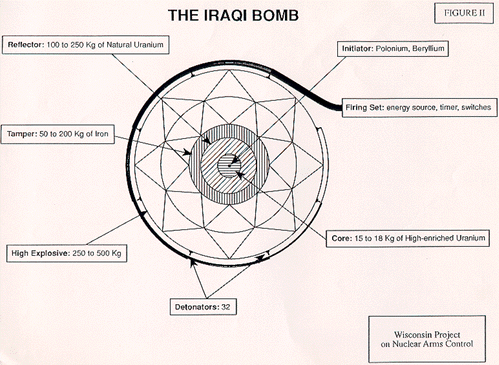
Manufacturing a first-generation bomb today is easier than it used to be. From secret documents discovered in Iraq, we know the design of the bomb that the Iraqis were building. We also know that Iraq fabricated a bomb part–a natural uranium reflector–that matched exactly the design of the reflector described in the secret documents.

The Iraqi design is strikingly similar–both in size and configuration–to the one China tested successfully in 1966 and gave to Pakistan in the early 1980s. After getting the design, Pakistan scoured Europe for steel spheres very close to the size of the sphere that the Iraqi design now uses. U.S. government analysts speculate that China’s design probably became known to Pakistan’s suppliers, and through them to the Iraqis. If so, China’s giant act of proliferation is still having its aftershocks. A sketch of the Iraqi design is attached as Figure II.

There are two things to keep in mind about the design: first, it works; and second, it is generally available to proliferant countries. This means that a country trying to make the bomb is already starting part way up the nuclear mountain. It can begin its effort with a design that works and then try to buy or make the parts. The main bottleneck, therefore, is acquiring the plutonium or weapon-grade uranium to fuel the bomb. This material is not easy to manufacture, and as far as we know, bomb quantities of it have not been for sale on the world black market. To stop proliferation, we must keep this material out of the hands of the countries we are worried about, or convince them to allow international inspection of any of it that they happen to acquire.

What, then, are the low-technology ways of delivering a bomb to an American target? We will assume that the bomb is about the size of a desk, and that it weighs about a ton. We can also assume that it will yield about twenty kilotons, which was the power of the Nagasaki bomb and also the estimated power of the planned Iraqi bomb.

Some of the possible means of delivery are listed in Figure III. I have tried to rank them in order of decreasing technical difficulty. The first is the classic case of the smuggled bomb. There is no reason why this would not work if done carefully. Bombs can be taken apart and put together safely.

One advantage of this option is that the bomb could be positioned wherever desired; one need not worry about the accuracy of a missile guidance system. Some of the other delivery methods are more limited with respect to positioning the bomb. I will go into that in a moment. The last entry of Figure III deals with missile technology, which is the most demanding technically. It could become more attractive, however, as cruise missile technology spreads. All of these options are within the means of a new nuclear weapon state.

To show the impact of a twenty-kiloton bomb on Washington, D.C., I have prepared Figure IV. The red circle has a radius of .6 miles, within which one could expect up to 90% immediate fatalities, based on the experience in Nagasaki and Hiroshima. The black circle has a radius of 1.6 miles, within which one could expect 30% fatalities and 30% additional injuries. Between 1.6 and 3.1 miles one could expect 1 to 2% fatalities and 10 to 25% injuries.

It makes a considerable difference where such a bomb is set off. If it were on a boat in the Potomac River, the effect would be different from that of a device set off in a building or van at Tenth and Pennsylvania, or on a plane approaching National Airport.

It is certainly within the power of Israel, and probably within the power of India, Pakistan and South Africa to deploy bombs more powerful than twenty kilotons. A fission bomb yielding one hundred kilotons would produce 90% fatalities roughly a mile in radius.

What conclusions can we draw from all of this? First, we should realize that there is really no defense against nuclear weapons. This, by the way, has been the position of every American president from Truman through Carter. If someone with a nuclear weapon wanted to deliver it to an American city tomorrow and set if off, we probably could not stop it. Thus, it is crucial to keep track of who has nuclear weapons and who is trying to get them.

Second, the low-tech delivery option has many advantages for a country with a handful of bombs. One is cost. It is much cheaper to buy a van, a boat, an aircraft, or even an office or apartment building than to buy an ICBM system. Another advantage is anonymity. A bomb in a building or a boat or a van would not leave much evidence. An American president would be reluctant to order a nuclear strike against another country without being certain where the bomb came from. It could take some time to figure this question out, especially if the FBI building is within the red circle. Forty months after the Lockerbie case we are still not certain who is responsible, and there was extensive physical evidence at the scene.

The doctrine of nuclear deterrence depends on knowing where an attack is coming from. If we look at the list of low-tech options, we see that the lower the technology the lower the risk of being detected, and therefore the lower the probability of being deterred.

Low-tech options can also be developed quietly. For India to develop an ICBM, there would have to be a series of long-range tests. The first test would undoubtedly set off a storm of opposition, and could easily end India’s access to the World Bank and International Monetary Fund.

Finally, if a country has only a handful of warheads, it will want to be sure they reach their targets. It would be more prudent to count on one of the low-tech methods than on an untried ICBM, which would itself be vulnerable to a preemptive strike.

The lesson, I believe, is that we should redirect our defense resources to counter the threats that are increasing rather than decreasing. We have already spent–and are still spending-billions of dollars to counter a Soviet threat that is disappearing, but we are spending very little to confront the growing nuclear threat from the developing world, which is not likely to include ICBMs.

To counter nuclear proliferation we must spend our money differently. We need, for example, better intelligence. Our intelligence on Iraq before the Gulf War was far too thin, and our intelligence now on North Korea is plainly inadequate. It is not acceptable to be told that North Korea is a closed society and therefore our government has no idea how close the country may be to making an atomic bomb. If we are going to protect ourselves during the rest of this century, we will have to improve our intelligence gathering.

We also need to fully fund the International Atomic Energy Agency–or even increase its funding–so it can carry out more aggressive inspections. And we need to fully fund the U.N. inspection effort in Iraq, a process that we cannot allow to fail.

In addition, we need to reduce the amount of nuclear weapon material circulating in world commerce. The more it circulates, the higher the risk that a few critical masses will go astray. Japan’s plans for plutonium shipments need to be canceled.

Finally, we need to tighten export controls. Iraq’s fantastic success in buying nuclear and chemical weapon and missile technology cannot be repeated. If we care about our cities, we cannot let that happen again.


Figure I

Possible Nuclear Threats to the United States
Able to reach United States
With ICBMs
Able to reach United States
With Low-tech delivery
Now In five years Now In five years
Undeclared
Nuclear
Weapon States:
India India India India [?]
Israel Israel Israel [None] Israel
Pakistan Pakistan Pakistan No
South Africa South Africa South Africa No
Threshold
Nuclear
Weapon States:
Argentina Argentina [?]
Brazil [None] Brazil [?] [None] [None]
Iraq Iraq [?]
North Korea North Korea [?]
Potential
Nuclear
Weapon States:
Iran
Libya [None] [Unlikely] [None] [None]
South Korea
Taiwan
Former Soviet
Republics:
Belarus Belarus Belarus [?] Belarus Belarus [?]
Kazakhstan Kazakhstan Kazakhstan [?] Kazakhstan Kazakhstan [?]
Ukraine Ukraine Ukraine [?] Ukraine Ukraine [?]
Declared Nuclear
Weapon States:
China China China China China
Russia Russia Russia Russia Russia

Figure II


Figure III

ATTACKING AN AMERICAN CITY WITH AN ATOMIC BOMB
THE LOW-TECHNOLOGY OPTIONS
A. Bomb parts smuggled into the United States and assembled:

* In a van or small truck and driven to the target
* On the upper floor of an office or apartment building

B. A bomb assembled elsewhere and delivered by:

* A truck or van entering the United States across the Mexican or Canadian border
* A yacht, cruise ship or cargo vessel entering port
* A cargo or passenger plane approaching National Airport and unwittingly carrying the bomb in a crate
* A private aircraft deviating from its approach to National Airport on a suicide mission

C. A missile launched from the deck of a ship:

* A Chinese-supplied Silkworm cruise missile (sold to Iran) could reach Washington from the deck of a freighter in the Chesapeake Bay, or could reach New York City or other American ports from 40 to 50 miles at sea.

Iraq’s Bomb, Chip by Chip

The New York Times
April 24, 1992, p. A35.

The U.S. Commerce Department licensed the following strategic American exports for Saddam Hussein’s atomic weapon programs between 1985 and 1990. Virtually all of the items were shipped to Iraq; all are useful for making atomic bombs or long-range missiles. United Nations inspectors in Iraq are still trying to find most of them. The list is based on Commerce Department export licensing records; the dollar amount of each transaction is as claimed by the exporting company. It was compiled by Gary Milhollin, a law professor at the University of Wisconsin and director of the Wisconsin Project on Nuclear Arms Control, and Diana Edensword, a research analyst at the project.

Atomic Bomb Builders

Sales to: Iraqi Atomic Energy Commission, the main atomic research laboratory; Badr and Daura sites, where bomb fuel was made; Al Qaqaa site, where detonators were made.

Canberra Elektronik: computers for measuring gamma rays and fast neutrons — $30,000

Cerberus Ltd.: computers — $18,181

Hewlett Packard: computers; electronic testing, calibration and graphics equipment — $25,000

International Computer Systems: computers useful for graphic design of atomic bombs and missiles — $1,600,000

Perkin-Elmer: computers and instruments useful for quality control of bomb fuels — $280,000

TI Coating Inc.: equipment for coating metal parts, useful for bomb production — $373,708

Atomic Bomb and Missile Builders

Sales to: Ministry of Industry and Military Industrialization, which ran the atomic bomb, missile and chemical weapon factories;Nassr state enterprise, where equipment for enriching atomic bomb fuel was made; Salah Al Din site, where electronic equipment for missiles and atomic bombs was made; Ministry of Defense, which oversaw missile and atomic bomb development.

Axel Electronics: capacitors — $84,000

BDM Corporation: computers; computer-assisted design equipment — $52,000

Canberra Elektronik: computers for computer-assisted design — $21,552

Carl Zeiss: microcomputers for mapping — $104,545

Consarc Corporation: computers to run machine tools capable of manufacturing atomic bomb parts (this sale was stopped by Presidential order in June 1990) — $525,550

Data General Corporation: computers for mapping — $324,000

Gerber Systems: computers to run machine tools capable of manufacturing atomic bomb and missile parts — $367,428

Hewlett Packard: computers for making molds; frequency synthesizers and other equipment useful for operating secured military communications systems — $1,045,500

Honeywell Inc.: computers — $353,333

International Computer Systems: computers for manufacturing, tool design and graphics — $4,497,700

International Computers Ltd.: computers — $687,994

Leybold Vacuum Systems: computer controlled welder used by Iraqis to produce centrifuges for making atomic bomb fuel — $1,400,000

Lummus Crest: Radio spectrum analyzers; design computers; computers for factories producing mustard gas ingredients — $250,000

Rockwell Collins International: equipment for navigation, directional finding, radar communications or airborne communications — $127,558

Sackman Associates: computers and instruments capable of analyzing metals and powders for atomic bomb and missile manufacture — $60,000

Siemens Corporation: computers and instruments capable of analyzing metals and powders for atomic bomb and missile manufacture — $78,000

Spectra Physics: lasers; detection and tracking equipment for lasers — $19,000

Unisys Corporation: computers — $2,600,000

Wild Magnavox Satellite Survey: computers for processing satellite images that are useful for military mapping and surveillance — $270,000

Zeta Laboratories: quartz crystals for military radar — $1,105,000

Missile Builders

Sales to: Saad 16, the main missile research site; State Organization for Technical Industry, the procurement organization for missile sites that bought most Scud missile parts and equipment.

BDM Corporation: computers; superconducting electronics — $29,405

Carl Schenck: computers — $10,228

EZ Logic Data: computers — $27,800

Finnigan MAT: computers that U.N. inspectors believe monitored uranium enrichment for atomic bomb fuel — $483,000

Hewlett Packard: electronic testing equipment; computers; frequency synthesizers; radio spectrum analyzers — $599,257

International Computer Systems: computers — $1,375,000

International Imaging Systems: computers for processing satellite data; infrared equipment capable of aerial reconnaissance and military surveillance — $988,000

Lummus Crest: computers to aid factory design — $44,320

Perkin-Elmer: computers — $24,560

Scientific Atlanta: equipment for producing radar antennas — $820,000

Semetex Corporation: computers — $5,155,781

Spectral Data Corporation: satellite data processing equipment — $26,880

Tektronix: high-speed electronics useful in developing atomic bombs and missiles; radio spectrum analyzers for developing microwave equipment — $102,000

Thermo Jarrell Ash Corporation: computers for testing materials — $350,898

Unisys Corporation: computers for production control — $7,796

Veeco Instruments Inc.: computers for factory design — $4,640

Wiltron Company: equipment for making radar antennas — $49,510

Building Saddam Hussein’s Bomb

The New York Times Magazine
March 8, 1992, p. 30

“About this big.” High in the United Nations building in New York, a U.N. official is holding his arms out in a circle, like a man gripping a beach ball. “About a yard across, weighing about a ton.”

This is the Iraqi bomb-slightly smaller than the one dropped on Hiroshima, but nearly twice as powerful-packing an explosive force of at least 20,000 tons of TNT. The official is dramatizing a drawing he has made in his notebook, based on documents seized in Iraq. He is sure that the bomb, if built to the specifications in the drawing, will work.

At the bomb’s center is an explosive ball of weapon-grade uranium. Around this is a layer of natural uranium to boost the yield and a second layer of hardened iron to keep the core from blowing apart prematurely. If the bomb is to detonate properly, these parts must have just the right dimensions, and there must be a firing circuit accurate to billionths of a second. Documents in the United Nations’ possession show that the Iraqis have all the right dimensions and the necessary firing circuit.

This is the bomb that, according to U.N. estimates, Saddam Hussein was 18 to 24 months from building when the gulf war started. It is the bomb he is still likely to build, despite the war and the most intrusive nuclear inspections in history, unless the United Nations changes its tactics.

“They are pouring concrete as we speak,” says a U.N. official at the next desk. Saddam, he says, is rebuilding the bombed nuclear sites in plain view of the U.N. inspectors. “He is even planting trees and re-landscaping,” he adds, “to boost employee morale.” Another U.N. official has a similar story. During a visit to the Iraqi nuclear weapon testing site at Al Atheer, he says, his Iraqi hosts looked him in the eye and said, “We are waiting for you to leave.”

Since the inspections started last spring, the Iraqi disinformation specialists who serve as guides have done their best to outfox the inspectors. In one instance, the Iraqis hid reactor fuel by loading it on the back of a truck and driving it around the reactor site, always staying about 200 yards in front of the inspection team. The fuel contained weapon-grade material.

Perhaps the most notorious confrontation occurred when inspectors followed an intelligence tip to a cache of sensitive documents. In an attempt to elude the Iraqis, each of the 44 team members hid a stack of papers inside his clothing. Rather than strip-search the inspectors before video cameras the Iraqis simply forbade them to leave, leading to a four-day standoff in a Baghdad parking lot under a scorching summer sun. Only alter a unanimous vote of support by the Security Council did Iraq finally relent.

That spirited encounter is now as much a part of history as the brief triumph or the 100-hour war. Under the cease-fire terms, inspectors for a U.N. Special Commission were charged with the “destruction, removal or rendering harmless” of Iraq’s nuclear weapon potential. But after months of chasing increasingly fruitless intelligence leads, morale on the Special Commission is scraping rock bottom.

The Iraqis know it, too. “They’ve started laughing at us,” one U.N. official says, adding that the Iraqis have even threatened individual inspectors. “They have basically told our people that they know where we live,” he says in exasperation.

The problem is that the inspectors have exhausted their information. The first inspections were fueled by leads from Iraqi defectors and the chance discovery of the sensitive documents in Baghdad. But that luck has run out just as the Iraqis have organized their resistance to the inspections. Recently, in fact, they told the inspectors that “you won’t find any more documents in this country.”

That remark came after a U.N. team had charged into several suspected reactor sites, following intelligence leads that turned out to be duds. “All we found were empty warehouses, cement factories making real cement and prisons with real prisoners,” one inspector says. The inspectors believe they have reached a dead end.

The inspectors’ defeat raises a chilling prospect: In the absence of a major new U.N. effort, Saddam Hussein is still likely to get the bomb. Thus, Iraq has become a test case for nuclear proliferation. If war and a full-court press by the United Nations cannot stop an outlaw nation like Iraq from making the bomb, what will it take to stop countries like Iran, North Korea and Libya?

In a sense, what is being played out in Iraq is the first battle of a new cold war, fought with spies, international pressure and export controls. The West may have won the first cold war against the Soviet Union, but it is losing the second to Iraq and other nations that want to get the bomb.

Saddam has hauled himself up the nuclear mountain on a chain of high-tech exports, sold by the very Western countries whose inspectors-now on loan to the United Nations-are trying to find them. Other similarly favored nations could easily follow Saddam’s example, given existing export laws. Iran and Libya are now maneuvering into this position.

Iraqi scientists know, for example, how to cast uranium metal into bomb parts in a vacuum furnace. The vacuum prevents molten uranium from burning in air. At Al Atheer, U.N. inspectors found vacuum furnaces made by a German firm, Arthur Pfeiffer Vakuum Technik. The inspectors rejected Iraq’s claim that the furnaces were for scientific research.

The inspectors also found a large “isostatic” press, made by a Swedish-Swiss firm, Asea Brown Boveri. This, too, the Iraqis claimed was for research. But the U.N. team thinks the machine was for shaping the high-explosive charges that set off a nuclear chain reaction. These specially shaped charges are wrapped around the bomb core and set off simultaneously, creating a shock wave that travels inward, “imploding” and compressing the core. When the core is compressed to sufficient density, the nuclear chain reaction begins.

How did the Iraqis learn to use such specialized equipment? In large part from the United States Government. In August 1989, the Pentagon and the Department of Energy invited three Iraqis to attend a “detonation conference” in Portland, Ore. Financed by American taxpayers, the meeting brought together experts from around the world to explain to the Iraqis and others how to produce shock waves in any desired configuration. There were even lectures on HMX, the high explosive of choice for nuclear detonation, and on flyer plates, devices that help produce the precise shock waves needed to ignite A-bombs. Both HMX and flyer plates have turned up at Al Atheer, which should surprise no one. The three Iraqis who attended the conference came from the laboratory that eventually provided Al Atheer with its first shaped charges.

To design a successful bomb, the Iraqis also needed computing power to solve the hydrodynamic equations that predict the behavior of shock waves. The inspectors discovered that Iraq was running the equations on a mainframe computer from the Japanese company NEC. Another Japanese firm, Hamamatsu, sold Iraq two “streak cameras,” sensitive instruments that can photograph a high-speed shock wave as it implodes. The inspectors confiscated both cameras after determining that they were rapid enough for nuclear weapon work.

Altogether, the Iraqis carried out 20 detonation tests before May 31, 1990 – the date of the last Iraqi progress report on Al Atheer found by the United Nations. The Iraqis had worked their way through five versions of the bomb design, cutting the weapon’s total weight from one ton in the first version to about half a ton in the last-light enough to go on a missile.

After May 1990 the Iraqis worked unimpeded at Al Atheer for eight more months. No one knows how much more they achieved. The Iraqis started relocating vital equipment before allied bombing began in January 1991, and as late as last summer tore out concrete floors to prevent inspectors from determining which machines were used there. They even ripped out electrical hookups to hide power usage. Now that Al Atheer is “sanitized,” inspectors fear the bomb work has moved elsewhere.

Wherever the work is going on, the Iraqis still have plenty of equipment. During the late 1980’s, Baghdad bought machines by the factory load, few of which have been found. The purchases included additional vacuum furnaces, from the German firm Leybold; plasma-coating machines, which could be modified to coat the surfaces of the molds into which molten uranium is poured, from the American company TI Coating; high-speed oscilloscopes, needed to develop firing circuits for nuclear weapons and for nuclear tests, from the American company Tektronix; and two X-ray diffraction systems, capable of analyzing weapon-grade uranium during production, from the German firm Siemens. TI Coating sold directly to an Iraqi factory charged with making A-bomb fuel; Tektronix sold to an Iraqi procurement agent for a string of nuclear and missile sites; Siemens sold to the Iraqi Ministry of Industry and Military Industrialization, which set up Al Atheer.

These purchases followed Iraq’s policy of “parallel sourcing.” The Iraqis never buy just one machine or build a single plant. If the item is important, they buy or build two. So if one vital machine or plant is bombed or surrendered to inspectors, they almost always have another.

The inspectors found out one other thing about the Iraqi bomb-it is highly unstable. The design calls for cramming so much weapon-grade uranium into the core, they say, that the bomb would inevitably be on the verge of going off – even while sitting on the workbench. “It could go off if a rifle bullet hit it,” one inspector says, adding: “I wouldn’t want to be around if it fell off the edge of this desk.”

Even a “fizzle,” when the bomb explodes too soon to get a full chain reaction, would be serious. The minimum blast effect would be equal to filling 20 semitrailers full of TNT, parking them side by side and setting them off simultaneously. The full yield would be like setting off 1,000 semitrailers’ of TNT.

With a workable and mostly tested bomb design, Iraq faces only one more barrier: weapon-grade uranium fuel. Iraq started producing this precious substance before the war, but never got close to making enough for a bomb. Whether it finally succeeds will depend on its foreign suppliers.

The key will be the centrifuge. By spinning uranium gas at high speeds, centrifuges separate light, unstable uranium isotope that explodes in an atom bomb from the heavy, stable one that doesn’t. A spinning tube called a rotor propels the heavy isotope to the outside wall and leaves the light one at the center. As the gas is run through a series of centrifuges called a cascade, the concentration of the light isotope is gradually raised from less than 1 percent in natural uranium to over 90 percent in uranium of nuclear weapon-grade. This technically demanding process is called enrichment.

Iraq’s centrifuges are based on German designs and were built with German help. Iraq somehow got German blueprints in the 1980’s. By 1988 it was already running experimental models. When one model developed a hitch in late 1988, Iraq summoned Bruno Stemmler, an ex-employee of M.A.N., the German company that makes centrifuges for the German national enrichment effort. After studying Iraq’s illicit blueprints, Stemmler removed the hitch.

Iraq’s next goal was mass production. It takes from 1,000 to 2,000 German-style centrifuges to produce a bomb’s worth of enriched uranium each year. German firms again obliged. From H & H Metalform – a company subsidized by the German Government – came “flow forming” machines that are specially adapted to produce rotor tubes, the most difficult part of the centrifuge to make. From Leybold’s American subsidiary came a giant electron beam welder, equipped with custom-made fixtures for welding the rotors to their necessary end caps. From Dr. Reutlinger & Sohne came machines to balance the rotors vertically and horizontally. From Neue Magdeburger came other specially adapted machine tools. And from Degussa came an oxidation furnace to treat the surfaces of parts so they could withstand corrosive uranium gas.

After surveying this glittering array, the U.N. inspectors concluded that Iraq would be able to produce more than 2,000 centrifuges a year, enough for a full-fledged bomb program. From a recent inspection, we know that Iraq ordered parts for 10,000 centrifuges, although it is not known how many parts were actually delivered, or how many centrifuges Iraq may have made.

The U.N. teams have now destroyed all the centrifuge parts it could find. But the inspectors don’t know how many more centrifuge parts there are, because they don’t know how many were sold to Iraq by Western companies. They are especially worried about a “missing cascade.” They assume that Iraq would not have built a plant to mass-produce centrifuges without first being able to connect them in an experimental cascade. No cascade has been found. As the inspectors warn in their report, Iraq “may still have an undisclosed program.”

The inspectors are also worried about a possible cache of weapon-grade uranium. Last July, they found four traces of this material in samples taken from Tuwaitha, Iraq’s primary nuclear site. Because of the possibility that the samples were contaminated after they left Iraq, however, the evidence was not considered conclusive. New samples were taken in October, but the test results are still not in. Thus, the U.N. inspectors cannot pursue the lead.

There is also the matter of a hidden reactor. Western intelligence sources believe that the Iraqis have at least started to build one, but the inspectors have not been able to find it. Even a small, 20-to-40-megawatt reactor would be large enough to fuel a few nuclear weapons a year.

And, finally, the inspectors are worried about outside suppliers. They have concluded that to stop Saddam permanently there must be “strict maintenance of export controls by the industrial nations.” But nothing in recent history suggests that the industrial nations will exercise such restraint.

In the five years before the Persian Gulf war, for example, the Commerce Department licensed more than $1.5 billion of strategically sensitive American exports to Iraq. Many were for direct delivery to nuclear weapon, chemical weapon and missile sites. Companies like Hewlett-Packard, Honeywell, International Computer Systems, Rockwell and Tektronix sold high-performance electronics either to Saad 16, Iraq’s major missile research center; to the Ministry of Industry and Military Industrialization, which set up Al Atheer; to the Iraqi Atomic Energy Commission, responsible for atomic-bomb research; or to Nasr State Enterprise, in charge of Iraq’s missile and nuclear procurement. Honeywell even did a feasibility study for a powerful gasoline bomb warhead, intended for an Iraqi-Egyptian missile.

The computer giant Sperry and its successor, Unisys, also benefitted. They got licenses to sell multimillion-dollar computers designed to handle a “personnel data base.” The powerful machines-ordered by Iraq’s Ministry of the Interior, which houses the secret police-are ideally suited to tracking and suppressing civilians.

The Commerce Department approved all these exports despite strong warnings from the Pentagon, the first coming in November 1986 concerning Saad 16. Commerce nevertheless permitted the sale of hundreds of thousands of dollars’ worth of sensitive computers and electronics to Saad 16, all after the warning.

And there was the strange case of the Badr General Establishment, a factory outside Baghdad. In the summer of 1989 it wanted to buy a computer-controlled lathe from Cincinnati Milacron and a high-accuracy measuring system from Brown & Sharpe. Badr said the equipment would make “crankshafts, camshafts, and gears” for automobiles. But the Pentagon was skeptical. Commerce therefore agreed to a “pre-license check,” in which an American official would actually visit the site.

After a 30-kilometer trip out from the capital, two embassy officials toured Badr with its production manager, Salam Fadl Hussain. The verdict was unanimous. The American Ambassador, April Glaspie, cabled the good news to Commerce on Sept. 13: “We believe that Badr General Establishment is a reliable recipient of sensitive United States origin technology and technical data.” We now know that Badr and another organization were jointly in charge of all the centrifuge production in Iraq.

As bad as the American record is, Germany’s is worse. Germany supplied more of Iraq’s mass-destruction machinery than all other countries combined. Germany not only sold Iraq most of its centrifuge equipment, it also furnished an entire chemical weapon industry and was Iraq’s greatest supplier of missile technology, including a flood of parts that enabled Iraq to extend the range of its Scud missiles. During the Persian Gulf war, enhanced Scuds hit Tel Aviv and a United States Army barracks in Saudi Arabia, killing 28 sleeping soldiers.

To develop an even longer-range missile, Iraq turned to the German armament giant Messerschmitt, now doing business as MBB (Messerschmitt-Bolkow-Blohm). MBB supplied the know-how for a 600-mile nuclear-capable missile called the Condor II that Iraq tried to develop jointly with Egypt and Argentina before the war. The missile’s range and configuration are similar to that of the American Pershing, which MBB worked on at the Pentagon. The same MBB employee who worked on the Pershing at the Pentagon also represented MBB in Iraq for the Condor, and thus was in a position tn transfer American missile technology to Baghdad.

Since the inspections began, critics have questioned whether civilian volunteers working under United Nations auspices could eradicate Iraq’s weapons of mass destruction. That question has now been answered. Despite great courage and enthusiasm, the inspectors still have not found the hundreds of Scud missiles Iraq is known to be hiding, or the headquarters of the centrifuge program, or exposed the supplier network. Nor have they solved the mystery of the weapon-grade uranium. Obviously, stronger methods are needed.

First, the United Nations has to change tactics. “We have diplomats when we should have detectives,” says a knowledgeable United States official. “It’s like looking for an escaped murderer. You question everybody who might have a lead and you keep on asking until you get answers.”

In other words, shift to police-style investigations. Only the Iraqis know where their nuclear treasure is buried; only they can reveal it. To make headway, the United Nations will have to deploy inspectors by the hundreds, station them in Iraq instead of New York, and use soldiers as well as civilians. The inspectors must be free to interrogate every Iraqi scientist or engineer who might have relevant information and to follow up the leads immediately. And they must have the power to push aside Saddam Hussein’s disinformation specialists.

The inspectors also need to know exactly what Iraq has bought. So far, though, not a single country has been willing to tell the inspectors what its companies sold. Only Germany has provided leads, and when it did, the inspectors quickly turned up centrifuge parts. As long as other suppliers sit on their export data, the inspections will be reduced to fishing expeditions, with the Iraqis steering the boat.

The United Nations must also put its own house in order. While the Special Commission has run the missile and chemical inspections with great zeal, the nuclear inspections are assigned to the International Atomic Energy Agency, the equivalent of an oxcart with its brakes on.

In late September, for example, the agency seized more than 60,000 pages of Iraqi documents, many of them describing the supplier network. Five months later practically no translations have been done.

The agency is also timid about destroying illicit equipment. While the Special Commission is destroying every machine it can find that the Iraqis bought, built or used to make chemical weapons or missiles, the Atomic Energy Agency has been willing to destroy only small parts of the machines used to make nuclear weapons. For example, Iraq bought a giant electron beam welder to fabricate centrifuges, but the agency destroyed only the small fixture that holds the centrifuge in place, leaving the giant welder intact. This means that if the Iraqis have extra fixtures – which is likely, given their parallel sourcing plan-they can go back into the bomb business with the same machines.

Assuming the United Nations does manage to eradicate Iraq’s nuclear, chemical and missile programs, it still faces the problem of preventing Baghdad from starting over. One solution is to expose Iraq’s supplier network, which is still intact. The United Nations has compiled lists of the companies in the network and what they sold, but it has furnished them only to the involved governments. The United States is reported to favor making the lists public, but Germany and France are said to be resisting.

Another way to defeat the network is to toughen export laws. Most of what Saddam bought was licensed. Governments knew he was getting dangerous equipment but hated to see their companies lose a sale. The resulting debacle should have taught the world a lesson, but Western export controls are no stronger now than they were before the gulf war. In fact, with the end of the cold war, the NATO countries and the European Community have been easing export controls.

The outcome in Iraq is now in the hands of President Bush and his gulf war allies. If they are willing to turn the United Nations into a vehicle for curbing the spread of the bomb, the battle in Iraq can still be won. If not, Iraq’s bomb makers will pick up where they left off, and the new world order will fail its first important test.