


Iran continues to obtain large volumes of electronic components and other commonly traded items with military applications through Hong Kong-based shell companies, despite a years-long effort by the United States and its partners to slow this trade. A novel policy by the U.S. Commerce Department’s Bureau of Industry and Security (BIS), first introduced in 2024 against Russia, was recently expanded to target diversion to Iran. It imposes export license requirements on all shipments of items controlled by Commerce to eighteen addresses in Hong Kong (and one in Turkey) that pose a high risk of diversion to defense industries. These “high diversion risk” addresses are associated with corporate service providers, known as company secretaries in Hong Kong. Company secretaries and similar corporate service providers are used by licit and illicit actors alike to incorporate companies, prepare their annual returns, and, in many cases, provide the companies with an address.
The policy’s goal is to make it harder for Russian and Iranian procurement networks to easily create new shell companies by incentivizing corporate service providers to stop servicing such networks, or risk their address being designated on the Entity List. The policy also aims to improve compliance by reducing the risk of an exporter supplying a newly created shell company based at the same address as its sanctioned predecessor. According to Kharon, a sanctions and compliance risk analytics firm, over 1,400 entities were based at the sixteen addresses in Hong Kong and Turkey listed by BIS in 2024, with some addresses hosting hundreds of companies.
In October 2025, BIS deployed the policy to explicitly target diversion to Iran, designating three addresses associated with the procurement network of Emily Liu, a Chinese national who has operated an arms proliferation network supporting Iran’s military, including its missile and drone programs, for nearly two decades. The network’s use of high diversion risk addresses illustrates the role company secretaries play in facilitating proliferation. The case also provides an example of the issue BIS seeks to solve by designating addresses associated with company secretaries, while highlighting the difficulty of keeping up with rapidly evolving procurement networks.
Emily Liu’s Network
Emily Liu (a.k.a. Liu Baoxia) was sanctioned by the U.S. Treasury Department in July 2017, along with three of her companies (Abascience Tech Co. Ltd., Raybeam Optronics Co. Ltd., Raytronic Corporation Limited) for procuring western-origin electronic components on behalf of Shiraz Electronic Industries (SEI). SEI produces radars and missile guidance technology for surface-to-air missile defense systems for the Iranian military and has been involved in procurement for Iran’s ballistic missile program. The full extent of Liu’s procurement network was only revealed in January 2024, when she and three co-conspirators were indicted in the United States in connection with the illicit procurement, since 2007, of thousands of U.S.-origin dual-use items on behalf of SEI and Rayan Roshd Afzar, an Iranian producer of components for Iran’s drone program.
Israeli strikes in October 2024 and Israeli and U.S. airstrikes last June destroyed much of Iran’s air defense capabilities, and Iran’s response depleted its missile stocks. As a result, the Liu network’s supply of electronic components to SEI has taken on renewed prominence as Iran attempts to rebuild its air defense systems through entities such as SEI and to replenish its drone and ballistic missile arsenals, which still rely on foreign-origin electronics.
To fulfill Iran’s need for foreign components, Liu’s network has used front companies based in China and Hong Kong, many of which are associated with high diversion risk addresses, to acquire items from U.S. manufacturers while concealing Iran as the final destination. Liu and her co-conspirators have relied on unscrupulous company secretaries to legally establish these front companies at addresses in Hong Kong, which gives the companies credibility in the eyes of potential U.S. suppliers.
One family of company secretaries in particular, based on the sixteenth floor of the Ho King Commercial Center in Hong Kong, has long supported the network and illustrates the problem BIS is attempting to address through its policy of designating high diversion risk addresses.
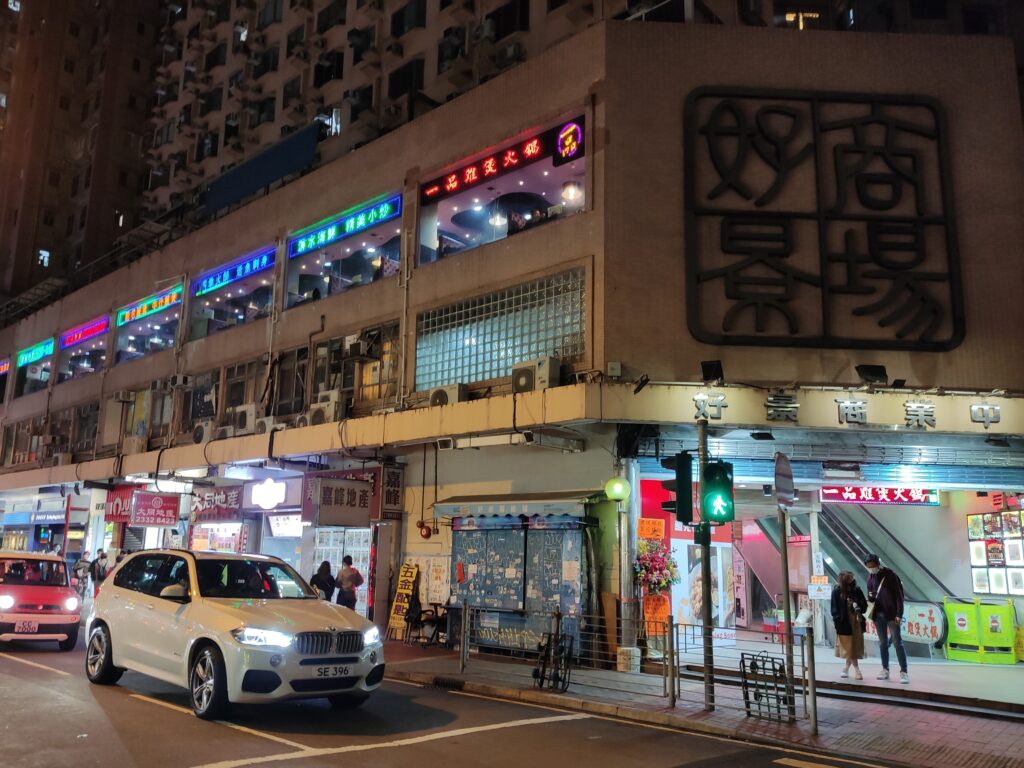
Room 1605, Ho King Commercial Center
The Ho King Commercial Center is a non-descript, 31-floor office building that hosts five of the eighteen addresses in Hong Kong designated by BIS as posing a high diversion risk. Company secretaries located in Rooms 1605A[1] and 1605,[2] addresses that were added to the Entity List in October for their ties to Liu’s network, facilitated the network’s illicit activities for nearly a decade.
In 2014, Emily Liu’s sister, Liu Baojuan, enlisted Hong Kong Vfon Business Technology Co., Limited, a company secretary based in Room 1605A, to serve as Raytronic Corporation Limited’s company secretary and to provide it with a Hong Kong address. The following year, Liu Baojuan registered Raybeam Optronics Co., Limited using Vfon and Room 1605A. While both companies were dissolved following their designation in 2017, the Liu network’s relationship with Room 1605 continued.[3] Shortly before Vfon (later renamed Shengang Business Secretary Limited) declared dormancy in 2023, its Chinese owner, Zhong Weifang, moved another one of his company secretaries, HK Jinzhong Business Group Limited, to Room 1605 to fill Vfon’s shoes and assume its email address.
In 2024, when Emily Liu’s brother-in-law, Hou Xueyuan, established Micro Device Co., Limited to support the network’s supply to SEI, he used HK Jinzhong Business Group as the company secretary. In October 2025, Micro Device was sanctioned by the U.S. Treasury Department for its role in the network.
In another example, Unico Shipping Co., Ltd. was established in Hong Kong in early 2024, using Jinzhong as its company secretary. In April 2024, Unico Shipping assumed ownership of the Shun Kai Xing, a ship used later that year to transport sensitive machinery bound for Iran’s defense industry and ultimately for the benefit of Rayan Roshd Afzar. In response to an inspection, Unico Shipping was prepared to falsify shipping documentation to obfuscate the Iranian end user. Unico Shipping was sanctioned by the U.S. Treasury Department in June 2025 in connection with the shipment.
By October 2025, when BIS designated Room 1605 as a high diversion risk address, the location and its family of company secretaries had supported over a decade of military-related diversion to Iran. Many of the entities that used the address (and the related company secretaries) had been publicly identified or sanctioned by the United States, though Room 1605 had yet to appear in sanctions listings until its addition to the Entity List. In January 2025, prior to Room 1605’s designation, Jinzhong relocated from Room 1605 and the Ho King Commercial Center to a different building in Hong Kong.[4]
Down the Hall at Office 4
The Liu network has also used a company secretary down the hall from Room 1605: Hongkong Tenyan Business Secretary Limited, located in Office 4 on the sixteenth floor of the Ho King Commercial Center. In 2021, Emily Liu’s brother-in-law, Hou Xueyuan, enlisted Tenyan as the company secretary for Innovia Electronic Technology Co., Limited, a supplier of electronic components used in Iranian missile and radar systems. Innovia’s original company secretary when it was established in 2017 was Hong Kong Vfon Business Technology in Room 1605. Innovia was ultimately sanctioned by the U.S. Treasury Department in October 2025.
In addition, Tenyan has provided a home for entities supplying Iran’s drone program, notably for a procurement network led by Iranian national Hamed Dehghan and his company, Pishtazan Kavosh Gostar Boshra (PKGB), which has acquired components used in Iran’s production of Shahed-series drones.[5]
Tenyan has serviced entities involved in diversion to both Iran and Russia, and its address was listed by BIS for diversion to Russia. In June 2024, BIS designated Office 4, 16/F, Ho King Commercial Center[6] as a high diversion risk address in connection with the significant transshipment of sensitive goods to Russia, including controlled electronic components and Common High Priority List items. The address has also been used by entities supporting Russia’s shadow fleet.
Looking Forward
The diversity of Jinzhong Business Group’s and Tenyan Business Secretary’s clients highlights the lack of due diligence carried out by certain company secretaries in Hong Kong and the value in requiring a license to export controlled items to their addresses.
There is some evidence that company secretaries have begun to respond to the BIS policy of designating addresses, although not always in the way BIS intended. In a sign of compliance, Jinzhong resigned as the company secretary for Micro Device and Unico Shipping about a month after their respective designations. On the other hand, nearly a month after its Office 4 address was added to the Entity List, Tenyan moved to a new address in a different building.[7]
To maximize the effectiveness of the policy, BIS could proactively designate new addresses associated with company secretaries that continue to service illicit actors as they move. While that may seem to mirror the burdensome practice of naming every shell company involved in illicit procurement as they pop up, it would cast a wider net with each designation, given the number of entities using the same address. Such a policy may provide company secretaries with an incentive to conduct better due diligence on their clients and disengage from those that violate U.S. sanctions and export control regulations, and therefore make it more difficult for proliferation networks to register shell companies.
Similarly, greater due diligence on the part of U.S. exporters to more comprehensively screen the addresses of parties in a transaction against those on the Entity List and of designated parties could also help. U.S. export control regulations require exporters to treat a near-match to an address on the Entity List or co-location with a designated entity as a red flag requiring additional due diligence. U.S. guidance also warns exporters to treat the co-location of multiple corporate entities at the same address as a red flag for potential diversion to Iran and Russia.
The diversion of western-origin components to Iran and Russia continues to sustain their drone programs. Despite attempts to diversify supply chains away from western-origin components in the face of four years of increasingly stringent sanctions and export controls, Russia is reportedly still dependent on western manufacturers for up to 40% of the components in its domestic version of the Iranian-designed Shahed-136, the Geran-2, which Russia deployed nearly 4,500 times last month against Ukraine.
Footnotes:
[1] Address 17 on the Entity List: Rm. 1605A, Ho King Commercial Center, 2-16 Fa Yuen Street, Mong Kok, Kowloon, Hong Kong.
[2] Address 18 on the Entity List: Room 1605, Ho King Commercial Center, 2-16 Fa Yuen Street, Mong Kok, Kowloon, Hong Kong.
[3] Vfon originally used Room 1605A on corporate documents before switching to Room 1605 around 2017.
[4] In January 2025, Jinzhong moved to Unit No.1732 on the 17th Floor, Star House, No.3 Salisbury Road, Tsim Sha Tsui, Hong Kong. In February 2025, Jinzhong relocated again to Portion 1 of Unit No.721A 7/F, Star House, No.3 Salisbury Road, Tsim Sha Tsui, Hong Kong.
[5] From 2021-2023, Duling Technology HK Limited, a front company in the network used to procure drone-related items, was based at the address and used Hongkong Tenyan Business Secretary Limited as its company secretary.
[6] Address 06 on the Entity List: Office 4, 16/F Ho King Commercial Centre, 2-16 Fayuen Street, Hong Kong.
[7] In July 2024, Tenyan relocated to Room 602, 6/F, Kai Yue Commercial Building, No.2C, Argyle Street, Mongkok, Kowloon, Hong Kong.